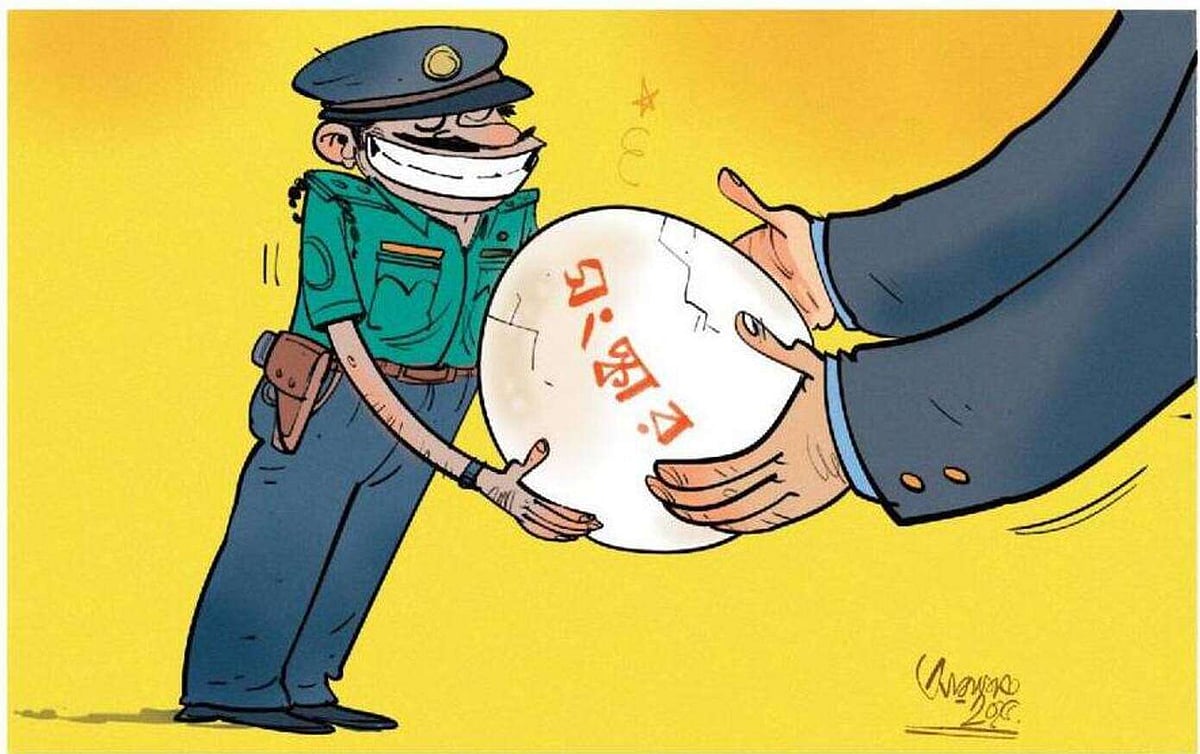
Bangladesh’s police force became further militarised during the recently ousted regime. The trajectory is rooted in the colonial era. Even today, the police operate under the 1861 Act enacted in the wake of the Sepoy Rebellion of 1857. The British designed the police force as a centralised, armed, semi-military institution, modelled on the “Royal Irish Constabulary” in Northern Ireland. The very birth of the police lay in repression, not in the protection of citizens but in their control.
The deposed Hasina administration used the police not as servants of the people but as an instrument to stay in power. The July uprising exposed their ferocious repression: semi-automatic rifles, submachine guns, and battlefield-grade ammunition were used on unarmed demonstrators. Hundreds of young lives were lost, a generation scarred. In consequence, senior police officials, complicit with the fallen regime, fled with their cohorts.
Mountains of arms, rivers of blood
An investigative report in The Daily Star on 10 August revealed how, in the years preceding the uprising, the police amassed a vast arsenal of lethal weaponry. Nearly Tk 2.4 billion was spent on submachine guns and semi-automatic rifles between 2021 and 2023. Expenditure on deadly arms was seven times higher than on non-lethal equipment.
Nearly Tk 2.4 billion was spent on submachine guns and semi-automatic rifles between 2021 and 2023. Expenditure on deadly arms was seven times higher than on non-lethal equipment.
During the July uprising, bullets were fired from semi-automatic rifles on unarmed citizens. The massacre shattered countless young lives, reminding the nation once again that the police remain a coercive instrument, not a service-oriented institution.
Policing rooted in society
History, however, offers alternatives. In Northern Ireland, birthplace of the old model, the Patten Commission, formed after the Good Friday Agreement in 1998, overhauled policing. It decentralised authority, established accountability through policing boards, and placed community engagement at the core.
Britain has no national police service. Instead, 43 regional police forces are overseen by locally elected Police and Crime Commissioners. They also control budgets and appointments. That is why legitimacy of the police force derives not solely from state power but from public consent.
In Japan, children trust the police rather than fearing them. In Denmark, Germany, and Canada, police officers are seen as partners of citizens, with emphasis on prevention over punishment. In Finland, surveys rank the police among the most trusted institutions.
In Sri Lanka, one of our South Asian neighbours, an independent National Police Commission was established during political turbulence. This commission worked to ensure oversight of recruitment, promotion, and discipline to insulate the force from political capture.
In India, the Supreme Court’s Prakash Singh ruling in 2006 mandated state-level complaints authorities, fixed tenures, and separation of investigative functions. Most states complied only partially. This suggests that without political will reforms falter.
When Home Ministry officials argue that an independent commission would mean “no control,” the depth of the problem becomes clear.
Post-war Sierra Leone widely restructured its police force, creating an Independent Police Complaints Board and introducing “Local Needs Policing”.
In the United States, following the 2014 killing of Michael Brown in Ferguson, President Obama’s Task Force on 21st Century Policing recommended body cameras, community oversight, and de-militarisation. Yet reforms remained uneven, resisted by police unions and hindered by political polarisation.
Cosmetic reforms
The interim government set up a Police Reform Commission in October 2024. Its recommendations—aligned with UN peacekeeping standards—included mandatory body cameras, safeguards against warrantless searches, reforms in interrogation, and transparent recruitment. Yet tellingly, the National Consensus Commission did not deliberate on police reform.
The central question is not simply about enhancing efficiency, but how to transform the very ethos of policing. Real reform requires remaking the police into a democratic, service-oriented institution dedicated to the people.
This is not possible by paper reforms, imposed from above. Genuine transformation demands decentralisation—bringing authority and accountability to the community. Without decentralised autonomy, reforms remain cosmetic and hostage to narrow interests. Decades of political control and patronage have hollowed the institution from within.
Structural changes
Transforming the police into a true civil service demands more than new training or modern equipment. For this, at least four structural changes are essential: firstly, an Independent Police Commission, established constitutionally, beyond the control of the Home Ministry; secondly, repealing of the Colonial-era laws including the Police Act of 1861 and the Criminal Procedure Code of 1898, is essential. Those will have to be replaced with rights-based legislation; thirdly, a mindset shift—from adversaries to partners, where police and citizens share responsibility; fourth, decentralisation—a roadmap to gradually place policing under local government, ensuring authority and accountability rest with the people.
When Home Ministry officials argue that an independent commission would mean “no control,” the depth of the problem becomes clear. This controlling power should not rest with a single ministry but with the people, exercised through democratic, community-led institutions. A centralised body is easily captured by narrow interests, whereas a decentralised civic service embedded in communities is far more resistant to abuse.
The police are the most visible face of the state. In Bangladesh, that face has long instilled fear through force rather than trust through service. This culture of fear must be dismantled. In a democratic republic, policing must be redefined—not as authoritarian control but as civic service.
Imagine a future where schoolchildren greet police officers with trust, not trepidation. That day, the police will truly have transformed into a civil service.
* Dr Rashed Al Mahmud Titumir is Professor, Department of Development Studies, University of Dhaka
* The views expressed are the author’s own.