Why can’t I speak perfect Bangla—does that make me guilty of something?
I grew up asking myself this question over and over. But later I realised that, given where I was raised, being able to speak Bangla at all, right or wrong, is something wonderful. Surely, Bangla speakers who try to learn a new language can relate to this feeling.
However, when I began losing opportunities in life simply because I couldn’t speak “perfect” Bangla, I realised this was a form of discrimination. I, too, have been a victim of linguistic inequality.
Being judged and left out because of language has hurt me deeply—it still does. And this is not merely a personal grievance; such discrimination stands as an obstacle to the success of an entire generation.
Linguistic and identity-based discrimination
Since childhood, I have faced bias due to my hill-tribe accent. Once, during a recitation competition at school, the judges repeatedly asked me to pronounce the word Taka (money). Each time, I said taka, unable to articulate it the way they wanted.
Later, after enrolling at university, a teacher once asked me which college I attended. I replied twice, “Chattogram Government Women’s College,” but both times the teacher heard “Chauddagram Government College.”
Growing up in the hills of Khagrachhari, my accent naturally bears the mark of that region. Still, I try hard to speak Bangla “properly.” Yet mistakes slip out unconsciously. I often struggle with certain consonants—like T, Th, t, and sh, ṣ, Sh. My mother’s tongue differs slightly from Bangla, and this linguistic gap shows in my speech. Because of that, native Bangla speakers tend to judge me in two ways.
The first group finds my speech “cute,” like a foreigner’s halting attempt at Bangla. The second mocks and ridicules my pronunciation.
I was born in Khagrachhari, into the Chakma community. My ethnic features are Mongoloid—something I had no hand in. Yet when I came down from the hills to the plains, these very traits became barriers. Despite being a citizen of Bangladesh, my friends, relatives, and I have often been mocked as “Chinese,” “Chingchong,” “Myanmar people,” or “dependent tribes.”
Whenever someone from the hills comes to Dhaka for the first time, or whenever an incident occurs in the hill districts, such ridicule intensifies. As a result, most minority ethnic groups tend to confine themselves to small social circles, even in big cities. They are forced to suppress their limitless potential as human beings.
Educational inequality between hills and plains
The hills do not offer the same access to higher education as the plains do. Even after 48 years of independence, it was not until 2019 that a student from the Khumi community of Bandarban had the chance to attend a public university.
And now, in 2025, the first Khumi woman has been admitted to Shahjalal University of Science and Technology. Similar educational disparities exist among the Santal, Orao, and Garo communities of the plains as well.
People from hill districts are often compelled to travel to Dhaka or Chattogram for higher education and healthcare. Despite working just as hard, they face intensified gender discrimination, social ridicule, and insecurity.
Gender identity and social inequality
Owing to cultural tradition and social norms, gender discrimination is relatively low in the hills. Growing up in such an environment, I was shocked to discover, upon arriving in Dhaka, how gender identity functions here. Simply being a woman exposes one to various risks—especially the fear of sexual assault when going out at night. On top of that, there is constant social ridicule.
During my participation in various projects, NGO programmes, and self-development initiatives, I noticed that men are often given preference.
Moreover, during the Dhaka University Central Students’ Union (DUCSU) elections, I was subjected to verbal abuse, obscene remarks, and cyberbullying on social media. All this, simply because I am a woman.
Economic inequality and the conflict of aspirations
My childhood and adolescence were marked by economic hardship. In fact, such hardship defines the lives of most people in my community. I wasn’t born with a silver spoon in my mouth.
Yet, through the help of many kind people, I made it all the way to Dhaka University. I am still struggling financially, fighting for a better life.
But when I look around, I see thousands of young men and women like me—losing their boundless potential to poverty.
If the state had ensured every citizen’s basic rights, this young generation could have contributed far more to the country. We would not be witnessing so many dreams die prematurely—dreams whose deaths only add to the nation’s burden.
Inequality in the social system
As a human being, I want to move forward, to fulfil my potential like every other citizen of this country. Yet the systemic discrimination we face in society and the state keeps holding us back.
If you look different, if you are not like everyone else, if you were born in the hills, if you are poor, if your opinions differ from the majority’s—then society assumes you are “abnormal,” and discrimination against you becomes “normal.” Our lives are trapped in this vicious cycle.
Many people think such inequalities are natural occurrences in society. But they are not natural, they are made to seem natural.
If Bangladesh truly aimed to ensure equality, dignity, and security for all its citizens as guaranteed by the Constitution, we would have seen that reflected in society by now. Yet this remains the state’s fundamental responsibility.
During the July mass uprising, people across the country demanded that the state finally fulfill its duties. But even after the uprising, the state still fails to provide equal access to quality education, economic equity, or healthcare for all citizens.
This indifference of the state continues to perpetuate superstition, communal attitudes, and the dominance of powerful groups. While there have been some scattered efforts to reduce inequality, no coordinated movement has yet emerged. The dream of an egalitarian Bangladesh that we nurtured after the uprising seems to be slipping away.
The dream I have
Bangladesh can move forward only when it strives to nurture every individual into an aware, educated, and humane citizen of the highest standard.
I dream of a Bangladesh where people treat one another with compassion—where everyone can build their own life freely; where the state ensures access to quality healthcare, education, work, and all basic rights for every citizen.
With all that I have achieved, I want to dedicate myself to building a better Bangladesh for the days ahead to create a safe and beautiful country for every new-born child.
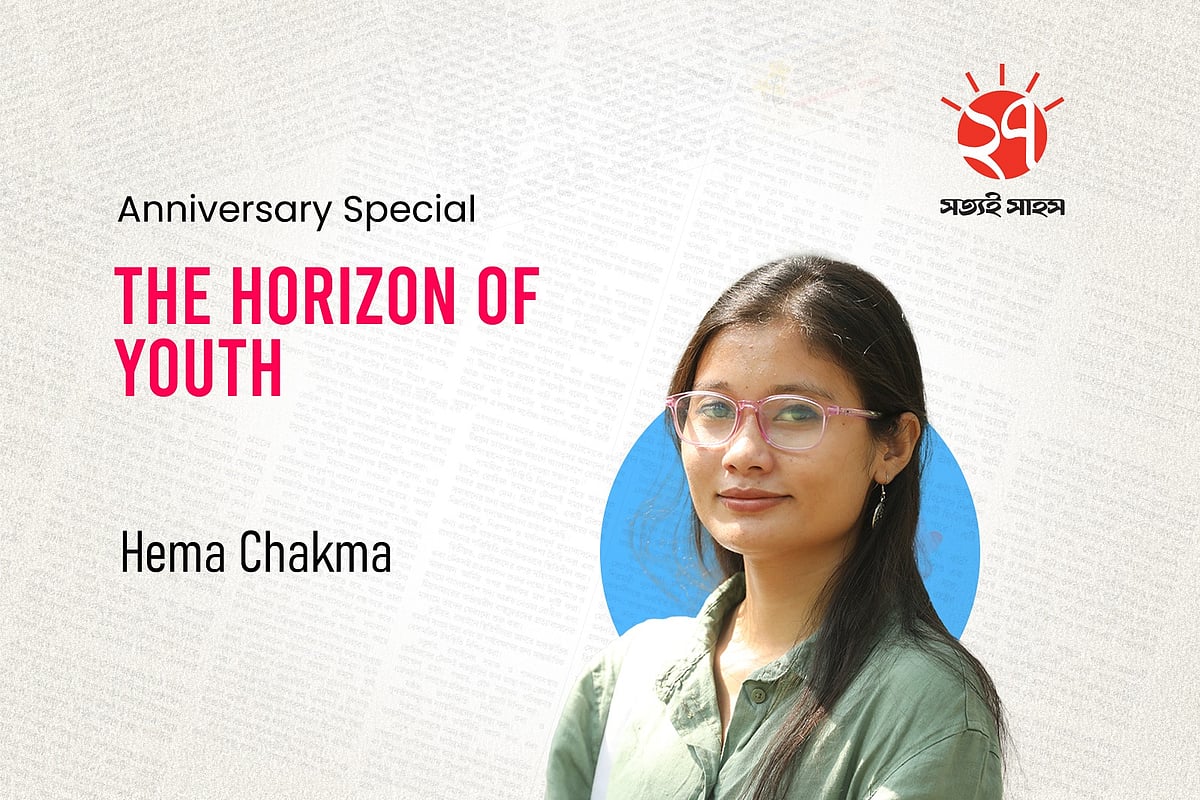
* Hema Chakma is an executive member of Dhaka University Central Students’ Union (DUCSU)