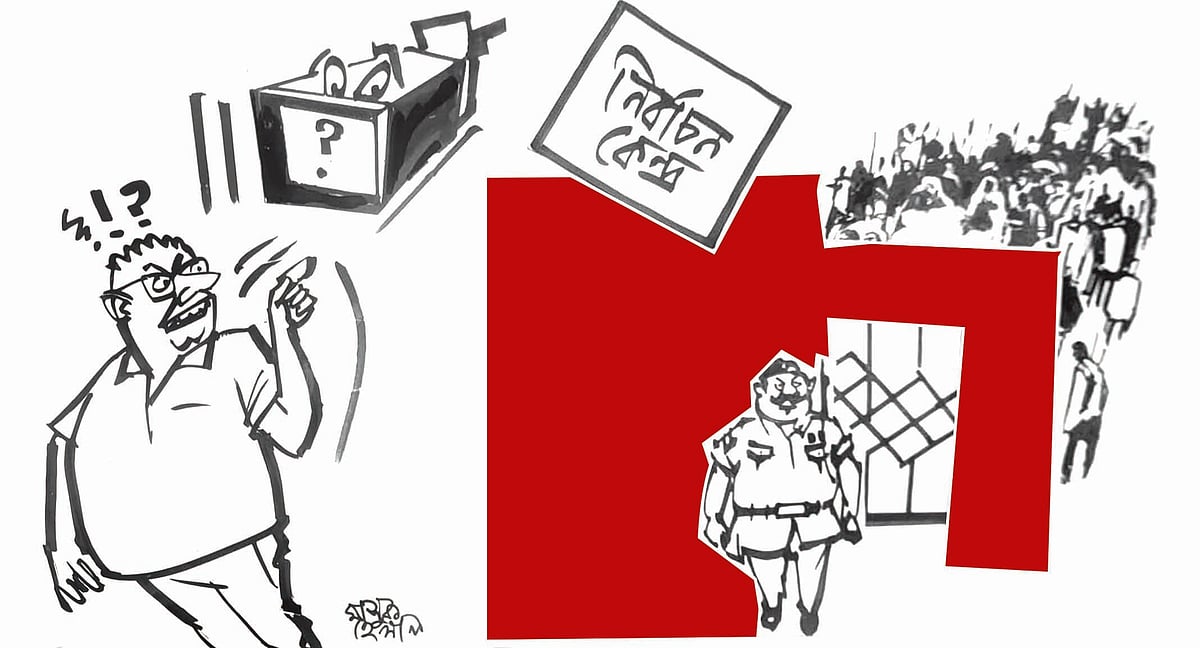
The national parliamentary elections and referendum are going to take place on 12 February. The government is making extensive arrangements for this. One of these involves spending approximately Tk 720 million to install CCTV cameras in risky centres (Prothom Alo, 21 January 2026). This is a piece of news. The question is, what do we mean by risky? The simple meaning is that there could be disturbances at these centres, which could disrupt the voting process. To prevent this, there will be strict monitoring.
By reviewing CCTV footage, the nature of disturbances and those creating them can be identified. It seems the government wants a peaceful election, and citizens want the same. So who doesn’t want it? Surely, there are some people who do not want us to live in peace.
An election is like a battle. In a battle, there are no rules and regulations. When there is a war between multiple United Nations member states, international law decides its arbitration and settlement. There are several charters for this, but not all adhere to them. Those who have more power can attack others if they wish. The UN can only watch and make statements during such times.
An electoral battle is somewhat similar. The stronger one attacks the weaker ones. Occupying polling centres, expelling or preventing the entry of opponent candidate agents from the centres, stamping one's symbol on ballot papers at will to fill boxes with votes by using their own people, threatening or assaulting officers on duty if obstructed, running away with ballot boxes on their heads, or if necessary, beating, hacking, or even shooting opponent workers or supporters are all possible.
Past elections have shown such scenarios. The Election Commission declares centres where such incidents are more likely as risky. There is an attempt to cover these centres with a security blanket using CCTV cameras. Previously, it was heard that law enforcement officers would be provided with body cameras. On television and in films, we see that soldiers in some Western countries have cameras on their helmets. It might be somewhat similar. Certainly, these involve a lot of expenses.
Candidates spend millions of taka during elections. This money is not being plucked from trees or falling from the sky. It is coming from the public. Either the public’s deposited money is being taken from banks as loans and siphoned off, or people are being forced to pay extortion. Those who don't repay borrowed money are called defaulters; in simpler terms, bank looters. Names of some defaulters are floating around. There has been talk about how their candidacy remained in the Election Commission. Questions have also been raised about dual citizenship, stating that while our people were stopped, theirs were let off—what kind of justice is this?
A lot of money will be spent on buying body cameras and CCTV cameras. The candidates will not provide this money; the government will. The government doesn't have a factory to make money. The money will come from the people. In other words, supporters of candidates will act thuggishly at polling centres, and commit vote theft. And to see how this happens, voters will supply the cameras. But what if vote thieves break the CCTV cameras or run off with them? Will the police or military catch them?
If there was fear of police or military, why would cameras be needed? In reality, these thieves are not afraid of the police or military. Otherwise, such misdeeds would not have occurred in the name of elections over the last five and a half decades. Here’s an example on this point.
The first vote in this country after independence took place on 7 March 1973. An account of that day was published in newspapers the following day. A summary of the report is as follows:
‘Most polling centres in Dhaka city became empty by 11 AM. Faced with terrorism, voters voluntarily refrained from voting. However, the same faces appeared at polling centres repeatedly, unbothered. Mizanur Rahman, an employee of Kohinoor Chemical's store department, voted four times. During a short visit to the Mohakhali-3 polling station, this representative witnessed the same individual casting votes for numbers 232, 233, 234, 235, 236, 84, 413, and 119.
When questioned by me, the presiding officer replied, "The opposition polling agents are silent; I only have one head on my shoulders, so why unnecessarily risk leaving my family and dependents orphaned in this dire financial crisis!’ (Gonokantho, 9 March 1973)
This was a brief picture of one out of many polling centres. Cameras might capture this, if they remain intact till the end. But how will the disruptions occurring on the way to the polling centre be monitored? Will law enforcement officers patrol? Will goons flee in fear upon seeing them? Can they patrol everywhere 24 hours a day? Is this possible? Then how will goons be stopped?
In past elections, it has been seen that clashes and killings mostly happen after the election is over. Those who lose attack supporters of opponents out of anger. Those who win also attack opponents to showcase their power. In most cases, the victims of their brutality are women and religious minorities. Minorities are already marginalised. During elections, the sky falls on them. They are in trouble if they vote and in trouble if they do not.
In one election, a candidate called the minority leaders of his area and asked, ‘Will you vote for me?’ Everyone looked at each other, not daring to say ‘no’. They all replied in unison, ‘Of course, we will vote for you.’ The candidate smiled and said, ‘I’ve already got your votes. Since you’ll vote for me, there is no need for you to bother to go to the polling station.’ The minority community members didn’t go to the polling centres, and all their votes were cast in favour of that candidate.
The situation for women is somewhat the same or likely worse. There is a proclamation by community leaders that virtuous women are forbidden from crossing the threshold of their homes. Newspapers report that women in 26 villages of a particular district voted for the first time, or women in 32 villages of another district didn’t go to polling centres. Even after one-fourth of the 21st century has passed, this becomes headline news in this desolate country.
A neat and beautiful election can happen. But there is a ‘what if’. If all candidates behave civilly, I see no reason for the election not to be good. If they don’t indulge in coercion or violence, there is no need for any camera or CCTV. But this is a mere fantasy.
The brave have hit the fields determined to win. Some who haven’t received party tickets have even contested independently. They have long dreamed of becoming a Member of Parliament. Those who have been in Parliament before know what honey exists there. Those who haven’t been also know that a honeycomb waits for them too.
*Mohiuddin Ahmad is a writer and researcher.
*Opinions expressed are the author’s own.
#This article, originally published in Prothom Alo print and online editions, has been rewritten in English by Rabiul Islam.