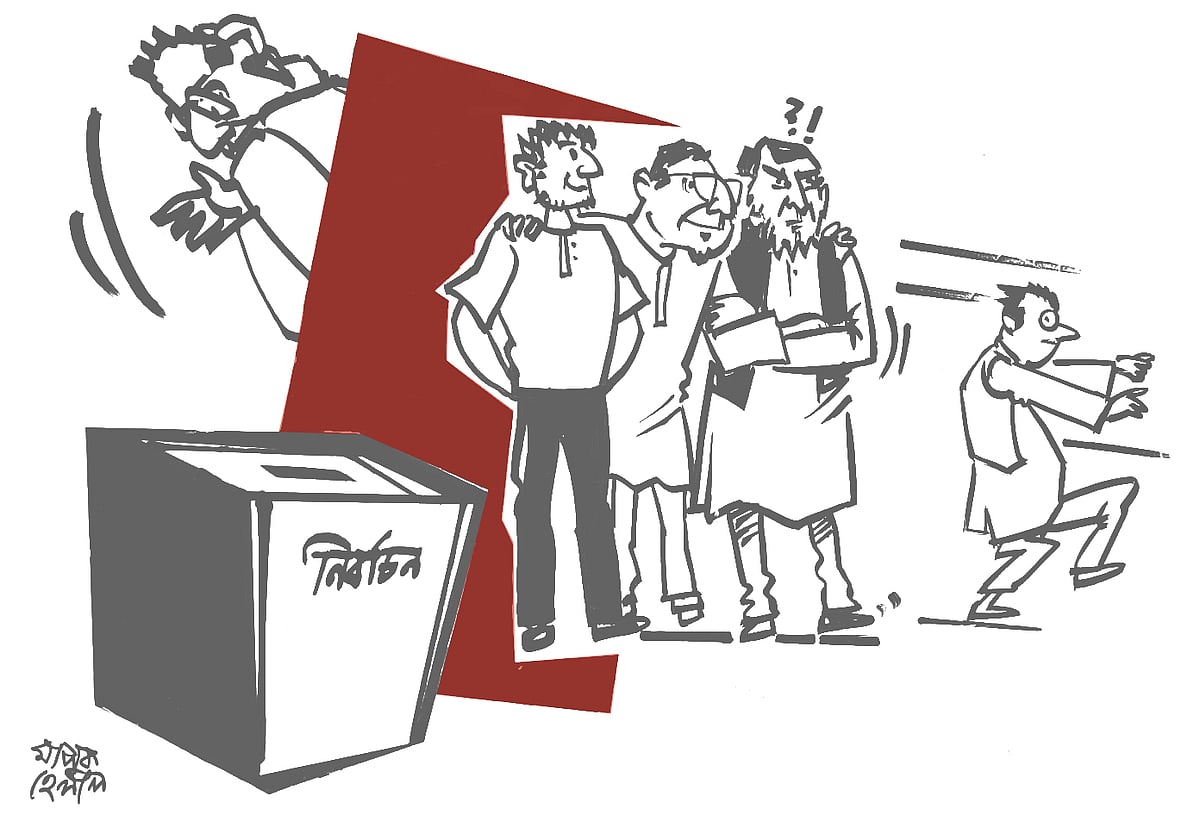
I was abroad for a fortnight. In Australia’s Sydney and Melbourne, among the Bangladeshis I met, the first anxious question on everyone’s lips was: will there be an election at all? Later, however, certain developments back home convinced them that there is no alternative to an election. In particular, after Tarique Rahman’s return to the country, most people have assumed that the election will indeed be held within the stipulated timeframe.
It may be recalled that the decision to hold the 13th Jatiya Sangsad (national parliament) election in the first half of February 2026 was taken at a meeting in London between Tarique Rahman and interim government’s chief adviser Muhammad Yunus.
In Sydney, I spoke with several expatriate Bangladesh Nationalist Party (BNP) leaders. Some of them have already returned home, while others are preparing to do so in order to work in their respective constituencies for their party candidates. Their interest lies less in voting by postal ballot and more in ensuring the victory of their party nominees on the ground.
About three weeks ago, it was evident that the BNP and its allies were locked in considerable tension over seat-sharing. Failing to secure favourable terms in negotiations with the BNP, some parties, including the NCP (National Citizen Party), gravitated towards the Jamaat camp. Others announced the formation of separate alliances or declared their intention to contest independently.
Given the scale at which the election commission initially cancelled candidatures, it was widely assumed that many aspirants would be seriously disadvantaged. Later, however, the commission adopted a more conciliatory stance and, one after another, reinstated many previously rejected nominations. This brought a sense of relief to the BNP camp, as their candidates constituted the majority of those initially disqualified. There is little precedent in the past for such a large number of nominations being cancelled at scrutiny only to be subsequently reinstated.
Fresh strains have now emerged within the Jamaat camp over alliance politics. Jamaat-e-Islami initially announced that it would form an alliance with all parties outside the BNP. That effort failed. It was then claimed that all religion-based parties would rally behind Jamaat, but this, too, proved elusive. Jamiat Ulema-e-Islam had already chosen to remain under the BNP umbrella, where it felt more secure.
Jamaat’s success, however, lay in bringing on board several parties outside the sphere of religious politics. Most notably, the NCP, known as the party of the July fighters, and Colonel Oli Ahmed’s LDP (Liberal Democratic Party) joined hands with Jamaat. Those who once branded Jamaat a party of collaborators (Razakar) are now aligning themselves with it. At an individual level, many think, Jamaat has also sought to partially atone for its 1971 legacy by recruiting former BNP leader and freedom fighter Akhtaruzzaman, and by nominating Krishna Nandi, a leader from the Hindu community, as a candidate.
Yet which party will be able to demonstrate the strength and capacity required to defeat its rivals and secure victory in the electoral battlefield is now becoming clearer to many observers. According to reports in Prothom Alo, after protracted wrangling, bargaining, and a series of last-minute meetings, 10 parties have reached an electoral understanding under the leadership of Jamaat-e-Islami. The Islami Andolan, which had been involved in the initiative from the outset, ultimately did not remain part of it.
At a press conference on Friday, party leaders announced: “Islami Andolan Bangladesh has submitted nomination papers in 270 constituencies for the upcoming 13th national parliamentary election. Of those, two candidates have been rejected on appeal. The remaining 268 parliamentary candidates are currently campaigning. We have instructed them to contest the election. None of them will withdraw their nomination papers.”
On Thursday, the Jamaat-led 10-party alliance announced candidates in 253 constituencies, leaving 47 seats vacant. At that point, they still hoped that Islami Andolan would remain within the alliance. Friday’s announcement, however, confirmed that Islami Andolan is contesting independently and will not join any alliance.
Under the declared electoral arrangement, Bangladesh Jamaat-e-Islami will contest 179 seats on its own. Of the remaining seats, the NCP will contest 30, Bangladesh Khelafat Majlis 20, Khelafat Majlis 10, the LDP seven, the AB Party three, and the BDP and Nizam-e-Islam Party two seats each. Some seats will remain open.
With the aim of bringing Islamic votes “into a single ballot box”, Jamaat, Islami Andolan and initially eight, later 11, parties had attempted to forge unity. Despite repeated rounds of meetings and discussions following the submission of nomination papers on 29 December, no agreement could be reached. Intensive talks over the past week, including an all-night meeting on Wednesday, also failed to produce a final settlement between Jamaat and Islami Andolan. Ultimately, seat-sharing was finalised with 10 parties, excluding Islami Andolan.
Even earlier, the absence of Jamiat Ulema-e-Islam had diminished the prospect of consolidating all Islamic votes. Now, with Islami Andolan contesting separately, the Jamaat-led alliance faces a formidable challenge.
Whatever the organisational strength of Islami Andolan and the followers of the Charmonai Pir, they command a definite number of votes in every constituency. While this may not be sufficient to secure victory for their own candidates, it will certainly play a decisive role in determining wins and losses.
Observing the current state of the Jamaat alliance brings to mind the 1991 election. Ahead of that contest, the Awami League, then the most dominant force in field politics, mishandled alliance negotiations through excessive bargaining with its partners. Many parties from the 15-party alliance withdrew, and those who remained were often treated in a stepmotherly fashion.
In 1991, Khaleda Zia’s charisma contributed significantly to the BNP’s victory, but the Awami League’s defeat was also attributable to the arrogance of its leaders and the fragility of its alliance. In many constituencies, candidates from allied parties stood against Awami League nominees.
The 13th national parliamentary election is being held in a very different context. With the Awami League’s activities banned, the party cannot participate in the election. A divided Jatiya Party is also unlikely to mount a serious challenge. In that case, the electoral contest is expected to be between the BNP and its allies on one side, and the Jamaat-led 10-party alliance on the other.
In this new political alignment, it would be self-destructive for any party to assume that victory is already in the bag.
Finally, I believe it is necessary to raise a question about a contradiction in the position of the NCP, the party of the July fighters. The party has submitted a memorandum to the election commission demanding the cancellation of the nominations of Jatiya Party candidates, labelling them collaborators of an autocratic regime. Yet within the 10-party alliance are parties that participated in the farcical “Me-Dummy” election of 2024. Although those parties may not be fielding candidates this time, the alliance has promised to evaluate them in the future, a position that the NCP has accepted. The question, then, is this: if the Jatiya Party were to seek entry into the 10-party alliance, would it too be specially evaluated?
* Sohrab Hassan is a journalist and poet.
* The views expressed are the author’s own.