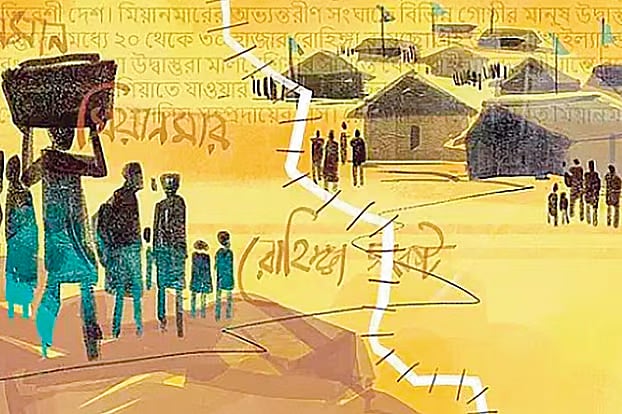
Since the year 2022, the date 25 August has been observed every year in Bangladesh as ‘Rohingya Genocide Day.’ On this day in 2017, Myanmar’s armed forces launched indiscriminate attacks on the Rohingya religious and ethnic minority, killing people, committing rape, setting homes on fire and looting property.
For years the Rohingyas had been victims of persecution and discrimination. The Myanmar government launched ‘Operation Clearance’ with the aim of wiping them out entirely. As a result, about 750,000 Rohingyas crossed into Bangladesh and took refuge.
Bangladesh on the one hand set an example of fulfilling humanitarian responsibility. On the other hand, the long-term sheltering of such a vast displaced population has placed Bangladesh under economic and political pressure
The United Nations and international courts have termed this brutal massacre, a ‘genocide.’ Yet this classification of the crime has not brought any qualitative change to the lives of the Rohingyas who have endured inhuman conditions in camps for eight years.
Two notable reasons for this predicament are:
a. The lack of legal recognition from the Bangladesh government as ‘refugees’; and
b. The failure to take any effective international measures for resolving the Rohingya crisis, particularly due to the stance of powerful South Asian countries such as India and China regarding Myanmar’s accountability.
2.
There are certain political, legal, and diplomatic reasons behind the Bangladesh government’s decision not to grant the Rohingya population formal recognition as refugees.
Bangladesh is not a signatory to the 1951 Refugee Convention or its 1967 Protocol. Therefore, under international law, the Bangladesh government had no legal obligation to grant refugee status to the Rohingyas who arrived in 2017. Instead, Bangladesh defined them as “Forcibly Displaced Myanmar Nationals.”
As a sovereign state, Bangladesh has allowed the Rohingyas to live not as refugees, but as temporary asylum-seekers. While this process has drawn humanitarian assistance from the international community, it does not oblige Bangladesh to provide them with permanent settlement.
Furthermore, the then Bangladesh government believed that by not granting the Rohingyas refugee status, it was diplomatically sending a message to Myanmar that the Rohingyas’ permanent home lies in Myanmar. For that reason, Myanmar would have to take responsibility for their repatriation, even if delayed.
By opening its borders and providing shelter to hundreds of thousands of Rohingyas in several phases, Bangladesh on the one hand set an example of fulfilling humanitarian responsibility. On the other hand, the long-term sheltering of such a vast displaced population has placed Bangladesh under economic and political pressure, due to increased population burden in Cox’s Bazar and Chattogram, environmental damage, economic strain, and a rise in criminal activities.
3.
The objective behind the decision not to recognise the Rohingyas as “refugees” has, to a large extent, failed due to various internal and international complexities. A notable reason for this is the absence of effective intervention from the two influential neighboring countries, India and China. Behind this lie several geopolitical, economic and strategic factors.
China and India consider Myanmar an important partner in their efforts to expand influence in Southeast Asia. For China, Myanmar is one of the key corridors of the Belt and Road Initiative (BRI). On the other hand, India seeks to use Myanmar as part of its “Act East Policy.”
China is one of Myanmar’s largest investors, with massive investments in ports, mines, gas and infrastructure. India, meanwhile, is involved in the Kaladan Multimodal Project and other road connectivity initiatives in Myanmar.
Beyond these projects, both countries view Myanmar’s geographic location as strategically important for various reasons. Therefore, fearing potential harm to their respective interests if pressure were applied, China and India have prioritised their geopolitical and economic interests over humanitarian concerns in the Rohingya issue.
4.
It is not only India or China, but Russia's veto along with that of China at the UN Security Council that ensured that Myanmar escaped major international punishment. Even so, in December 2017 the then UN human rights chief indicated that Myanmar had carried out genocidal attacks against the Rohingya population and mentioned the need for preventive monitoring.
In August 2018, the UN Human Rights Council’s fact-finding mission published its report, stating that the actions of Myanmar’s military against the Rohingyas demonstrated “genocidal intent.” The crimes identified included genocide, war crimes, and crimes against humanity, all serious international crimes.
On 22 December 2018, the UN General Assembly passed a resolution. Referring to the fact-finding mission’s report, it expressed “serious concern” over the Rohingya situation and called for an investigation into whether crimes of genocide had been committed. However, this was not an “official recognition”; it was presented rather as a conclusion based on specific observations.
5.
Myanmar ratified the Genocide Convention in 1956. Under Article 9 of this Convention, The Gambia filed a case, which allows disputes between parties concerning state responsibility for genocide to be submitted to the International Court of Justice (ICJ).
On 23 January 2020, in the case of The Gambia vs. Myanmar, the ICJ issued provisional measures. These required Myanmar to prevent any acts of genocide against the Rohingyas, halt unacceptable conduct by its security forces, and preserve evidence of attacks against the Rohingyas.
While this was a significant legal recognition, it was not the final judgment. The case remains at a preliminary stage. Once both parties complete their written submissions, oral hearings will be held where The Gambia and Myanmar will present their arguments before the Court.
After considering the legal arguments, the Court will deliver its final ruling, which may take several more years. Although ICJ cases are conducted between states and the Court has no jurisdiction to carry out criminal investigations, such cases can nonetheless contribute to the cause of justice and play a preventive role against future crimes.
6.
The International Criminal Court (ICC) has jurisdiction to prosecute individuals (such as heads of state, military chiefs, or politicians) for crimes. Even so, the ICC has not been able to prosecute any individual linked to the Myanmar government.
The reason is that Myanmar did not sign or ratify the Rome Statute of 1998. However, since Bangladesh is a party to the Rome Statute, and because the forced expulsion of the Rohingyas took place partly on Bangladeshi territory, the ICC has gained jurisdiction to investigate the crime of “forced deportation.”
Since 2019, the ICC has been conducting a preliminary investigation into these allegations, but no final report has yet been submitted. In November 2024, the ICC Prosecutor’s Office filed an application seeking an arrest warrant against a senior Myanmar military leader.
However, whether or not an arrest warrant will be issued depends on the judges’ decision. It is not possible to say precisely how many years the investigation might take to gather sufficient evidence for a potential arrest warrant or a summons to appear before the Court.
7.
Within the political and legal framework of refugee protection, there is a principle of “burden sharing,” which calls for responsibility to be distributed among all states. Under this principle, countries are expected to share responsibilities in a balanced way to address refugee protection and related challenges, so that no single state bears a burden beyond its capacity.
Regrettably, in the case of the Rohingya crisis, responsibility has not been shared equitably. For many years Bangladesh has been carrying the main burden, while the international community has failed to provide adequate or coordinated support for repatriation and humanitarian assistance.
The primary reasons for this imbalance in responsibility-sharing include:
Myanmar’s persistent refusal and ongoing political instability that prevent granting the Rohingyas citizenship and ensuring their safe return; insufficient international funding; and the practical challenges of managing a protracted refugee situation.
These factors are creating long-term political and economic pressures on Bangladesh and are fueling growing discontent among the local population. In the current reality, voluntary repatriation of the Rohingyas remains uncertain, while it has become nearly impossible for Bangladesh alone to bear the responsibility of such a vast population.
To improve this complex situation, Bangladesh needs to continue effective diplomatic dialogue with Myanmar and other concerned countries. At the same time, it must make every effort to draw the attention of the international community and human rights organizations. Without such efforts, the Rohingya crisis in Bangladesh will slide further into uncertainty.
*Umme Wara is Associate Professor, Department of Criminology, University of Dhaka
The views expressed are the author’s own.