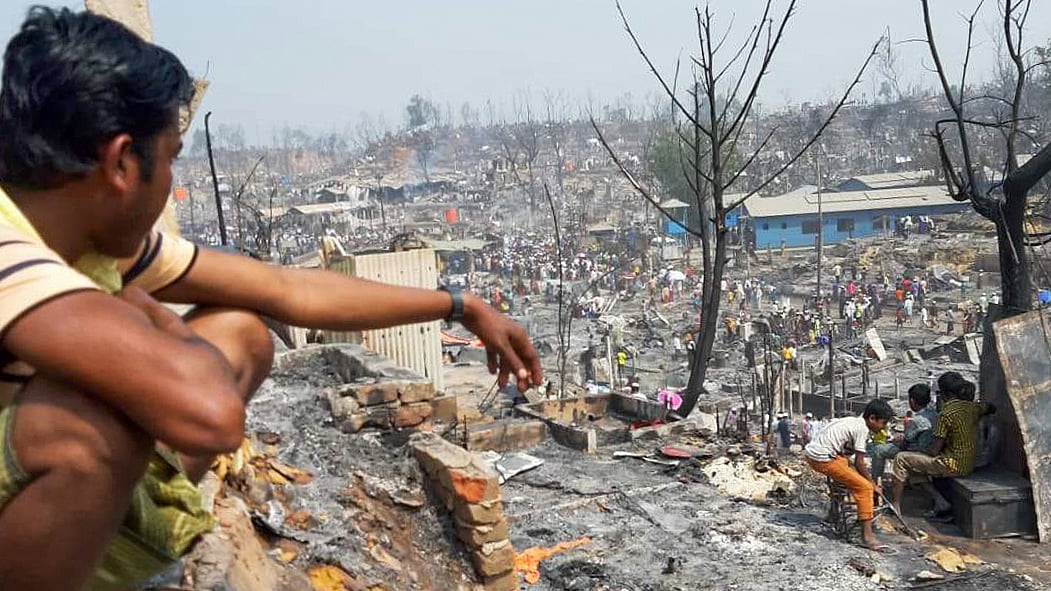
It has been nearly four years since Rohingya people were forced to leave their homes in Myanmar and take shelter in Cox’s Bazar. It was a vicious military crackdown that made them flee their homeland where they had been living for centuries. UN called the brutalities they encountered in 2017, “a text book example of ethnic cleansing”.
Over the years, life in the camps has changed a lot, particularly in terms of living conditions. Different support systems have been developed to ensure better protection in the camps. Yet this is a life of humanitarian refuge in a country to which they do not belong.
With the current political turmoil in Myanmar and the recent incidents of fire in the camps at Cox’s Bazar, in a sense their aspirations to go back are becoming more pressing. And many rights activists and experts are also assuming that if the current anti-coup movement for democracy in Myanmar succeeds, safe repatriation of Rohingya refugees to their homeland may turn into a palpable possibility. However, after nearly four years of living in Bangladesh, with all these mounting uncertainties over their head, what are the Rohingya refugees thinking about their future?
Most Rohingya refugees are grateful to Bangladesh for the love, solidarity and support they received in 2017 and for the humanitarian refuge Bangladesh has rendered to them. Some are also aware that in their prolonged stay here, they are becoming burden for Bangladesh. “Before coming to Bangladesh in 2017, we never thought that we will get so much love and support at that terrible moment. Bangladeshi people assisted us so much when we arrived here but now it has been nearly four years, how long will they tolerate us?” says Shamsu Alam, a 45-year-old Rohingya man.
Given the recent devastating fires in the camps, they are feeling more vulnerable as their households and belongings burned to ashes. “Our houses got burned down, we lost everything, where will we go? It would have been better if we could die,” says 35-year-old Rohima Khatun. A kind of frustration and despondency is growing as they lost whatever little shelter and belongings they had.
It is difficult to understand how it feels to be a refugee because we are not always conscious of the state authority, the identity and protection our state provides us. But refugees like the stateless Rohingyas can truly feel what it means to have a state identity. Though they lived there for centuries, recognition of their ethnicity and identity have been denied. So, for decades they were pushed aside in Myanmar, lived a life of no rights and suffered widespread persecution and discrimination. Now they are living as refugees in another country – a life nobody wants to live.
People often say things like they are being given free food, other necessary items and support in the camps and they are living well. But in truth, it is a living with bare minimum. They have nothing of their own here and are fully dependent on aid– a life where they keep waiting and waiting for aid, and for the time to come to go back to their home country.
Many Rohingya people have lost hope about going back to Myanmar as they are well aware of Myanmar military junta and the country’s treatment towards them very well. In their memory, the atrocities and persecution by their state that they encountered for years and especially in 2017 are still alive. They are pretty sure that Myanmar is not likely to welcome them with their rights as the military junta again takes over the country. If their lands, houses and rights are not given back, they think it is safer to stay in the camps in Bangladesh than to live in the camps in Myanmar. Because, to them, Myanmar is the notorious exploiter and abuser who cannot be trusted for protection and Bangladesh is like a protector and it has always been.
Most refugees are uncertain about their future. They often helplessly say God knows what will happen to us. As the solution to their crisis lies in Myanmar but, as a state, Myanmar is politically getting more chaotic. With the current political situation in place, as more people are now fleeing Myanmar, Rohingyas’ hopes to go back home are turning bleaker and uncertainty is mounting in their minds. However they all want to go back if their rights are met, lands are given back and protection ensured. “We do not want to live here anymore, we want to go back if our houses and lands are given back to us but God knows what will happen”
Most of the Rohingya people had vast land property in Myanmar where they cultivated crops, animals and fish. In terms of livelihood and natural resources, life was easy there in Myanmar. But the way modern states increasingly try to make the life of its citizens progressive, easy and comfortable, Rohingya people did not get such facilities from Myanmar. On the contrary, they were systematically deprived, oppressed and persecuted. And sometimes, being nostalgic, they share how they lived in Myanmar and how destitute they have been here.
Naturally, human beings have adaptability. They get used to whatever situations they live in. Such has been true for Rohingya people in the camps. If anyone from outside goes to visit camps and see their lifestyle in the camps, one can easily perceive how miserably they live. As they continue to live in the camps, people are growing, families are extending. Consequently they need more place to build homes but the places are quite limited and commercialised as well. On top of that, some sort of hostility is growing between Rohingya and the host communities in Ukhiya and Teknaf.
Nobody chooses to be a refugee unless they are forced to be so. It is what people of the world should understand. We should be empathetic – meaning we should be sensitive and understanding about the emotions and the suffering the refugees are going through.
* Parvez Uddin Chowdhury is a protection worker and researcher. He can be reached at p.uddinchy@gmail.com