Opinion
Staple food vs. Cash crops: The dichotomy
Is agriculture a business? Are food grains commodities within that business? Then, what will happen when food-grain production becomes less profitable? If producing food grains offers farmers lower returns, why would they continue to grow them?
If farmers are considered agricultural entrepreneurs, why wouldn’t they produce crops that generate higher profits? An entrepreneur is expected to allocate resources where better return is anticipated. So, why would a farmer continue growing food grains when other crops are more profitable?
Here lies the paradox! And therein lies the irony- who will grow our food?
From the individual farmer’s perspective, shifting the production of food-grain to cash crop, may be entirely a rational economic decision. However, when many farmers would make the same rational decision, it could result profound implications for food security and, ultimately, human survival.
At this point, a fundamental tension emerges- a dichotomy between ‘private profitability’ and ‘public food security’.
It is important to remember that food grains (staple grain- in our case, rice) are not simply commodities traded within a market economy. They carry a different level of economic and political significance because food security is ultimately linked to human survival. The production and supply of staple food grains also have a subtle yet intricate connection with the political and social stability of a country.
So, returning to the question of cash crops, a decision that may be economically rational for an individual farmer, when replicated across many farmers, can have profound consequences for society as a whole. The pursuit of individual profit may, therefore, create collective vulnerability.
And this leaves us with a difficult question: would it be wise to treat agriculture merely as a business? More importantly, is it safe to leave the production of staple foods entirely to the logic of profit?
Historic agrarian tradition of rural Bangladesh
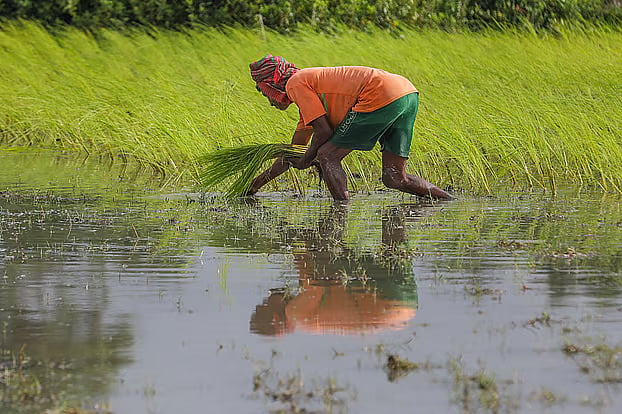
The rural agrarian landscape has traditionally followed an integrated farming system centered on the staple grain - paddy. Paddy has historically been cultivated across the major growing seasons, with Rabi crops, such as mustard, lentils, chickpeas, spices, and potatoes- grown in between. Alongside field cultivation, households often maintained kitchen gardens to grow vegetables for household consumption. This diversified farming system enabled households to meet not only their own food needs but also those of their livestock.
Rice cultivation also supported livestock rearing through its by-products: paddy straw, husk, and other crop residues served as important sources of animal feed. Thus, paddy was not merely a staple food crop; it was an integral part of a broader, interconnected rural food and livelihood ecosystem
Taking stock of land and livelihoods
Now, if we take a stock of land ownership and occupation among farmers, the Sixth Agricultural Census (2019) reveals a highly unequal distribution of agricultural land in Bangladesh. Approximately 11.33% of households do not own any land, while nearly 40% of farm households are entirely landless tenant farmers. Marginal and smallholder farmers, who constitute around 41% of farm households, operate only 11% of the country’s agricultural land. Ironically, 6% (approx.) of large farmers control nearly one quarter of the country’s arable land. Overall, around 40% of the rural population is classified as landless.
From an individual farmer’s perspective, shifting from rice to more profitable crops may be a perfectly rational economic decision. But if this transition occurs at scale, rice cultivation may gradually decline
Again, at the global level, smallholders are estimated to account for 50–70% of food production and play a critical role in sustaining food systems. Smallholders, therefore, are not peripheral actors in agriculture; they are central to how food is produced and how food systems function.
So, if smallholders increasingly operate as agricultural entrepreneurs and shift towards more profitable cash crops, what happens to the food-security ecosystem of densely populated Bangladesh—a country where dietary diversity remains limited and rice constitutes the overwhelming staple of everyday food consumption? The warning signs are alarming.
If we now consider the large landless population who possess inherited agricultural knowledge and skills but little or no land, the traditional staple-grain-centred agrarian system provide them with opportunities to work on others’ farms. They cultivate paddy as agricultural labourers or through adhi (sharecropping arrangements). Depending on the locality and the nature of the arrangement, they were compensated in cash, kind, or through a share of the harvested crop, most commonly rice.
In this way, the historical rural agrarian economy is not merely a system of crop production; it is an interconnected livelihood system within which land, labour, livestock, seasonal crops, and informal arrangements of exchange and sharing of labour meet basic subsistence needs. Food is produced, exchanged, earned, and shared through a web of interdependent relationships, sustaining both livelihoods and local food security. This system may not have eliminated rural poverty or hunger, but it provided functional mechanisms where the landholding and landless households could sustain their basic livelihoods and food consumption.
But what happens when profit takes precedence? What might happen in the long run if farmers, particularly smallholders, are gradually encouraged to shift towards high-value cash crops such as mangoes, dragon fruit, avocados, capsicum, cherry tomatoes, and many others?
Farmers, quite understandably, will be attracted by the prospect of higher returns. From an individual farmer’s perspective, shifting from rice to more profitable crops may be a perfectly rational economic decision. But if this transition occurs at scale, rice cultivation may gradually decline, the consequences could extend far beyond the individual farm.
The concern is not that farmers should refrain from pursuing profitable crops. Rather, the real concern is what happens when profitability begins to displace food security as the primary logic of agricultural production.
It is important to note that rice is not simply another agricultural commodity in Bangladesh. It is the foundation of the country’s staple food system and a critical component of household food security. A substantial decline in domestic rice production could increase dependence on markets and imports, may create upward pressure on rice prices, and disproportionately affect low-income households whose diets are heavily dependent on rice.
And this brings us back to the paradox:
- What is economically rational for the individual farmer may not necessarily be optimal for society as a whole.
- If every farmer is encouraged to maximise individual agricultural returns, who will grow the food that the country needs to eat?
Now the question is- why should farmers be expected to sacrifice their own profits for the food security of others?
No doubt, farmers, like any other economic actors, need economic agility. They must be able to respond to markets, prices, climate conditions, production costs, and livelihood opportunities. Expecting them to continue producing less-profitable food grains simply to safeguard the food security of others is neither economically sustainable nor necessarily fair.
Where Does the Responsibility Lie?
Here lies the larger responsibility: the state and the broader agricultural system must step in. Ensuring national food security cannot be left to individual farmers alone, nor can farmers be expected to sacrifice profitability indefinitely for the sake of feeding the nation.
Given the strategic importance of food-grain production for a densely populated LMIC such as Bangladesh—particularly amid geopolitical tensions and potential disruptions to global food supplies— there must be a functional subsidy mechanism that makes paddy cultivation economically viable, especially for smallholder farmers.
• The mechanism should be targeted and subsidy-based, with priority given to smallholder farmers who are most vulnerable to rising production costs and market risks.
• Much of Bangladesh’s high-yield paddy cultivation depends on irrigation, making farmers particularly vulnerable to rising irrigation and energy costs. Targeted subsidies for irrigation and other essential production inputs could therefore help keep rice cultivation economically viable.
• Support for quality and climate-resilient seed varieties is equally important. If farmers are to continue cultivating paddy, they need access to improved seeds that can increase yields while helping them cope with changing climatic conditions.
• Climate risk also needs to be addressed. Farmers cannot be expected to absorb the full cost of climate-induced crop losses. Crop insurance for paddy, particularly schemes designed to protect smallholders from climate-related shocks, could provide a critical safety net and reduce the financial risks of continuing food-grain production.
However, production support alone is not enough. Marketing systems, procurement mechanisms, and price stabilization policies also need to be strengthened.
Why could we not establish an accessible “crop bank” or community grain bank, where farmers could deposit surplus rice after harvest and receive payment or financial support in return?
The objective, therefore, should not be to prevent farmers from pursuing more profitable crops. Farmers deserve economic agility. The challenge is to create an agricultural system in which producing essential food grains remains economically viable alongside other profitable agricultural opportunities.
Food security is a public good. If the nation needs farmers to grow food for everyone, the nation must also ensure that growing food is a viable livelihood for farmers.
This brings us to another fundamental question: who should bear the cost of the country’s food security?
We, as taxpayers, contribute to the national economy with the expectation that public resources will be invested for the country’s collective wellbeing. But how much of that contribution is effectively directed towards the smallholder farmers who produce the food that sustains us? If food security is a national priority, why should a portion of public resources (tax payer money) not be deliberately earmarked to support those who produce essential food grains?
Perhaps it is time to think beyond conventional agricultural subsidies and imagine a more farmer-centred food-security mechanism. We have already built an extensive network of public services—from helplines and police stations to community clinics and other institutions—designed to reach communities through a nested, locally accessible system. Why not develop a similar mechanism for farmers to safeguard their staple crops?
Why could we not establish an accessible “crop bank” or community grain bank, where farmers could deposit surplus rice after harvest and receive payment or financial support in return? Such a system could allow farmers to retain enough grain for household consumption while providing a secure and reliable channel for managing their surplus.
As we know, the government already operates public procurement and grain-storage mechanisms in Bangladesh. However, the governance of these systems remains a concern. The challenge is to make them more accessible, transparent, predictable, and genuinely farmer-friendly, particularly for smallholders.
If we want the farmers to continue producing the food grains that feed us, should we not be willing to pay a price that makes food production economically worthwhile for them?
The Alert
An aggressive shift towards cash crops warrants caution. We already have examples - mango orchards in the north and shrimp cultivation in the south. Both have created economic opportunities, but they have also generated far-reaching ecological, social, and socio-cultural consequences. In some contexts, these transformations have also been ignited deeply rooted gender inequalities and gender-based violence.
The lesson is not that cash crops are inherently undesirable. Rather, the challenge is to maintain a rational balance between profitability and food security. That needs to be guided by appropriate regulation and impartial oversight.
Throughout modern history, environmental failures, radical state ideologies, and wartime crises have repeatedly triggered devastating famines. The Irish Potato Famine (1845–1853), the Soviet Ukraine Holodomor (1932–1933), the Bengal Famine (1943), the Great Chinese Famine (1959–1961), and the Ethiopian Famine (1984–1985) all occurred because staple grain production and distribution networks failed.
Certainly, we need profit. We need to make productive use of the land and natural resources available to us. But there must be a balance, wise calculation, visionary thinking, and strong regulation. After all, economic profitability should ultimately serve life-making, rather than come at the cost of it. People’s hunger should never be collateral for the capital economy.
* Masuma Billah PhD Candidate, Utrecht University, The Netherlands
* The views expressed here are the author's own