Language is not static. It flows, bends and reshapes itself with time, much like a river that absorbs new streams while leaving some old channels behind. The Bangla Slang Dictionary, compiled under the initiative of Amin Rahman and his collaborators, is a valuable attempt to document one such living stream of language: the rich and colourful slang of Dhaka and its surrounding regions.
At first glance, slang may appear to belong to the margins of language. It is often informal, sometimes playful, occasionally irreverent. Yet history shows that many expressions once dismissed as slang eventually become part of accepted language. Conversely, when formal expressions fade from everyday speech, slang frequently takes their place in daily communication. For that reason, a dictionary devoted to slang is not merely a catalogue of colourful phrases; it is an important linguistic record of how people actually speak.
This dictionary serves a particularly useful role in bridging two linguistic communities. On one side stand the traditionalists who are accustomed to standard Bengali and may find certain colloquial expressions unfamiliar or puzzling. On the other side is a younger or more locally embedded community of speakers who naturally employ slang in everyday interaction. By presenting standard Bengali words alongside their slang equivalents, the dictionary allows readers from both groups to better understand each other.
As someone who grew up in a village on the outskirts of Dhaka but has lived outside Bangladesh for more than five decades, I found my own experience with this dictionary both surprising and enlightening. While browsing through its pages, I discovered that many of the slang words sounded unfamiliar, even foreign, to my ears. Part of this is no doubt due to the simple fact that I have not been immersed in everyday speech in Bangladesh for many years. In other cases, the expressions themselves appear to be relatively new, coined long after my early years in the country.
For me, therefore, this dictionary became more than just a reference book. It opened a window into how my mother tongue has continued to evolve during my long absence. It reminded me that language never stands still; it moves forward with each generation, absorbing new influences, new humour, and new modes of expression.
In that sense, the dictionary performs another valuable function: it reconnects those of us living abroad with the linguistic pulse of contemporary Bangladesh. By providing a clear guide to these expressions and their meanings, it equips readers like me with a practical tool. I have little doubt that during my next visit to Bangladesh, this knowledge will help me communicate more comfortably and confidently with the younger generation.
The editors also deserve credit for the care with which the material has been assembled. The inclusion of phonetic transcription and careful categorisation adds scholarly value to the work and makes it useful not only for casual readers but also for those interested in linguistics and dialect studies.
Slang, by its very nature, is dynamic. New words will inevitably emerge, while others will fade away. But that is precisely why works such as this are important. They capture a living snapshot of language at a particular moment in time.
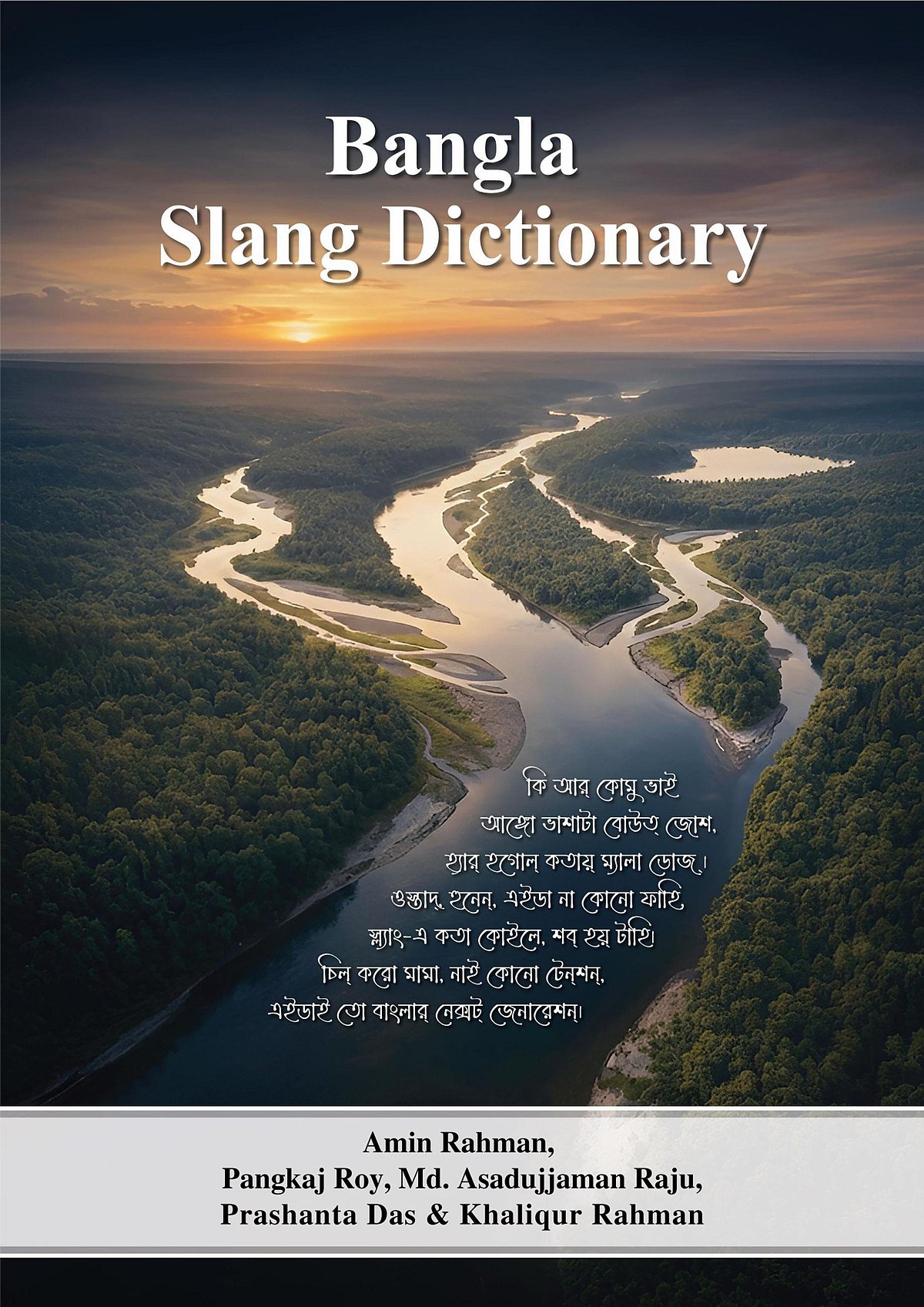
The cover of the book deserves a brief mention as well. It features a striking image of a winding river, an apt visual metaphor for language itself — constantly flowing, branching and reshaping its course over time. Superimposed on this landscape is a short poem written entirely in Bangla slang. The playful lines celebrate the ease and confidence with which the younger generation uses slang in everyday speech. In a sense, the poem serves as a fitting prelude to the dictionary itself, reminding readers that slang is not merely informal speech but an important and vibrant layer of a living language.
Amin Rahman and his colleagues deserve appreciation for undertaking this ambitious project. By documenting the slang of Dhaka and its surrounding regions, they have preserved an important layer of Bengali linguistic culture — one that reflects the humour, vitality and everyday life of the people who speak it.
* Mushfiqur Rahman is a retired telecommunications specialist based in Melbourne, Australia. He can be reached at Rahman.mushfiq@gmail.com.