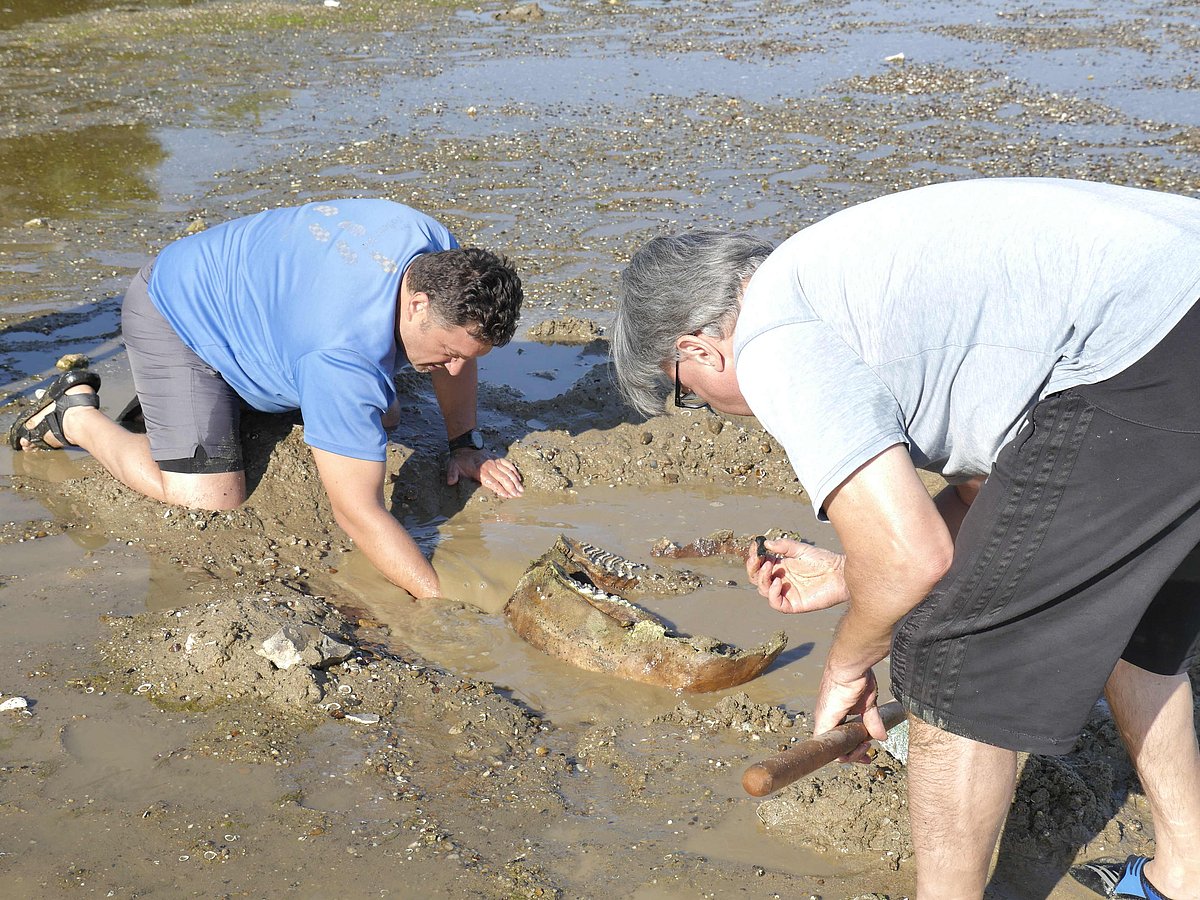
This handout photograph taken by Teodor Mechev and released on 30 July 2026, shows scientists from Rousse’s Regional Historical Museum examining remains of an ancient mammoth, as historically low water levels on the Danube River exposed parts of the riverbed near the village of Ryahovo, north east of Rousse

Mammoth bones found on parched bed of Danube in Bulgaria

Sinking water levels in the Danube river have unveiled bones of a mammoth in Bulgaria and could lead to further discoveries, a local museum director told AFP on Thursday.

The bone fragments found near the northeastern city of Ruse “very likely” belonged to a woolly mammoth that lived during the Ice Age, said Nikolay Nenov, director of the Regional Historical Museum.

Specialists have so far identified a jaw bone, fragments of tusks, part of a shoulder blade and a femur with its articular head among the stash, Nenov said.

This handout photograph taken by Teodor Mechev and released on 30 July 2026, shows remains of an ancient mammoth, as historically low water levels on the Danube River exposed parts of the riverbed near the village of Ryahovo, north east of Rousse

The animal is thought to have been young and the dark colour of the bones may indicate that it spent a lot of time in a marshy environment, he added.

This handout photograph taken by Teodor Mechev and released on 30 July 2026, shows remains of an ancient mammoth, as historically low water levels on the Danube River exposed parts of the riverbed near the village of Ryahovo, north east of Rousse

The bones are an important discovery because they are well preserved and “unlike many previous discoveries... were concentrated in the same place”, indicating that they all belonged to the same animal, Nenov said.

Woolly mammoths co-existed with early humans who hunted the cold-resistant herbivores for food and used their tusks and bones as tools.

This handout photograph taken by Teodor Mechev and released on 30 July 2026, shows remains of an ancient mammoth, as historically low water levels on the Danube River exposed parts of the riverbed near the village of Ryahovo, north east of Rousse

The animals died out about 4,000 years ago. For decades, scientists have been recovering bits and pieces of mammoth tusks, bones, teeth and hair.

The remains in Bulgaria were spotted by chance on Wednesday by a resident of the village of Ryahovo in the Ruse region, before being collected on Thursday by experts from the museum.

This handout photograph taken by Teodor Mechev and released on 30 July 2026, shows scientists from Rousse’s Regional Historical Museum examining remains of an ancient mammoth, as historically low water levels on the Danube River exposed parts of the riverbed near the village of Ryahovo, north east of Rousse

The Danube -- which runs from the Black Forest mountains of western Germany through 10 countries to the Black Sea -- has dropped to record low levels in parts due to prolonged rain shortages and successive heatwaves since May.

This handout photograph taken by Teodor Mechev and released on 30 July 2026, shows a scientist from Rousse’s Regional Historical Museum examining remains of an ancient mammoth, as historically low water levels on the Danube River exposed parts of the riverbed near the village of Ryahovo, north east of Rousse

Specialists are now planning a new search of the area in the hope of finding other remains, Nenov said.