Sylhet Test
Even at the summit, Mushfiqur remains unsatisfied
There was still some time left before tea ended. Players from both teams had yet to emerge from their dressing rooms. But one man already seemed desperate for play to resume, as though even the 15-minute break felt unbearably long for him. He was already standing near the boundary rope.
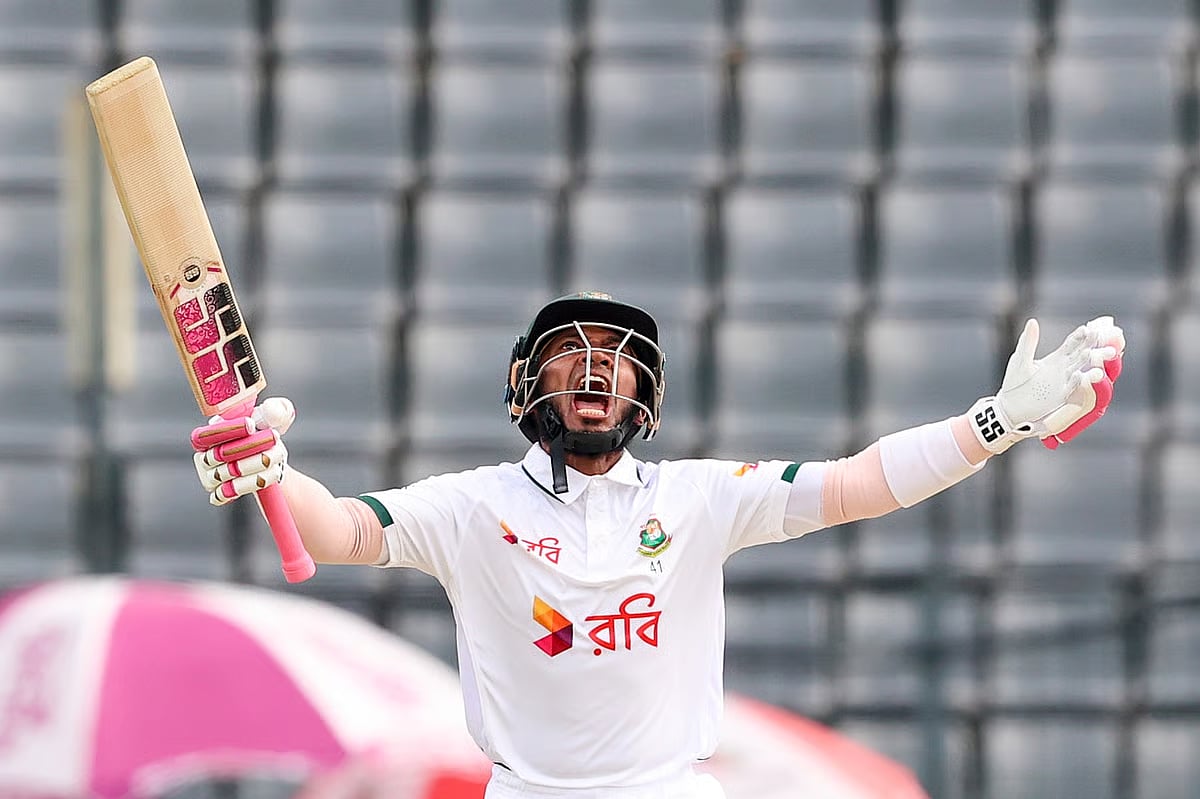
Mushfiqur Rahim has long intertwined batting with the very fabric of his life. And at that moment, he was in the nineties. It was only natural that he could hardly wait to return to the crease. Twenty-three deliveries after play resumed, Mushfiqur reached the coveted century and became visibly emotional.
The moment he realised his shot off Mohammad Abbas would race to the boundary, he raised his hand in celebration. He then flung away his bat in the middle of the pitch, lifted both arms aloft and embraced his batting partner Taijul Islam. It was the 14th Test century of his 21-year career across 102 Tests. Yet to Mushfiqur, it all seemed as fresh and emotional as a first.
When Bangladesh resumed batting yesterday morning, Mushfiqur’s partner was captain Najmul Hossain Shanto. Clouds hovered overhead and the Pakistani bowlers posed a stern challenge. But Mushfiqur never lost control. Wickets fell at the other end, and there was even a brief exchange between Taijul and Shan Masood. None of it disturbed Mushfiqur’s concentration.
At the end of one over, Taijul was taking a little extra time before getting back on strike, which appeared to irritate the Pakistan captain. Masood told him, “Go bat.” Taijul responded, “It’s not your job to decide when I should bat.”
Masood then moved towards Mushfiqur, perhaps hoping to break his concentration with a few words. After all, Mushfiqur was the biggest obstacle standing between Pakistan and an all-out Bangladesh innings.
Taijul later explained the incident at the end of the day. “They had been fielding for a long time and couldn’t hold their temperament. Mushfiq bhai didn’t say anything. Naturally, he was speaking to the umpire,” he said.
With his trademark calmness and patient batting, Mushfiqur once again demonstrated why he remains Bangladesh’s greatest pillar in Test cricket. After Najmul’s dismissal in the first hour, Bangladesh had slipped to 115 for 4. The lead was healthy, but not entirely secure. That changed significantly through Mushfiqur’s 123-run fifth-wicket partnership with Litton Das.
Mushfiqur then faced another difficult period when both Litton and Mehidy Hasan Miraz departed within the space of 10 overs. The question became: with whom would he continue to build Bangladesh’s total? Taijul took up that responsibility, adding 77 runs alongside Mushfiqur. Earlier, with Litton, Mushfiqur had pushed the lead beyond 300; with Taijul, he effectively batted Pakistan out of the match.
Taijul, who scored 22 from 51 balls, once again highlighted Mushfiqur’s value to the team. “When you share a dressing room with senior players, or when someone like him is scoring runs and staying at the crease, it makes batting easier for the player at the other end too.”
Even so, Taijul said Bangladesh had wanted a few more runs. Mushfiqur certainly tried. When he finally fell — caught off Sajid Khan — Bangladesh’s lead had already stretched to 437. Yet as he walked back to the dressing room, he was seen kicking his helmet outside the boundary in frustration.
In an age where moments spread instantly, images and videos of the incident quickly circulated across social media. But this, too, is quintessential Mushfiqur — driven by stubbornness, perseverance, quiet self-discipline and deep emotion.
With yesterday’s century, Mushfiqur moved past Mominul Haque to become Bangladesh’s leading century-maker in Test cricket. Across all three formats, only Tamim Iqbal has more centuries than him, by just two. Mushfiqur also now holds the record for the oldest centurion in the World Test Championship for Bangladesh.
But beyond records and milestones, Mushfiqur now stands on an even higher plane. Sylhet once again showed that he remains the backbone of Bangladesh’s batting in Test cricket.