When Ankon Roy visited the Rohingya refugee camps in Cox’s Bazar last November, what stayed with him was not the scale of the crisis, but a young Rohingya, not much older than himself, studying to achieve his dream of becoming a doctor. "Statistics cannot show you people's humanity," he said.
Ankon, a student at Daffodil International University (DIU), was part of the 2025 winning team of the ‘Forced to Flee’ category at the Dhaka International Mobile Film Festival (DIMFF), a partnership between UNHCR, the UN Refugee Agency, and the University of Liberal Arts Bangladesh (ULAB). The UNHCR-organized camp visit was life-changing for him and fellow DIU filmmakers Mostofa Wakil and Md. Nayamul Haque Asib, allowing them “to move beyond news headlines and connect them with the people behind the crisis,” as Wakil puts it.
From the camps to the canvas
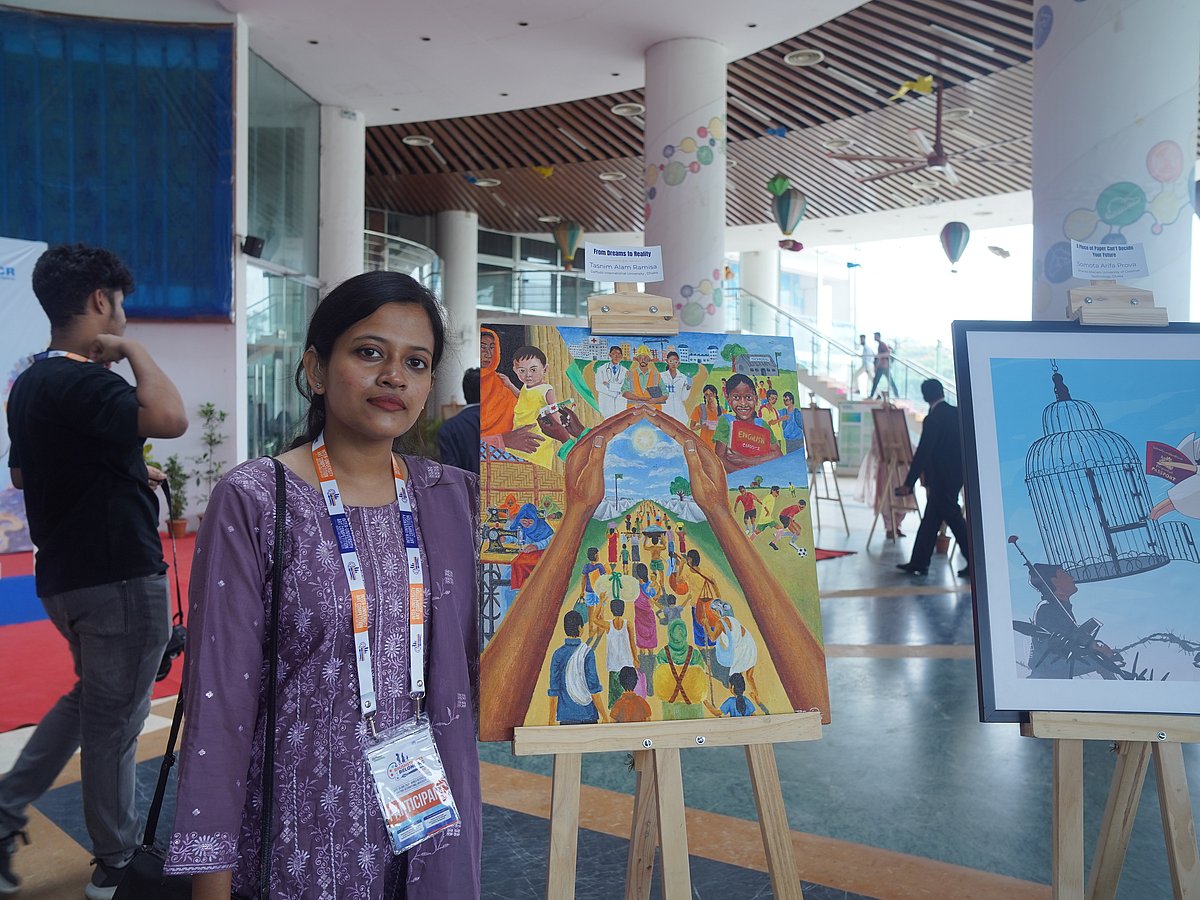
This year, the students turned their experience into Brushstrokes of Belonging, a student-led art competition developed with UNHCR to mark World Refugee Day, observed annually on 20 June in honour of the courage and resilience of people forced to flee. The initiative invited students from across Bangladesh to reflect on refugee experiences through painting, collage and digital art. It offered a new approach for universities in Bangladesh to engage with one of the world's largest refugee crises.
Bangladesh was the first country to open its doors to the Rohingya fleeing Myanmar, and nine years on, 1.2 million Rohingya refugees still live there, hosted with remarkable generosity by communities in Cox's Bazar. However, many students know little about their lives beyond the stereotypes often perpetuated on social media. The students were invited to challenge these notions.
The open call for the Brushstrokes of Belonging project led by Daffodil International University, in partnership with UNHCR, drew over 300 students from 35 universities and higher education institutions. Of these, 115 attended awareness sessions on ethical storytelling, the reasons people are forced to flee, and life in a refugee camp, with 20 works selected , including Ankon's.
Ankon's piece depicted children playing inside the camp, not as symbols of crisis, but simply as children. "Displacement may change where people live," he said, "but it doesn't take away their dignity or capacity to hope."
Faculty supporter Kazi Jahid Hasan said the strongest pieces shared one quality: "a student sat with the discomfort of the subject and responded with dignity rather than spectacle."
Rushad Tanzeem, whose piece placed third, built hers around a question from a UNHCR awareness session: if you had to leave home and might never return, what would you take with you? She imagined a Rohingya man playing his mandolin at dawn, titling the work Morning Will Come. "It''s an act of faith," she said, "that no matter how long and painful the night might seem, the morning will always come."
Twenty students, five teams, one mobile phone each
For the past three years, UNHCR's partnership with the University of Liberal Arts Bangladesh (ULAB) on DIMFF''s ''Forced to Flee'' category has provided hands-on training and awareness-building workshops on refugee matters. This year's cohort brought five competitively selected teams from ULAB, Dhaka University, North South University, DIU and Jahangirnagar University. Before any camera rolled, students attended two days of UNHCR-led sessions on the realities of the Rohingya crisis and ethical storytelling.
For Syeda Sadia Mehjabin, a senior lecturer at ULAB who coordinates the festival, those sessions are essential. "Without understanding the framework, the laws and regulations, you cannot build a solid foundation for a film," she said. "Once students comprehend these structural elements, it becomes much easier to build a narrative that is an accurate reflection of reality."
Samiha Hyder Kongka, a Mass Communication and Journalism student at Dhaka University, came to the subject through a course and noted how little attention the crisis receives. The workshop shifted her perspective through empathy. Her team's film follows a Rohingya child's point of view and ends on a note of hope: "They are brave, they flew a conflict, and they want to change the world, they are full of hope," she said.
On the ULAB team, Khadija Chowdhury Safa pushed back on the idea that forced displacement is a threat. "It's not their fault. They didn't choose this - they were forced into it," she said. Her teammate Taslima Bushra Islam Jeem put it more bluntly: "As students, we carry the voice that the Rohingya don't have. It is our responsibility and duty to speak on their behalf to raise awareness."
For the second time, the winning DIMFF team will be offered a UNHCR-facilitated visit to the Rohingya camps - an opportunity to engage with the crisis on a personal level.
Beyond World Refugee Day
For Wakil, Brushstrokes of Belonging fulfilled a deeper ambition born from his camp visit the previous year. "We wanted to create a student-led initiative that could extend this learning beyond a single workshop - encouraging students to challenge common misperceptions and share those messages with a wider audience," he said.
Mir Wadud Islam, the DIMFF workshop instructor, put it simply: "Filming is about human beings." The aim, he said, is to tell "a human story, through a human lens."
The exhibition closed with a screening of Lost Land, directed by Akio Fujimoto, the first feature film made entirely in the Rohingya language. For DIU students Zarin Tabasum and Jackie Aslam, what stayed with them was not the siblings' loss but a recurring image: a mango tree that first appears in their aunt's stories of Myanmar, then resurfaces in the children's search for it among strangers in Malaysia. They saw it as a symbol of the siblings' bond and their culture, which displacement could not uproot.
Both students said they wanted more opportunities to engage. World Refugee Day lasts only twenty-four hours. For the 1.2 million Rohingya refugees in Bangladesh, the crisis goes on.
* Mathilde Aupetit is working for UNHCR Bangladesh as an Associate External Relations Officer