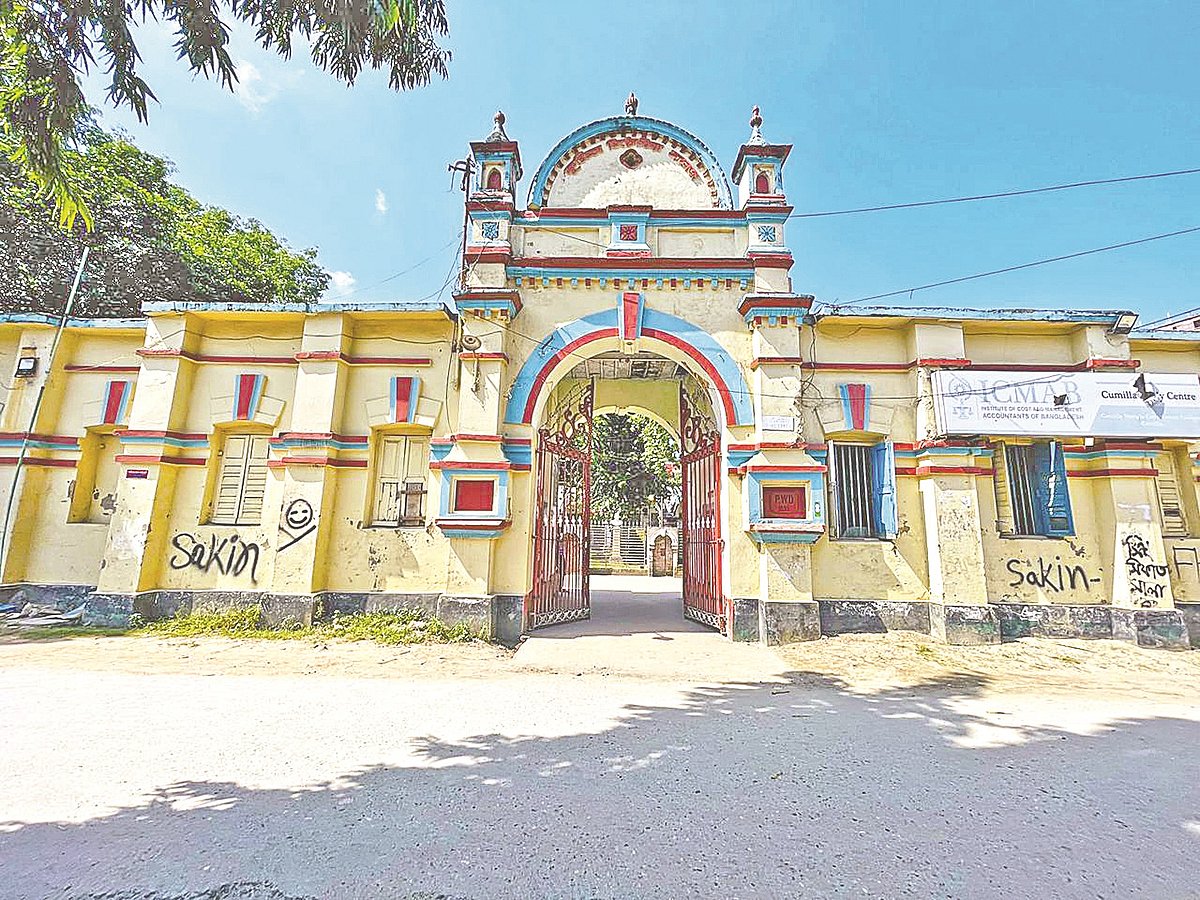
Big college
Victoria College plagued by teacher shortage and housing crisis
Cumilla Victoria Government College, one of the oldest educational institutions in Bangladesh, carries a 126-year legacy of history and heritage. Yet, the institution now faces multiple crises. A severe shortage of teachers is disrupting education, while a housing crisis forces nearly 97 per cent of students to live in messes or rented flats. On top of that, the campus becomes waterlogged after even light rainfall.
The college was established on 24 November, 1899, by zamindar Roy Bahadur Ananda Chandra Roy. Today, the college campus is divided into two sections: the higher secondary campus is located by Rani Dighi in the Kandirpar area—the heart of Cumilla city—while the degree and honors section is situated in Dharmapur on the outskirts of the city.
A total of 29,850 students are currently enrolled at the college—2,400 in the higher secondary section and the rest in the degree and honors programs. However, despite the large number of students, accommodation is extremely limited as only about 3.4 per cent can stay in dormitories. The rest must rent rooms or flats, which increases their monthly expenses three- to fourfold.
A student named Motaleb Hossain told Prothom Alo, “Nine of us share a three-room flat in Dharmapur. The rent alone is Tk 11,000 per month, not counting food and other expenses. It’s unfortunate that such an old and historic college has no proper accommodation for its students.”
Unhealthy dormitory conditions
The college has four residential halls—two for men and two for women. For higher secondary students, Suhrawardy Hall has only 80 seats for boys, and Sher-e-Bangla Hall has 136 seats for girls. For degree and honors students, Kabi Nazrul Islam Hall (for boys) and Nawab Faizunnesa Hall (for girls) each have 400 seats—1,016 in total.
But living conditions in the dorms are deplorable. Billal Hossain, a student residing at Kabi Nazrul Islam Hall, said that the building is 65 years old, and the ground floor is so damp that it’s almost uninhabitable. Rainwater seeps in, and mosquitoes are a constant problem.
A student of Sher-e-Bangla Hall added, “The building is dilapidated, and the toilets are filthy. We’re forced to stay here because we have no other choice.”
Campus flooded during rain
Teachers and students have been struggling with waterlogging for over 15 years. During the monsoon, even a 30-minute rainfall submerges the degree and honors campus under knee- to waist-deep water. This happens mainly because surrounding roads and buildings were built at higher elevations, blocking water drainage.
On 31 May, around 500 first-year honors students had to take their admission tests standing in knee-deep water. Kabi Nazrul Islam Hall and Nawab Faizunnesa Hall are also affected with the same problem.
Teaching disrupted by teacher shortage
Across its two sections, the college currently has 170 teachers—but needs at least 340 to meet student demand. Vice Principal Professor Md Abdul Majid said most of 20 departments have only six to eight teachers, while each needs 16 to 18.
The shortage is hampering both classes and exams, he added.
The college also faces a severe shortage of support staff. Of 54 sanctioned posts, only 32 are filled by government employees. The college administration employs an additional 128 staff privately, but that’s still insufficient. Chief Assistant Md Majharul Islam said that every department needs at least five staff members. Because of the shortage, both cleaning and administrative work are falling behind.
Aging infrastructure
The degree campus lacks adequate academic buildings. More than 27,000 students attend classes in just six small, aging buildings, including the arts building. Most structures are in poor condition. The 60-year-old arts building, for example, houses seven departments but only has three restrooms—most of them broken.
The higher secondary section has no administrative building. The gymnasium has been closed since 2000. Teachers’ housing is nonexistent, and even the principal’s residence is abandoned. As a result, faculty members live in rented apartments.
Principal Md Abul Bashar Bhuiyan said that at least three new academic buildings are urgently needed in the degree section. The matter has been raised with the authorities. A proposal has been submitted to construct two 10-storey dormitory buildings to address the housing crisis. Approval is awaited. A project to solve the waterlogging issue has also been initiated, and walkways are being built to prevent outside water from entering.
Need for planned intervention
Former teacher Titash Chowdhury, in his book on the history of Cumilla Victoria College, wrote that “by age and heritage, this college belongs among the great institutions.”
Victoria College is a cornerstone of the educational history of greater Cumilla and East Bengal. Yet today, it risks losing its legacy due to crises in housing, infrastructure, staffing, and waterlogging. Both teachers and students agree that only new buildings, sufficient teacher recruitment, and effective drainage can restore a proper learning environment.