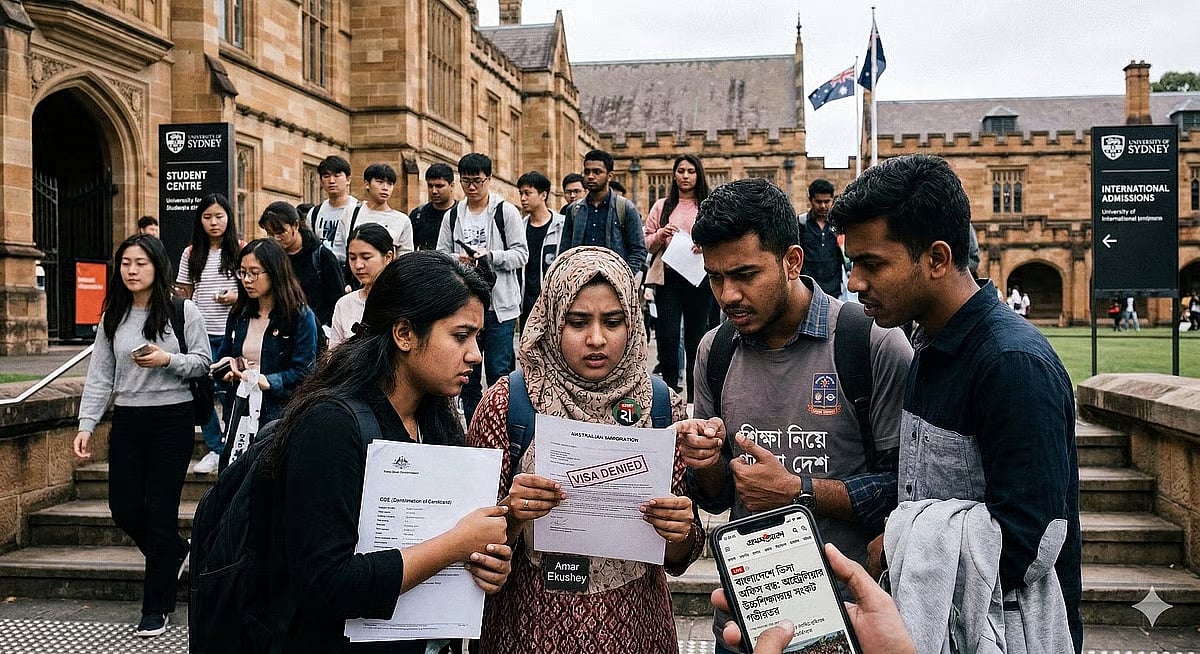
Higher education in Australia: Bangladeshi students facing crisis
Australia’s international education sector—worth about USD 54 billion and regarded as a key driver of the country’s economy—is currently passing through a period of deep uncertainty.
Leading experts have warned that the sector is being threatened by the intense debate over immigration in the country and the rising tide of anti-immigration public sentiment.
In particular, unprecedented tightening in visa procedures for students from South Asian countries such as Bangladesh, Nepal and India has created serious concern among stakeholders about the future of the sector.
At a major conference of Australian universities, Adele Lausberg, executive director of the Property Council, presented a worrying picture of the current situation.
She said that just as the global media’s misrepresentation during the devastating bushfires of 2019 had long-term negative impacts on the country’s tourism industry, the current strong anti-immigration political messaging is creating fear and uncertainty among international students.
According to her, when prospective students abroad regularly see negative news about immigration in Australian newspapers, they become discouraged from choosing the country as a study destination.
Julian Hill, federal assistant minister for International Education, told the conference directly that the government had been compelled to introduce stricter controls in the visa system due to an unusual increase in applicants from some parts of South Asia who were considered ‘unscrupulous’ or not genuine students.
He noted that in May 2022 the number of applicants from Nepal had even surpassed those from China, which was highly unusual.
The government is currently following a ‘slow-processing’ policy for visas, which has already led to a nearly 15 per cent drop in the number of new students.
Hill also warned that universities trying to recruit students by opening campuses abroad merely to offset financial deficits are likely to see those plans fail.
Commenting on the crisis, Sydney-based immigration lawyer Mohammad Nizamuddin said, “Australia’s education system has always been a place of trust for South Asian students. But the current visa complications and frequent policy changes are making the future uncertain for talented students. We hope the Australian government will maintain a balance between international students and domestic political considerations.”
Fahim Hossain (pseudonym), a student at a Sydney university who has faced visa complications, expressed frustration, “We spend hundreds of thousands of taka to study here. But the current environment makes it seem as though international students are the root of all problems. This negative narrative is putting us under mental pressure.”
Another student, Sultana Akter (pseudonym), said, “If Australia wants to maintain the quality of its education, discouraging talented students in this way is not the right approach. There should certainly be rules, but they must be transparent.”
According to local educationists, if Australia wishes to retain its leading position in the global market for international education, the government must deliver a balanced and positive message both domestically and internationally. Otherwise, the multi-billion-dollar sector could face long-term damage, which would ultimately have negative consequences for the country’s overall economy.
*Kawsar Khan is the Sydney correspondent of Prothom Alo and an immigration lawyer. He can be reached at kawsark@gmail.com.