Seminar
Effective referral pathway for journalists and human rights defenders
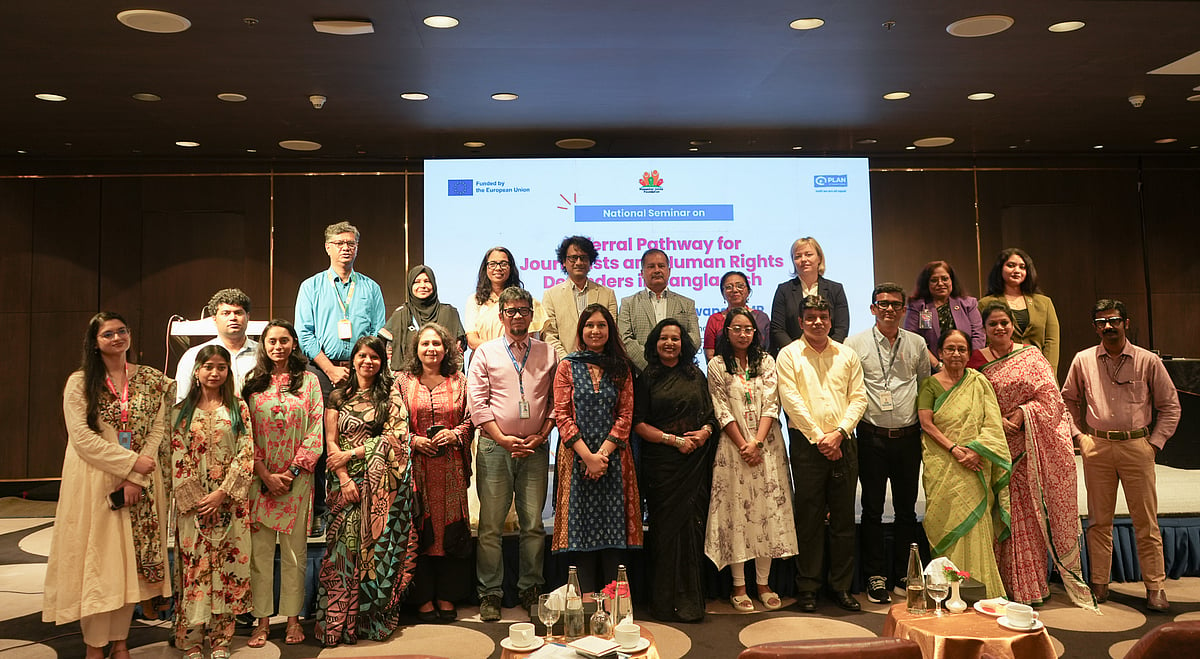
Strengthening a coordinated and effective referral mechanism to ensure timely and appropriate support for journalists and human rights defenders facing threats and protection risks was highlighted at a national seminar held on Monday in Dhaka, reports a press release.
Titled “Referral pathway for journalists and human rights defenders in Bangladesh,” the seminar shared the findings of the study “Mapping of support services and proposing a referral pathway for journalists and human rights defenders in Bangladesh,” conducted under the Swadhinata: Freedom of Expression for Digital Democracy (FREEDOM) project, alongside a proposed referral mechanism and strategic recommendations.
Funded by the European Union, the project is led by Plan International Bangladesh and implemented by Manusher Jonno Foundation (MJF).
Speaking as the Chief Guest, Zahir Uddin Swapon, political adviser to the prime minister and Member of Parliament, said that, “A progressive society cannot be built without protecting people’s fundamental rights and freedoms. Strengthening collaboration between government, civil society and development partners is therefore essential. At the same time, as technology and artificial intelligence transform our world, we must empower young people to navigate these changes responsibly and use innovation as a force for positive change.”
The study found that a range of services, including legal and psychosocial support, emergency response and digital security assistance, are available for journalists and human rights defenders in Bangladesh.
However, service providers often operate separately, while access to specialised support remains uneven across the country. These gaps are comparatively greater in districts, upazilas and remote areas.
Baiba Zarina, deputy head of Delegation and head of the Political, Economic, Trade, Press and Information Section of the Delegation of the European Union to Bangladesh, said that, “No journalist or human rights defender facing a threat should be left wondering where to turn. They should know exactly whom to contact, where to seek help and what support is available. Today’s discussion is an important step towards strengthening coordination and building clearer referral pathways so that timely support can reach those who need it.”
Faruk Wasif, director general of the Press Institute Bangladesh (PIB), said that, while social media has expanded opportunities for people to express their views, it has also increased the risks of misinformation, hate, online harassment and the misuse of artificial intelligence.
He stressed the importance of protecting the rights and safety not only of journalists and human rights defenders, but also of ordinary social media users, alongside strengthening media literacy.
Kabita Bose, country director of Plan International Bangladesh, said that digital democracy is not simply about having access to a mobile phone or the internet; it is also about how safely and responsibly people are able to use technology.
Platforms, policies or action plans alone will not bring the desired results. She emphasised the need for timely legal measures and rapid responses when complaints are made.”
Shaheen Anam, executive director of Manusher Jonno Foundation, said that, “Having laws and policies in place is not enough; their effective implementation must also be ensured. With misinformation, misuse of social media and digital harassment increasing, she stressed the need to raise public awareness and engage young people as agents of change.”
The study was conducted across all eight administrative divisions of Bangladesh. It included 16 focus group and small-group discussions, 20 key informant interviews, eight divisional stakeholder consultation workshops and one national-level validation workshop.
Legal and judicial harassment, digital threats and online violence, physical intimidation, economic insecurity and psychosocial stress were identified as interconnected risks faced by journalists and human rights defenders.
The research proposed three possible referral models: a central national referral hub, a decentralised community-based referral network, and a multi-stakeholder coordination mechanism at district or divisional level.
The discussion recommended ensuring clear institutional responsibilities and long-term coordination so that the referral mechanism can remain sustainable beyond the project period.
It also recommended maintaining an updated and easily accessible information or communication system specifying where legal, psychosocial, digital security and emergency assistance can be obtained.
At the same time, relevant institutions should have clearly defined responsibilities and be able to respond promptly when journalists and human rights defenders face threats or crises.
The discussion also recommended inclusive support that considers the needs of women and others who face additional barriers in accessing services.