Analysis
Beijing pressures Dhaka to become active in China-Pakistan-Bangladesh trilateral forum
In June, China arranged a “non-official discussion” involving Bangladesh and Pakistan in Kunming. Although Dhaka has clearly stated that this was not the formation of any alliance but merely an official-level discussion, Beijing’s efforts have not ceased. China continues its diplomatic pressure and engagement to activate Bangladesh in the trilateral initiative.
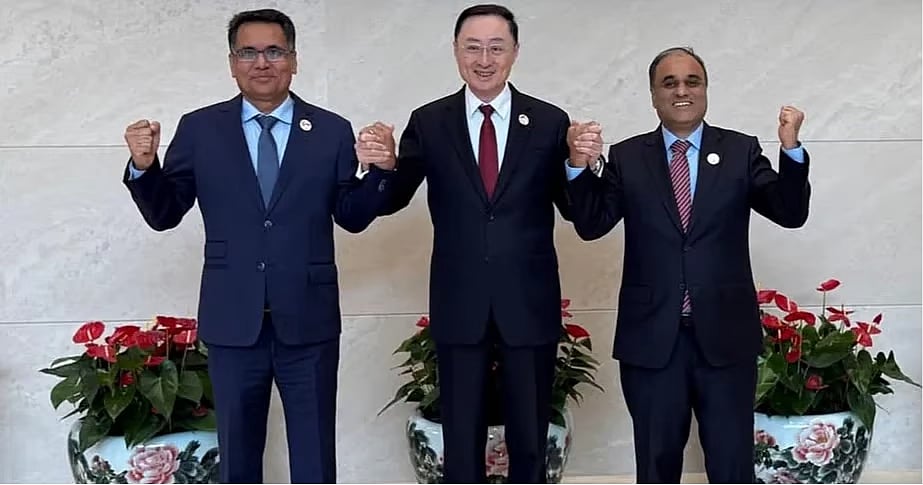
On 19 June, the foreign secretaries of China, Pakistan, and Bangladesh held a meeting in Kunming, the capital of China’s Yunnan province. Over the past month, this trilateral initiative has become a topic of discussion among political and diplomatic circles.
On 21 July, Chinese ambassador to Bangladesh Yao Wen paid a courtesy call on Foreign Affairs Adviser Touhid Hossain in Dhaka. During the meeting, the Chinese ambassador once again brought up the trilateral initiative.
Yao Wen stated that China is interested in holding the first meeting of the trilateral initiative’s Joint Working Group in September in Islamabad, the capital of Pakistan. China hopes Bangladesh will participate in that meeting. However, Bangladesh is currently not interested in participating in any meetings of the trilateral initiative.
Earlier, on 11 July, during a break in the ASEAN Regional Forum (ARF) Ministerial Meeting in Kuala Lumpur, Malaysian capital, Chinese Foreign Minister Wang Yi met with Foreign Affairs Adviser Touhid Hossain. Alongside bilateral and international topics, Wang Yi also mentioned the Kunming meeting. He stated that this is an open group and others may also join. Bangladesh should play an active role in this initiative, he said.
Whatever China’s goals and intentions behind this effort, Dhaka does not want to take any steps that may cause suspicion among different countries in the regional and international arena.
Diplomatic sources in Kuala Lumpur informed this reporter that although the Chinese Foreign Minister raised the issue of the Kunming initiative, Bangladesh’s foreign affairs adviser did not express any opinion. He listened attentively and smiled.
Foreign Affairs Adviser Touhid Hossain confirmed to this reporter that the issue of the trilateral initiative came up during his meetings with the Chinese foreign minister and ambassador. He said that Bangladesh will not join such a trilateral initiative at this time.
Diplomatic sources told this correspondent that since the 19 June meeting in Kunming, China has raised the issue of advancing the trilateral initiative with Bangladesh at least five times.
The current global system is evolving, and bilateral and regional issues are no longer confined to specific boundaries. As such, there is a possibility of a global dimension being added to China’s trilateral initiative.M Humayun Kabir, Former Bangladesh ambassador to the US and current President of the Bangladesh Enterprise Institute
Whatever China’s goals and intentions behind this effort, Dhaka does not want to take any steps that may cause suspicion among different countries in the regional and international arena.
Moreover, Bangladesh’s relations with Pakistan—stagnant for a decade and a half—have only recently begun to normalise. Some serious historical political issues between the two countries remain unresolved. Therefore, diplomats believe that the decision to participate in such a trilateral initiative should be left to an elected political government.
Another factor behind the reluctance to join the initiative at this time, as diplomats see it, is that although China claims the trilateral initiative aims at regional cooperation, it has not included Nepal and Sri Lanka. Bangladesh had asked China about this. However, China has not clarified whether it invited these two South Asian countries to join the initiative.
A high-level delegation from the opposition Bangladesh Nationalist Party (BNP), led by Secretary General Mirza Fakhrul Islam Alamgir, visited Beijing from 22 to 27 June.
At the invitation of the Communist Party of China, Fakhrul’s first meeting during the trip was with China’s Vice Foreign Minister Sun Weidong. It is rare for a senior Bangladeshi political leader to publicly meet with China’s vice foreign minister. Diplomatic sources say the trilateral forum was discussed in this meeting as well.
Subsequently, from 11 to 15 July, a delegation of the Bangladesh Jamaat-e-Islami, led by party chief Shafiqur Rahman, also visited Beijing. Diplomatic sources assume that China brought up the trilateral initiative with Jamaat just as it did with the BNP.
Multiple sources within the Ministry of Foreign Affairs told this reporter that at the beginning of this month, Chinese ambassador Yao Wen met with a senior official of the government. During the meeting, the ambassador raised the issue of implementing the trilateral initiative.
At that time, the Chinese ambassador was informed that the three countries must first discuss and finalise the areas of cooperation. In addition, each country should separately express its views on the objectives, purpose, and framework of this cooperation. Only then can the future roadmap of the initiative be decided.
Former Bangladesh ambassador to the United States and current President of the Bangladesh Enterprise Institute (BEI), M Humayun Kabir, believes that in the current global geopolitical context, China is taking various initiatives with a somewhat aggressive approach.
He said that the current global system is evolving, and bilateral and regional issues are no longer confined to specific boundaries. As such, there is a possibility of a global dimension being added to China’s trilateral initiative.
Therefore, any active participation in such an initiative should be approached with caution, Humayun Kabir added.