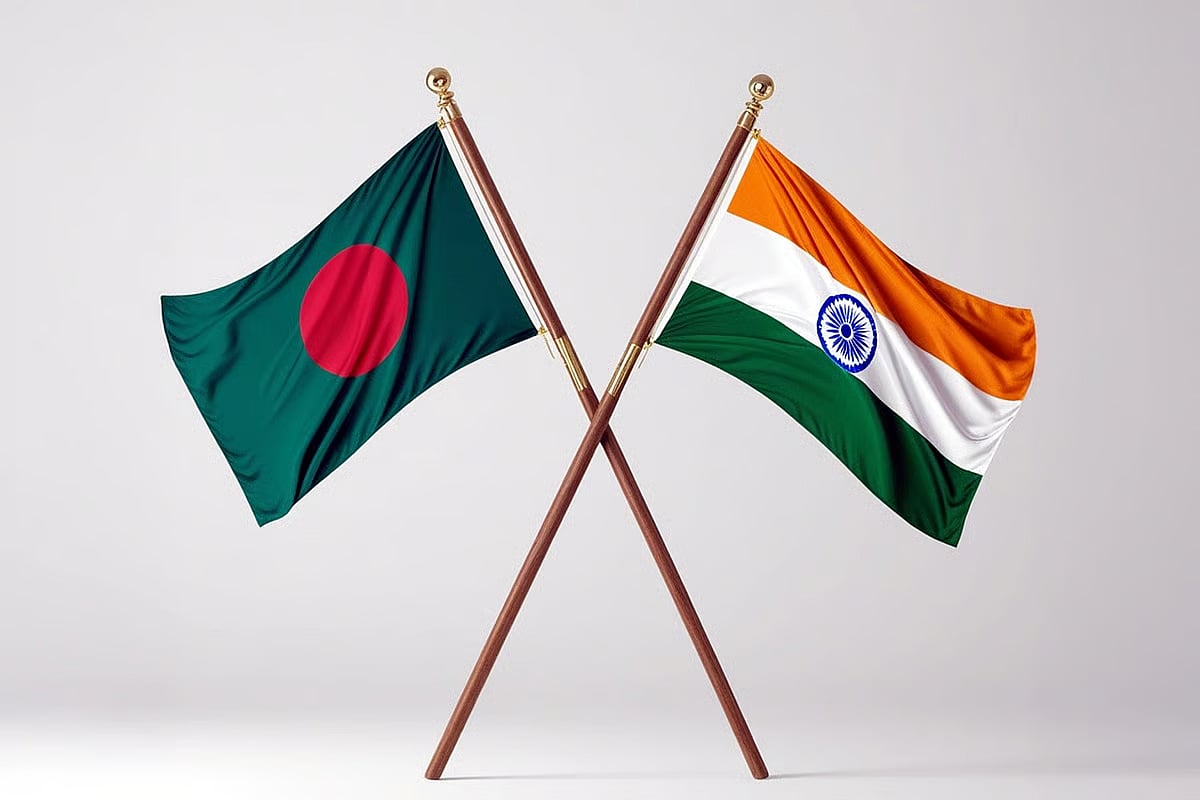
After nearly a four-year hiatus, India’s defence minister Rajnath Singh visited the Bangladesh High Commission in Delhi yesterday, Thursday afternoon. During his visit, he paid his last respects to former prime minister and BNP chairperson Khaleda Zia, writing that she had made a significant contribution to strengthening relations between Bangladesh and India. “Her notable contributions will always be remembered,” he wrote. Rajnath Singh conveyed this information after signing the condolence book with his own hand.
The brief visit of India’s foreign minister S Jaishankar to Dhaka over the past two days, along with the defence minister Rajnath Singh’s visit to the Bangladesh mission, is significant. Since the popular uprising of 5 August 2024, which led to the fall of the Awami League government and Sheikh Hasina’s flight to India, relations between the two countries have deteriorated.
Tensions were further exacerbated in the second half of December 2025, following a series of reciprocal summons of diplomats.Against this backdrop, the engagement of these two key Indian political figures signals a qualitative shift in the relationship with Bangladesh.
About ten days ago, tensions arose around a protest march called by the Vishwa Hindu Parishad (VHP) and several other Hindu nationalist groups heading toward the Bangladesh High Commission in Delhi. Ahead of that protest march on 23 December, a group of demonstrators on the night of 20 December reportedly shouted anti-Bangladesh slogans on the opposite side of the High Commissioner’s residence within the High Commission complex. There are also allegations that the High Commissioner was threatened with assassination that night. These incidents heightened bitterness and tension between the two countries.
Analysts suggest that there are indications of a possible BNP victory in the elections scheduled for February. Accordingly, India is placing emphasis on normalising and advancing its relations with BNP, using the opportunity of Khaleda Zia’s funeral
Yet, barely a week later, Rajnath Singh’s visit to the Bangladesh High Commission to pay respects to Khaleda Zia, is significant. In addition to honouring the former Prime Minister of Bangladesh, his presence at the High Commission signals that Delhi is taking responsibility for ensuring the highest level of security at the mission.
According to diplomatic analysts, in the context of recent tensions between the two countries, India’s Foreign Minister S. Jaishankar’s brief visit to Dhaka is significant. During the nearly four-hour whirlwind trip, he met with BNP Acting Chairman Tarique Rahman, paid respects to Khaleda Zia, and delivered a letter from Prime Minister Narendra Modi. In a discussion lasting about 20 minutes, the two spoke about the past and future of bilateral relations.
Analysts suggest that there are indications of a possible BNP victory in the elections scheduled for February. Accordingly, India is placing emphasis on normalising and advancing its relations with BNP, using the opportunity of Khaleda Zia’s funeral.
Notably, Delhi has repeatedly stated over the past six months that it is waiting to engage with whoever comes to power in Bangladesh through a democratic process in the upcoming elections. Conversations with diplomatic and government sources over the past two days suggest that the issue of “India’s engagement with the election-winning side” was also raised in the brief discussions last Wednesday. Analysts interpret the term “whoever comes to power” here as referring to the BNP. From this perspective, Rajnath Singh’s signing of the condolence book at the Bangladesh mission in Delhi, just a day after S. Jaishankar’s Dhaka visit, is a clear signal from India of its eagerness to advance relations.
Significance of Modi’s letter
Before early afternoon last Wednesday, India’s foreign minister S Jaishankar arrived in Dhaka and went directly from the BAF airbase to the National Parliament building. There, he held a brief discussion with BNP Acting Chairman Tarique Rahman and handed him a letter from Indian Prime Minister Narendra Modi.
In the letter, Narendra Modi referred to his personal acquaintance with Khaleda Zia. He expressed his respect by praising her leadership, her role in Bangladesh’s democracy, and her contributions to the people. At the same time, he conveyed optimism that the BNP will progress based on Khaleda Zia’s ideals. Modi also expressed confidence in Tarique Rahman’s leadership in guiding the BNP and in further enriching the “deep and historic partnership” between the two countries.
Diplomatic sources indicate that Modi’s letter hints that Tarique Rahman’s leadership could mark a new beginning in advancing the partnership between the two nations.
Hope for advancing relations
The significance of the letter from Narendra Modi to Tarique Rahman is hinted at in the remarks of Bangladesh’s High Commissioner to India, Riaz Hamidullah, in Delhi. Reporting on S. Jaishankar’s departure from Dhaka, Riaz Hamidullah wrote in his own hand that India’s Foreign Minister S Jaishankar had left Dhaka after a whirlwind four-hour visit. He noted that this visit could mark the drafting of a new chapter in Bangladesh–India relations. This new chapter might be based on interests, framed within the realities of mutual dependence. In this context, a brief discussion also took place between India’s Foreign Minister Jaishankar and BNP Acting Chairman Tarique Rahman.
It is reported that during the brief discussion with Tarique Rahman, the positive experiences of cooperation between the BNP and the BJP while in power in their respective countries (2001–2004) were mentioned. Against this backdrop, India’s foreign minister emphasised the potential for future collaboration between the two countries. He also expressed optimism that India wants free, fair, and participatory elections as Bangladesh moves toward democratic progress. S. Jaishankar made it clear that India is awaiting engagement with whoever comes to power in Bangladesh through the elections.
Referring to unresolved issues between the two countries, Jaishankar noted that problems may exist, but relations can be advanced through dialogue.
In discussions with India’s Foreign Minister, BNP Acting Chairman Tarique Rahman stressed the importance of advancing bilateral relations. According to him, sitting down and resolving problems through discussion is the way to move the relationship forward.
Discussion on democratic transition
Government sources reported that Delhi confirmed S Jaishankar’s visit to Dhaka to pay his last respects to former Prime Minister Khaleda Zia on Tuesday afternoon. That evening, a phone call took place between the national security advisers of the two countries.
After his discussion with Tarique Rahman, S Jaishankar held informal talks at the National Parliament building with legal adviser Asif Nazrul and national security adviser Khalilur Rahman. The discussions focused on the democratic transition in Bangladesh through free and fair elections scheduled for February. Diplomatic sources said that the talks also covered how bilateral relations could be restored and advanced through a process aligned with democratic transition.
When asked whether India’s foreign minister’s visit would ease tensions between the two countries, foreign adviser Touhid Hossain told journalists at his office yesterday, “You will have to look for the answer in the days ahead. In the coming days, you will see what happens.”