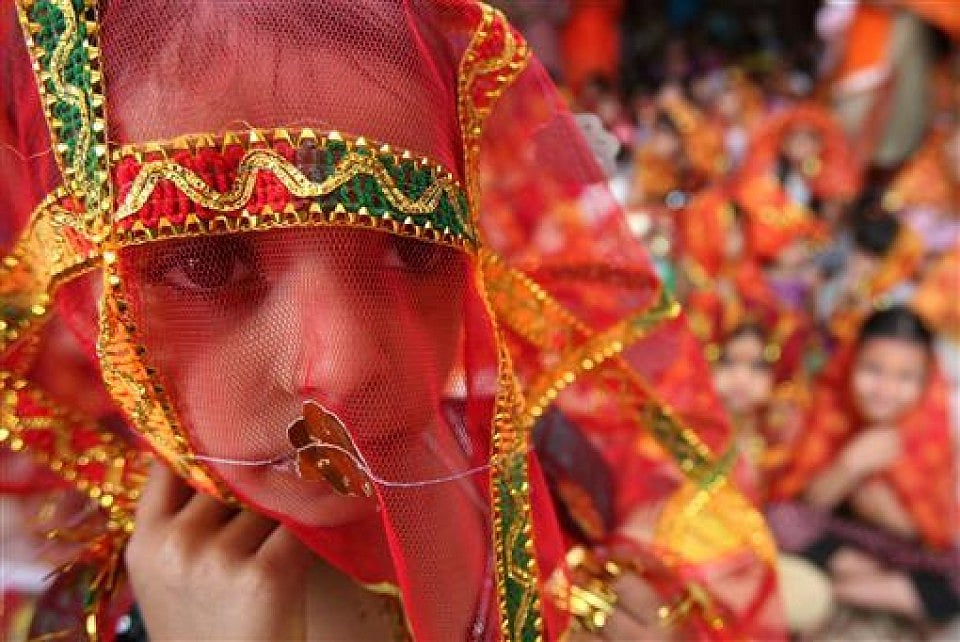
Upon receiving information about the arranged marriage of an 11-year and 9-month-old child in Satkhira, the local administration intervened and stopped it last Thursday. The child is a fourth grader at a local madrasah. Her parents have given a written undertaking to the administration, pledging not to marry her off before she reaches the legal age.
The incident took place on 14 September in Satkhira Sadar Upazila. However, speaking to Prothom Alo, the child's parents denied that they had arranged the marriage. They claimed that the groom's side had come to see the girl but they did not say they would marry her off.
Local rights activists and field-level officials said they had not heard of an attempt to arrange the marriage of a girl this young in recent times.
Although the marriage was stopped, the number of child marriages prevented by the authorities has been declining, according to government data.
According to the Department of Women Affairs, 1,846 child marriages were prevented in 2023; the numbers were 1,474 in 2024 and 968 in 2025. In the first six months of this year, only 479 child marriages were prevented.
Arranged marriage for a girl not yet 12
These figures only reflect cases prevented and documented by the authorities. They do not show how many child marriages are taking place in the country.
The Ministry of Women and Children Affairs does not keep regular records of how many child marriages occur. The Department of Women Affairs centrally compiles the data on prevented child marriages recorded by field-level women affairs officials.
Rights activists say the authorities have been receiving fewer reports of child marriages because efforts to prevent them at the local level have slowed over the past two years, informants lack confidence that their identities will remain confidential and awareness programmes by non-government organisations have declined because of funding shortages.
Women and Children Affairs Minister Abu Zafar Md. Zahid Hossain told Prothom Alo on Sunday that child marriage remains a major problem. He said more human resources was needed at the field level to enforce the law.
According to him, instructions had been issued earlier this month to reconstitute child marriage prevention committees from the national to the grassroots level. The number of adolescent clubs is also being increased to raise awareness.
The minister added that a certain group campaigns in favour of child marriage on social media. Enforcing the law in remote villages is also difficult. The government is considering how to handle the situation.
According to the ministry’s plan, the number of adolescent clubs will be increased from 4,883 to 14,790. The project has been extended until 2030. The clubs organise various programmes on cultural development, including awareness activities to prevent child marriage.
Today is National Girl Child Day. This year’s theme is “No more child marriage, girls will conquer the world.”
Reports do not reach authorities, monitoring also limited
Local rights activist Sakibur Rahman was present when the marriage of the under-12 girl in Satkhira was stopped. He fears that the girl could later be married off secretly if there is no regular monitoring.
He said parents were not particularly afraid of signing undertakings on plain paper.
Sakibur Rahman claimed that over the past nine months, he had visited 70 secondary schools in the area and learned of at least 700 girls facing child marriage, none of which had come to the attention of the authorities.
According to him, many people do not report such cases because they are not confident that their identities will remain confidential. At the same time, government officials are sometimes unable to reach remote areas even after receiving information because of manpower shortages and pressure from other responsibilities.
Satkhira Sadar Upazila Nirbahi Officer Arnab Dutta acknowledged that the administration does not receive information about many child marriages.
He said neighbours in some areas support the marriages, while families sometimes keep elopement and marriage cases secret for fear of social embarrassment.
He claimed that the rate at which people inform the administration has declined compared with the past. Since taking charge of the upazila nine and a half months ago, he has prevented more than 50 child marriages, he said.
Most of the girls involved in those cases were between 14 and 16 years old. The under-12 girl was the youngest.
How many child marriages
Under the Child Marriage Restraint Act, 2017, a girl below the age of 18 and a boy below the age of 21 are considered minors for the purpose of marriage. The law provides penalties for those involved in arranging, solemnising or conducting child marriages.
However, in special circumstances, a marriage involving a minor is not considered an offence under the law if it is conducted in the minor’s best interests under a court order, with the consent of the parents or guardians and in accordance with the procedure prescribed by the rules.
According to the 2025 Multiple Indicator Cluster Survey by the Bangladesh Bureau of Statistics (BBS) and UNICEF, 55.8 per cent of women aged 18 to 49 at the time of the survey had been married before the age of 18. Among married young women aged 20 to 24, 13 per cent had been married before turning 15.
Child marriage continues
A guardian recently married off a 14-year-old girl in Shibganj municipality of Bogura. Asked why, the guardian told Prothom Alo that she was poor and widowed. She said she had arranged the marriage considering her daughter’s safety and the family’s financial hardship.
Shamima Akter worked as a programme officer on a project run by the NGO TMSS in Shibganj. The project operated 234 clubs where adolescents were given awareness sessions on child marriage, health and education. The project ended in April.
Shamima Akter told Prothom Alo last Tuesday that during the 10 months from June last year to April this year, around a dozen girls aged 13 to 15 were married off in the area while she was responsible for the project.
The marriages were arranged secretly, she said, escaping everyone’s attention. As so many marriages took place while the project was still running, the number may have increased further after it ended, she added.
According to field-level government officials and employees, in many cases the families of both the girl and the boy, as well as neighbours, agree to the marriage. In some cases, elected representatives and teachers are also involved.
Meanwhile, government activities to prevent child marriage remain limited. Employees of the One-Stop Crisis Centre (OCC) under the Ministry of Women and Children Affairs are also involved in this work at the upazila level.
An OCC employee also went to help stop the marriage of the under-12 girl in Satkhira. However, the centre’s officials and employees have been facing uncertainty over their employment for a long time and have not received their salaries for the past nine months. This is also affecting their field-level work.
Need to identify challenges and take action
In 2023, BRAC’s Social Empowerment and Legal Protection (SELP) programme published a report titled “Born to Be a Bride”, based on a survey of 50,000 families in 27 districts.
According to the report, parents cited finding a suitable groom, poverty, lower or no dowry demands for girls married at a young age, lack of security and poor academic performance as reasons for marrying off their daughters early.
Shashwatee Biplob, director of BRAC’s SELP and Gender, Justice and Diversity departments, told Prothom Alo that parents were marrying off their daughters despite knowing the harmful consequences of child marriage.
She said parents did not have assurances about their daughters’ safety, protection from rape and abduction, or a better future after completing their education.
She believes it is essential to identify these challenges and take measures to prevent child marriage.
According to Shashwatee Biplob, activities at the union and upazila levels had slowed over the past two years, and many child marriage prevention committees had also become ineffective.
She also said that after the US Agency for International Development (USAID) stopped its activities last year, many NGOs working on child marriage scaled back their programmes because of funding shortages. This created further gaps in prevention efforts.