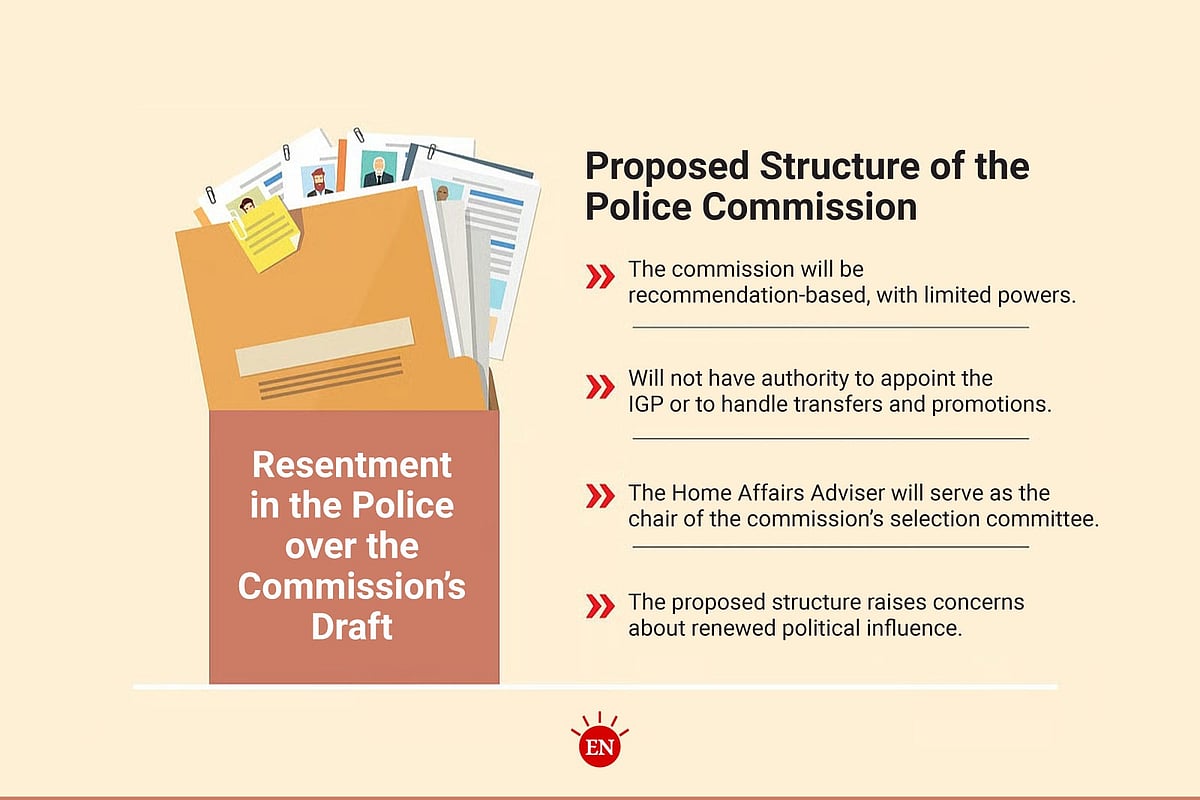
After the July mass uprising, there was a strong demand for the formation of an independent police commission to restore discipline within the police force and establish accountability. After the interim government took office, a committee led by the law adviser prepared the draft of the police commission. However, when that draft was sent from the law ministry to the home ministry, it was significantly altered, with many key recommendations omitted.
Several top-level police sources have said that bureaucrats raised objections to the draft prepared by the committee comprising advisers. Opposition came to several recommendations, including the appointment of the IGP (inspector general of police). Bureaucrats suggested keeping the police under the home ministry as before, effectively rendering the Police Commission powerless. As a result, significant changes were made to the draft originally prepared by the law ministry.
Speaking about the challenges faced from bureaucratic opposition to the Police Commission Ordinance, law adviser Professor Asif Nazrul said at an event in Dhaka on 11 November that the law was originally supposed to be prepared by the home ministry, but the law ministry took the initiative and drafted it. The law included an important provision that the commission would propose three names for the IGP, from which the government would appoint one as inspector general of police. When the draft was sent to the inter-ministerial committee, the bureaucracy strongly opposed the law.
Lately, the draft Police Commission Ordinance 2025 was presented at a special meeting of the interim government’s advisory council on Saturday. However, the ordinance was not approved. It has been requested that the ordinance be presented in more detail and in a revised form at the next meeting of the advisory council.
Exactly one day before the special meeting of the advisory council, on Friday, the BNP issued a statement demanding that the revised draft of the Police Commission not be passed. In the statement, the party’s secretary general Mirza Fakhrul Islam Alamgir said that the government’s push to pass these laws (related to the Police Commission and NGOs) before the elections serves some other purpose, which would obstruct the path to democratic transition. He added that it would not be appropriate to hurriedly pass such important laws without the mandate of the people and called on the government to refrain from taking such initiative.
Several sources have said that the draft presented to the advisory council did not recommend giving the Police Commission the authority over appointments, transfers, and promotions. In other words, these powers would remain with the home ministry as before.
Even the proposal by the committee led by the law adviser to grant the commission the power to form a three-member panel for the transparent appointment of the IGP was omitted. Furthermore, although the advisory committee had called for the formation of a “constitutional, independent, and impartial Police Commission,” this was also absent from the draft.
The advisory committee had proposed forming a nine-member Police Commission, but the revised draft calls for a seven-member commission. However, in both drafts, the selection committee responsible for choosing the commission members will be chaired by the home minister. This has raised questions about how impartially the selection committee will be able to operate.
Uncertainty over Police Commission
Several top-level police officials told Prothom Alo that even after the advisory committee’s recommendations, the entire process has been deliberately delayed. The ministry does not want to lose control over the police under any circumstances. For this reason, they have omitted key recommendations to create a ‘toothless’ Police Commission—meaning the commission will exist in name, but will have no effective role.
Inspector General of Police (IGP) Baharul Alam told Prothom Alo over the phone on Friday that what is happening with the Police Commission is very disappointing. A committee comprising advisers drafted the Police Commission, which was then sent to the home ministry. Yet, despite this, the work of forming the commission was not progressing and remained stalled.
The IGP said that the exact same situation occurred in 2007. Even then, when an initiative was taken to form the Police Commission, it got stuck in the ministry for 15 years. This time, there was a major opportunity to bring transparency to the police, but the formation of the Police Commission has once again fallen into uncertainty. He added that if the commission is formed without granting any real powers, it will never be able to make the police free from political influence.
In the advisory committee’s first draft, most aspects of the Police Commission’s work were directive- or recommendation-based. In some cases, the commission’s role would be to formulate policies—for example, even if it did not have the authority over appointments, promotions, or postings, it would issue directives or make recommendations for implementing related policies. However, the draft did not specify any binding obligation to implement these recommendations. In the latest draft, even this provision has been removed.
There was a major opportunity for reform, but what is happening with the Police Commission is very disappointing.Baharul Alam, IGP, Bangladesh Police
In the draft sent from the law ministry to the home ministry, it was proposed that the IGP be included as a member of the Superior Selection Board (SSB) for police promotions, and the additional inspector general of police (administration) be included in the Divisional Promotion Committee (DPC). The draft also proposed that the relevant authorities receive directives or recommendations regarding promotions.
In the advisory committee’s draft, the Police Commission was not proposed as the authority managing the force. Only the power to recommend the appointment of the IGP was included. According to the draft, the commission would form a panel of three additional IGPs and recommend one of them to the government for appointment, based on integrity, merit, competence, seniority, and satisfactory service. The commission would recommend the appointment of the IGP for a minimum term of two years and a maximum of three years.
However, several top-level police sources said that these proposals from the advisory committee were omitted in the draft presented to the advisory council. Two former police officers at the deputy inspector general (DIG) level told Prothom Alo that some members of the police follow illegal orders from the government and the ruling political party regarding appointments, promotions, and postings. They said that forming a commission without addressing these issues would not produce positive results.
Change in ranks
In the draft of the proposed Police Commission prepared by the committee comprising advisers, it was proposed to form a self-governing, nine-member Police Commission led by a retired judge of the Appellate Division. At least one of the members would be a woman. The term for commission members would be five years.
The draft stated that a former IGP would serve as the member-secretary of the commission. It also recommended including one representative each from the parliament and the opposition as temporary members.
The committee’s proposal further suggested appointing five additional members. These would include: a retired officer of secretary rank, a retired government officer of grade-1 in the national pay scale, and a retired officer of additional IGP rank (grade-1). Another member would be either a retired judicial officer of grade-1 or a renowned lawyer registered in the country with at least 20 years of legal experience.
Additionally, a prominent human rights activist with at least 20 years of experience working in nationally or internationally registered human rights organisations would be included as a member of the commission.
However, the home ministry has proposed forming a seven-member commission. The draft omits a retired government officer of grade-1 in the national pay scale and a retired officer of additional IGP rank (grade-1) from the advisory committee’s proposal. The ministry has, however, stipulated that at least two women must be included in the commission.
The advisory committee had proposed that the commission’s chairperson be a judge of the Supreme Court’s Appellate Division, and the members be of equivalent rank to High Court Division judges. This provision was omitted in the draft presented to the advisory council. Instead, it states that the government will determine the ranks of the commission’s chairperson and members.
A commission for the show
M Akbar Ali, president of the Retired Police Officers’ Welfare Association, told Prothom Alo that the police had sought a working environment free from political and bureaucratic influence. Everyone wanted reforms that would allow the police to stand as an institution. However, it appears that these efforts are being obstructed by the interests of various parties.
The former police officer said that the committee formed with advisers had proposed a Police Commission, but it was not comprehensive. Some provisions, including the appointment of the IGP, were in that draft, but the ministry has removed even these. As a result, forming this Police Commission will make little difference; it will be a nominal, showpiece commission. The huge opportunity for police reform that had arisen will be wasted.