Certain quarter wants to keep society unstable in various ways: Mirza Fakhrul
Local Government, Rural Development and Cooperatives Minister Mirza Fakhrul Islam Alamgir has said that a pessimistic group in the country is attempting in various ways to keep society unstable.
“There is a pessimistic group in our country that remains constantly disheartened. They want to keep society unstable in different ways. They are trying to create unrest over minor issues. We must remain cautious about them. None of us wants any further unrest in the country,” he said.
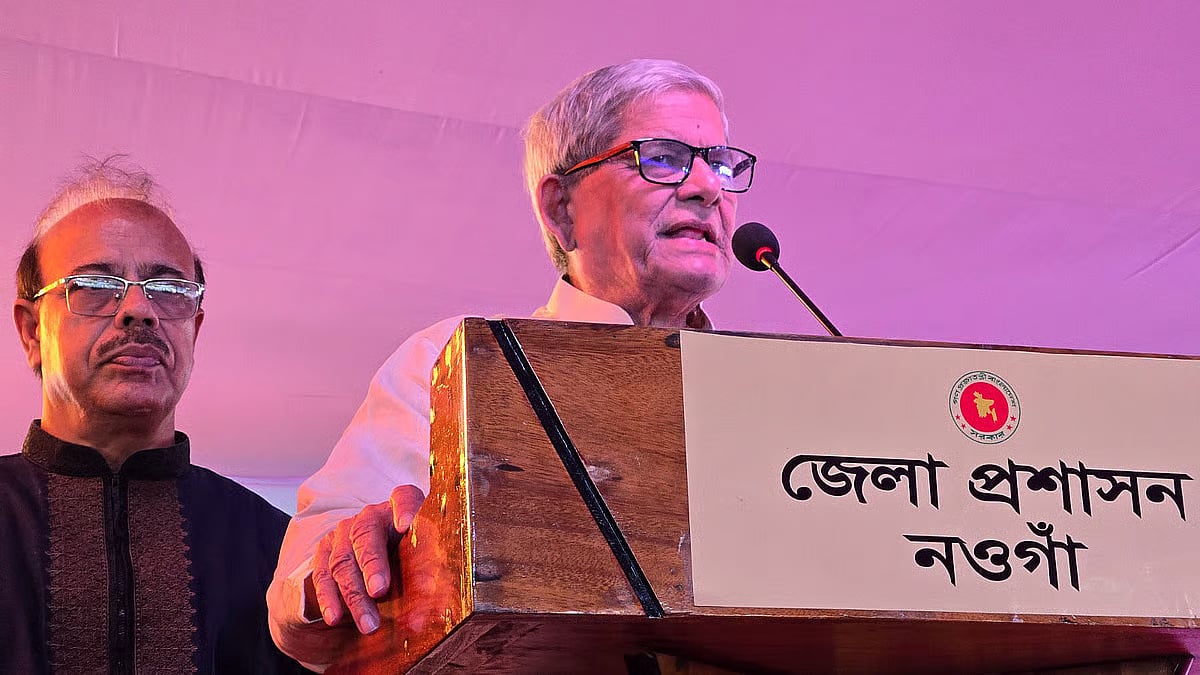
Mirza Fakhrul made the remarks around 12:00 pm on Friday while addressing a discussion at the Rabindra Kachharibari in Patisar, Atrai Upazila, marking the 165th birth anniversary of Rabindranath Tagore.
The event was organised by the Ministry of Cultural Affairs and the Naogaon district administration, where he attended as chief guest.
Referring to the July uprising, the minister said, “Last July, our children fought together in what we call the July war. Change has come. A new election has been held. People have expectations from the new government. The fascists had pushed the country towards destruction. They looted the economy and siphoned money abroad. They plundered the banks and destroyed the administration. We have reached this point through struggle against all that. Many are now trying to divert this change in a different direction.”
Highlighting the enduring relevance of Rabindranath Tagore more than a century later, Mirza Fakhrul said, “The ideas and initiatives Rabindranath pursued a hundred years ago are still things we think about today. Biswakabi remains relevant. When Rabindranath visited Patisar, he saw the suffering of farmers and established a bank for them. He also introduced modern agricultural methods to modernise farming. A person who practises literature, listens to poetry, writes poetry, listens to songs or sings songs undoubtedly becomes a better human being. To become good people, we must cultivate literature.”
Speaking about politics and national identity, he said, “We have spent our entire lives in politics. Our politics has not been beautiful or clean. Time and again, people here have struggled and sacrificed their lives for change. But unfortunately, real change did not come. I only want to say that we must always remember our core foundation — the 1971 Liberation War, our uniqueness, and our distinct identity as Bangladeshis. We did not gain independence easily. We fought for nine months to achieve it. And we regained democracy through struggle as well.”
The event was chaired by Rajshahi Divisional Commissioner ANM Bazlur Rashid. Special guests included Land Minister Mizanur Rahman, State Minister for Cultural Affairs Ali Newaz Mahmud Khaiyam, Whip M Ruhul Quddus Talukdar, and Sheikh Mohammad Rezaul Islam, MP, Naogaon-6 (Atrai and Raninagar), Mostafizur Rahman, MP, Naogaon-1, Enamul Haque, MP, Naogaon-2, Fazle Huda, MP, Naogaon-3, Ekramul Bari, MP, Naogaon-4, Zahidul Islam, MP, Naogaon-5.
Among others present were Rajshahi Range DIG Mohammad Shahjahan, Joint Secretary of the Ministry of Cultural Affairs Mohammad Harun Or Rashid, Naogaon Deputy Commissioner Mohammad Saiful Islam, Superintendent of Police Mohammad Tarikul Islam, and District Council Administrator Abu Bakkar Siddiq.