World Press Freedom Day
I want to see a vibrant media thrive again in Bangladesh: Information adviser
The Prime Minister’s Information and Broadcasting Adviser, Zahed Ur Rahman, has urged the media to continue offering robust and reasoned criticism of the government, saying he hopes to see a “truly vibrant media” flourish again in the country.
“You should continue to criticise the government strongly—any form of criticism, provided it is rational,” he said. “I want to see a dynamic and vibrant media take shape again in this country.”
The adviser further said it would be unwise for a democratically elected government to become embroiled in conflict with the media, especially when it wants to be elected again. He added that the current administration does not intend to take any steps that could harm its relationship with the press.
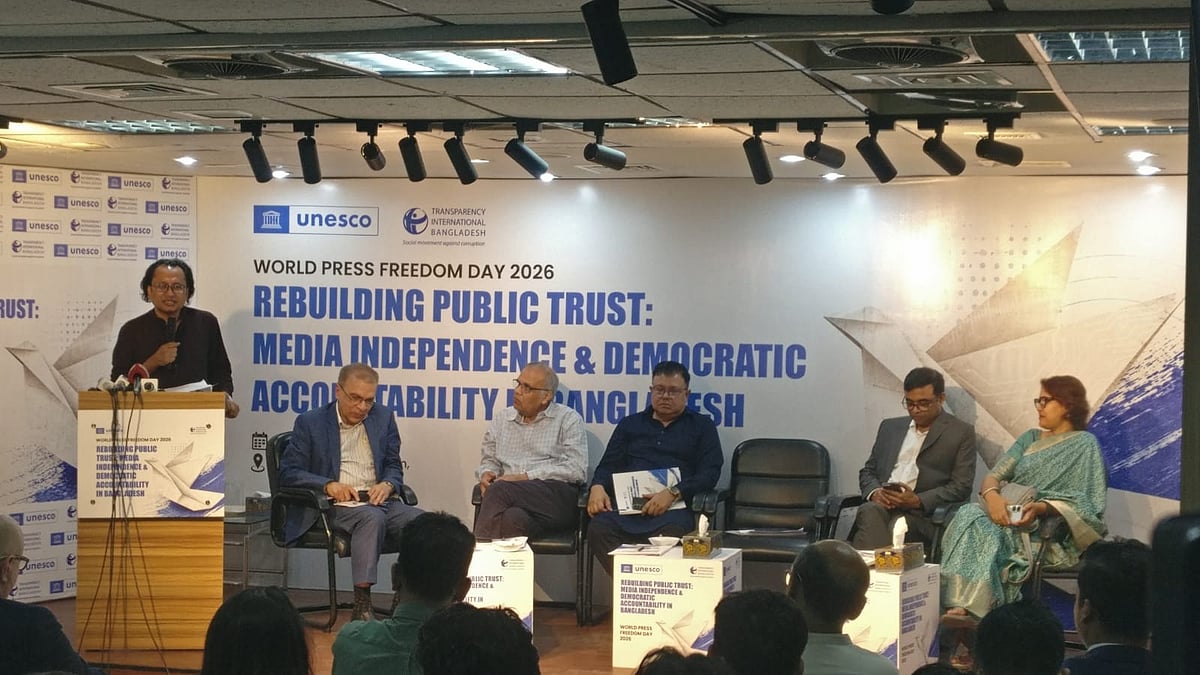
Zahed Ur Rahman made the remarks at a discussion, Rebuilding Public Trust: Media Independence and Democratic Accountability in Bangladesh, at the Transparency International Bangladesh (TIB) office in Dhanmondi, Dhaka, marking World Press Freedom Day on Sunday.
The prime minister’s adviser also said he had recently fallen victim to a fake photo card circulating on social media. “It claimed that I had said increased load-shedding was being carried out for the public good. Friends sent it to me asking if I had lost my mind,” he said, adding that he was also subjected to abuse after being tagged in such posts.
He expressed concern that misinformation and disinformation-laden photo cards are increasingly being spread, sometimes even linked to mainstream media outlets. He further alleged that a mainstream outlet had misrepresented his remarks, effectively producing “fake news”.
“Producing fake news is wrong,” he said, adding that the government would take action through lawful and fair means, while also calling on media organisations to play a responsible role in countering such practices.
The adviser also pledged to hold an early meeting with the Media Reform Commission to discuss practical and implementable measures. He said steps that can be executed swiftly would be prioritised.
During the discussion, media professionals and civil society representatives demanded the release of journalists detained after 5 August (2024).
Speaking about this, Zahed Ur Rahman noted that the issue had been raised in a meeting between the Prime Minister and the (NOAB) Newspaper Owners’ Association of Bangladesh, and that the Prime Minister had taken the matter seriously.
Cyberbullying concerns
Addressing the event, Zahed Ur Rahman said a preliminary decision had been taken to establish a special cell at the Prime Minister’s Office to monitor cyber violence against women, with relevant ministries working in coordination.
“We are going to take a very tough stance on genuine cases of cyber abuse against women,” he said.
He also addressed the role of the state broadcaster, Bangladesh Television (BTV) and Bangladesh Betar (Radio), which was raised by a panel speaker, Dhaka Tribune Editor Reaz Ahmad.
Speaking about BTV, Zahed Ur Rahman noted that despite an annual budget of over Tk 320 crore, it generates only around Tk 15–16 crore in revenue. In an era of expanding private media, he said, there is a need to reassess the broadcaster’s role.
The government, he added, aims to restructure BTV in a way that better serves the public interest as the organisation is run by public money.
At the opening ceremony, Iftekharuzzaman, Executive Director of TIB, highlighted the critical role of independent media in ensuring transparency and accountability.
“Public trust in the media is fundamental to democratic governance. Strengthening media independence and protecting journalists are essential to ensuring that citizens have access to credible information and can hold institutions accountable,” he said.
Delivering opening remarks, Susan Vize, Head of Office and UNESCO Representative to Bangladesh, noted, “Independent, pluralistic and professional media is central to informed public discourse. Strengthening journalist safety and information integrity is critical to rebuilding trust in today’s complex information environment.”
Speaking after the speech of Zahed Ur Rahman, TIB Executive Director Iftekharuzzaman said this aproach of the government regarding maintaining relationship with the press was a bit problematic.
According to him, maybe the government today thinks about the press this way but, after facing a few criticisms it may change the approach within a few days.
It would be better if the government considers ensuring freedom of the media as one of its central policies, the TIB executive director remarked.
Iftekharuzzaman moderated the event where Paola Castro Neiderstam, First Secretary, Human Rights, Democracy and Gender Equality, Embassy of Sweden; and Rudiger Lotz, Ambassador of Germany also addressed.
The panel speakers were Kamal Ahmed, Consulting Editor, The Daily Star; Fahim Ahmed, Chairman, Broadcast Journalists Centre (BJC); Shahnaz Munni, Senior TV Journalist; and, Reaz Ahmed, Editor, Dhaka Tribune.