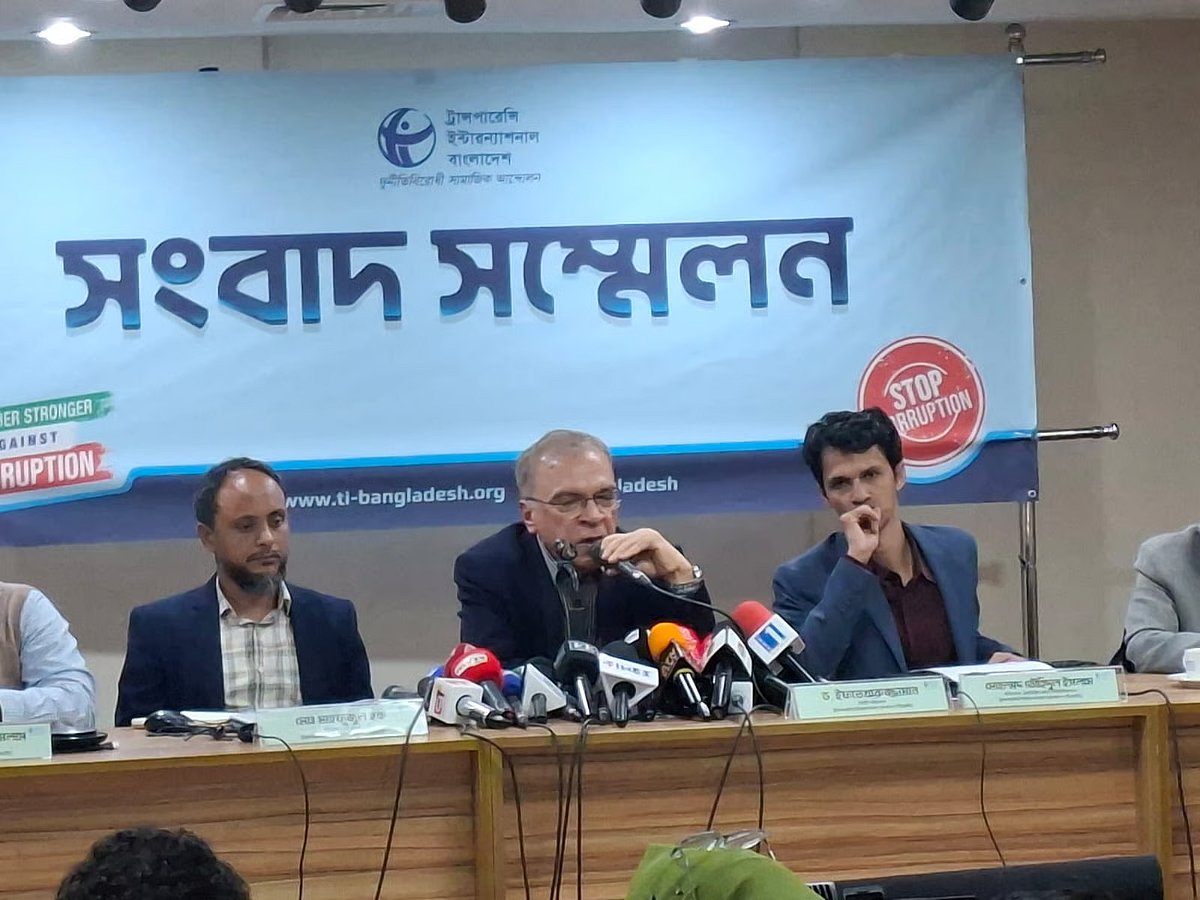
Election was participatory, no evidence of engineering: TIB
Transparency International Bangladesh (TIB) executive director Iftekharuzzaman has stated that the 13th national parliamentary election was participatory and inclusive to an acceptable degree.
He said that the organisation did not observe any elements of ‘election engineering’ in the polls. In TIB’s assessment, the election was generally acceptable, free, neutral and participatory.
Iftekharuzzaman made these remarks while responding to questions from journalists at a press conference held at TIB’s office in Dhanmondi, Dhaka on Monday morning.
TIB organised the press conference to publish its report titled ‘13th national parliamentary election process and affidavit-based observation.’
Responding to a question as to whether the election could be considered inclusive in the absence of the Bangladesh Awami League, Iftekharuzzaman said that leaders and activists of the Awami League participated actively at the local level by joining other parties or contesting as independent candidates.
He added that a significant portion of those who cast their votes belonged to the Awami League. He therefore stated that, based on facts, the election could be described as participatory and inclusive to an acceptable degree.
At the press conference, TIB presented a report outlining the overall situation of the election.
Using a representative sampling method, the organisation selected 70 constituencies at random from the total 300 parliamentary seats to prepare the report.
The report states that 99 per cent of the candidates who contested in this election violated at least one of the 58 electoral codes of conduct.
On voting day, incidents included attacks on an independent female candidate at voting centres, intimidation outside the centres, the expulsion of polling agents of independent candidates, the denial of entry to agents of rival candidates at certain centres, harassment of voters on the pretext of fabricated rules, one person casting votes on behalf of another, and the distribution of money during voting hours.
In addition, many voters who went to voting stations could not cast their votes because their names and photographs did not match the voter list.
Regarding post-election violence, the TIB report notes that in the 70 constituencies surveyed, clashes between political rivals occurred in 45 constituencies; incidents of intimidation against rival voters, activists and supporters occurred in 34 constituencies; attacks on houses and offices took place in 18 constituencies; and clashes among rebels within the same party occurred in 16 constituencies.
In its overall observations, TIB stated that although the election initially showed signs of relatively healthy competition, political parties and candidates gradually reverted to old practices of violent electoral conduct.
As a result, conflicts between parties and alliances, intra-party disputes, unhealthy competition for power and violence increased progressively and continued even after the election.
The report further states that in 21.4 per cent of the 70 constituencies surveyed, one or more incidents of ballot fraud took place.
Speaking at the press conference, TIB senior research fellow Md Mahfuzul Haque, who was involved in preparing the report, said that the researchers recorded even a single incident in a constituency.
He clarified that the percentage refers to the proportion of constituencies, not the percentage of votes.