Children are spending increasing amounts of time on mobile phones, televisions, tablets, and computer screens. Parents and guardians are worried and anxious about this trend. Some believe it is a problem unique to their own child. In reality, the problem exists in households across the country. Unregulated screen time is harming children’s physical and mental health.
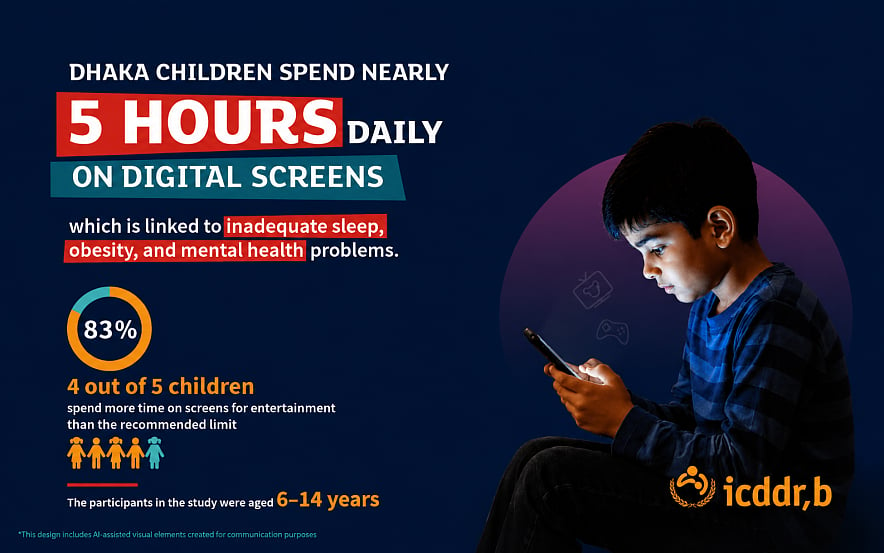
A study conducted by the International Centre for Diarrhoeal Disease Research, Bangladesh (icddr,b) has found that a large proportion of school children in Dhaka spend an average of nearly five hours a day looking at the screens of electronic devices such as mobile phones, televisions, tablets, or computers.
As a result, their sleep duration is decreasing, while weight gain, headaches, and eye problems are increasing. Negative impacts on mental health have also been observed.
The study was conducted over two years on 420 children from six schools in Dhaka. Its findings were published on 4 May in the Journal of Medical Internet Research (JMIR) Human Factors.
Five researchers from icddr,b and one researcher from Dhaka’s Tele Psychiatry Research and Innovation Network were involved in the study.
Shahria Hafiz Kakon, Assistant Scientist at icddr,b and the lead researcher of the study, said, “Parents should not ignore signs such as late sleeping, headaches or eye discomfort, unusual irritability or withdrawal, loss of interest in outdoor activities, or difficulty concentrating, as these may indicate that screen exposure is beginning to affect their children’s physical and mental health.”
The study paper states at the outset that because digital devices are now widely available and easily accessible, they have become part of children’s daily lives around the world. Children are spending increasing amounts of time on screens — in other words, more time watching mobile phones, televisions, tablets, or computers. Using digital screens for education and entertainment is not inherently harmful. However, excessive and uncontrolled screen time is emerging as a public health concern.
The study further notes that such conditions are negatively affecting children’s — especially schoolchildren’s — physical and mental health and overall well-being. One major concern is that excessive screen time encourages a sedentary lifestyle.
National Institute of Mental Health and Hospital assistant professor Muhammad Shibli Sadiq of the Child, Adolescent and Family Psychiatry Department told Prothom Alo that the problem is global.
However, he said, this study is extremely important for Bangladesh. Its findings are consistent with global research outcomes. He added that students should not have more than one to two hours of screen time daily and stressed the importance of determining practical measures to address the issue.
Two Years of Research
The study was conducted between July 2022 and June 2024 on 420 students from six schools under the Dhaka North and Dhaka South city corporations. Three schools were English-medium institutions and the remaining three were Bangla-medium schools. Seventy students were selected from each school.
The participants were between 6 and 14 years old and studied in different classes from Two to Eight. Ten students were selected from each grade level. However, students already suffering from mental health conditions such as depression or anxiety were excluded from the study.
Two trained research assistants and one research supervisor collected data from students at the schools.
The researchers spoke with the children, conducted physical examinations, and used internationally recognised questionnaires to determine how much time they spent on screens, whether they slept properly, whether their weight was within a healthy range, and whether they had behavioural or mental health problems.
Children at Risk
The study found that four out of five children (83 per cent) use digital screens for more than two hours a day, exceeding the internationally recognised limit of around two hours for recreational screen use among children. On average, children spend about 4.6 hours a day on screens.
The study also found that more than one-third of the children suffer from eye problems, while 80 per cent frequently experience headaches. Children who use screens for more than two hours daily sleep an average of only 7.3 hours, significantly below the recommended 8 to 10 hours necessary for healthy development at that age.
In addition, around 14 per cent of the children were found to be overweight or obese, and the rate was higher among those with greater screen use. Health experts have warned that chronic sleep deprivation during childhood can negatively affect memory, concentration, learning ability, emotional regulation, physical growth, and overall mental well-being.
The study further found that nearly two out of every five children suffer from one or more mental health issues, including anxiety, hyperactivity, or behavioural problems.
Researchers noted that excessive screen time can harm children in various ways. Using screens at night overstimulates the brain and disrupts normal sleep cycles. Long periods of sitting reduce physical activity and outdoor play, increasing the risk of obesity.
Excessive screen use can also cause eye strain, headaches, and reduced concentration. In addition, screen dependency reduces children’s direct social interaction with others, which can negatively affect their mood, emotions, and mental health.
International studies worldwide have similarly linked excessive screen use among children with inadequate sleep, reduced physical activity, obesity, anxiety, and poorer academic performance.
Lead researcher Shahria Hafiz Kakon told Prothom Alo that during the Covid-19 pandemic, children were given mobile phones for online classes. Even after schools resumed in-person classes, the devices never left their hands.
A form of addiction has developed, he said. Many parents themselves also spend four to five hours daily on screens. In addition, cities lack playgrounds. All these factors together have contributed to the current situation among students.
The Way Forward
Many parents, guardians, and children themselves want to overcome this problem. On Thursday evening, several mental health specialists told Prothom Alo that parents are visiting them daily seeking advice on how to help their children overcome screen dependency.
Lead researcher Shahria Hafiz Kakon said that for eye care, children are advised to follow the “20-20-20” rule. That means after every 20 minutes of screen use, they should look at something 20 feet away for at least 20 seconds. He also stressed the need for a national guideline on screen time.
Researchers said that completely banning technology is not the solution. Rather, children need to develop healthy and balanced digital habits at home and at school. To achieve this, easy-to-follow guidelines and awareness programmes for students, teachers, and parents should be introduced.
They emphasised the urgent need for intervention-based research and public health initiatives to control what they described as an invisible epidemic among Bangladeshi students.
Tahmeed Ahmed, executive director of icddr,b, said, “Digital devices are now part of modern life and education, but children need healthy boundaries. The World Health Organization recommends limiting recreational screen time for school-aged children to about 2 hours per day.”
“Parents should encourage outdoor play, physical activity, proper sleep, and device-free family time to help children grow both physically and mentally. They should also have extra curricular activities such as debates, group reading, library, taking care of pot plants etc.” he added.