July mass uprising
Many in long illnesses, 39 still receiving treatment abroad
How are you? On the mobile phone, Md Rakib Uddin says, "I'm good, but my body is not entirely okay." Is your health very bad? He says, "I have muscle spasms. My left leg has become shorter. I can't sleep well at night. A medical board convened at the orthopedic hospital a few days ago. The doctors said I won't fully recover. Going abroad won't help much either."
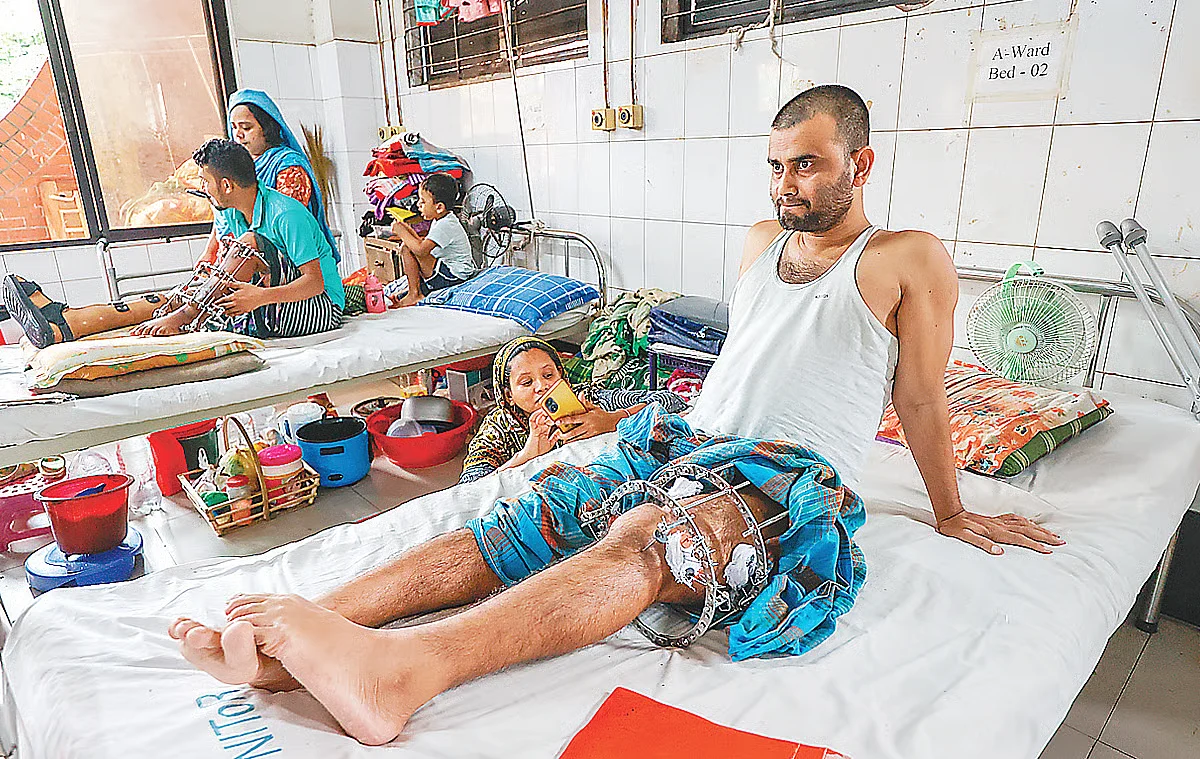
According to the latest government figures, 843 people were killed, and 14, 370 were injured due to police shootings and violence during the July Mass Uprising. One of the injured is Md Rakib Uddin, a resident of Uttara. He is currently a student at Daffodil International University.
Md Rakib Uddin was on the streets with student protesters during the tumultuous days of July. On the evening of 18 July 2024, police opened fire on protesting students in Rabindra Sarani, Azampur, Uttara. Md Rakib Uddin, a student of Uttara High School and College, was among the injured. He was shot from the front in the waist. At the time, his higher secondary exams were ongoing.
Md Rakib Uddin says, "Initially, I was taken to Crescent Hospital in Uttara. From there, to Shaheed Suhrawardy Medical College Hospital, then to the National Heart Institute and Hospital. At around 2am, I was taken to the orthopedic hospital." He stayed in that hospital for a long period. He has undergone three major surgeries on his leg and waist. Doctors are also considering a hip joint replacement.
Director of the National Orthopedic Hospital and Rehabilitation Institute (orthopedic hospital), Professor Abul Kenan, told Prothom Alo, "Many of the injured come regularly for follow-ups. They are prioritised. Treatment is provided based on expert advice.
Officials of the July Mass Uprising Directorate, under the Ministry of Liberation War Affairs, have stated that the injured from the uprising have been categorised into three categories based on the severity and impact of their injuries. However, each injured person has been provided with a ''Health Card''. Using this card, they can receive necessary treatment from any government hospital or selected private hospitals.
Injured are in 3 categories
The government has divided those injured during the July Mass Uprising into three categories. The most severely or critically injured individuals belong to ''Class A''. Their injuries have caused lifelong disabilities, such as the loss of eyesight, limb amputation, or permanent impairment of a major body part.
Those in ''Category A'' receive a monthly allowance of Tk 20,000.
Additionally, they are given one-time financial assistance of Tk 500,000.
There are 990 individuals in this category.
Next are those in ''Category B'', who were seriously injured but do not have the permanent or complete disabilities of ''CategoryA''. Their treatment is prolonged, and recovery takes significant time. Md Rakib Uddin from Uttara reports that he is categorised under ''Category B''. They receive a monthly allowance of Tk 15,000, along with one-time financial assistance of Tk 300,000. There are 1, 417 individuals in this category.
Then there are those in ''Category C'', who sustained injuries of a general or moderate nature. Their injuries are comparatively less severe. They receive a monthly allowance of Tk 10,000 and one-time financial assistance of Tk100,000. They number 11,963 individuals.
Treatment abroad
After the fall of the Awami League government on 5 August 2024, the treatment of July fighters gained special attention. Various medical expert teams from the United States, United Kingdom, France, Thailand, Singapore, and China came to Bangladesh. They advised and sometimes participated in treating the injured admitted to the orthopedic hospital, National Eye Institute, Combined Military Hospital, and Bangladesh Medical University. However, for many, traveling abroad for advanced treatment became imperative.
According to information from the July Mass Uprising Directorate, so far, 154 seriously injured individuals have been sent to Singapore, Thailand, Russia, and Turkey for advanced treatment. Of them, 105 have returned to the country, while 39 remain abroad. Officials have reported they are all in Thailand, most having sustained gunshot wounds and receiving orthopedic treatment. As of 15 March, the government has spent Tk 3,489,999,207 on them.
Permanent damage
When dispersing protesters during the July Mass Uprising, the police indiscriminately used pellet guns. Many with pellet injuries to the eyes and various parts of their body were admitted to Dhaka Medical College Hospital and the National Eye Institute.
Current government data shows that 502 individuals sustained eye injuries during that time. Among them, 28 have permanently lost their vision. Around 100 individuals (give or take a few) have lost sight in one eye, while others suffer from various eye problems.
During the movement, delays in treatment or severe injuries led to some people having their hands or legs amputated. Such injured individuals have been fitted with artificial limbs at the BRAC Limb Centre, operated in Mohammadpur with support from BRAC and BRAC Bank.
Md Shahinul Haque, director of the BRAC Limb Centre, told Prothom Alo that they have provided artificial legs to 34 people and artificial arms to 5.
Additionally, 68 individuals have been given braces or physical aid equipment. Psychosocial counseling has been provided to 147 individuals. Sixty people regularly receive physiotherapy from the centre.
Obstacles in emergency treatment
Except for a few government hospitals, generally, hospitals in the country lag in emergency medical services. Almost none have experience managing many patients simultaneously. Private hospitals, big or small, do not take responsibility for injured road accident patients. There was no preparation or extra initiative during the July Mass Uprising.
During the July Mass Uprising, reporters from Prothom Alo visited 38 government and private hospitals in the capital to survey the treatment situation of the injured. It was found that the wounded did not receive timely and adequate treatment. Hospitals, especially private hospitals and clinics, expressed reluctance to admit the injured. Many declined hospital treatment out of fear of arrest. Concerns about who would cover the treatment costs for so many people simultaneously deterred many private institutions from admitting patients. Some hospitals also experienced government interference.
An investigation into what happened at the hospitals during that time was conducted by researchers from the International Centre for Diarrhoeal Disease Research, Bangladesh (icddr, b), Eminence Associates for Social Development, University of North Carolina, Singapore National University, WaterAid Asia Region, and the international organisation Ipas. A Prothom Alo representative and one from the Swedish Embassy were in the research team. Their research paper was published last year by Bangladesh Health Watch.
The research found that due to fears of the police or litigation, lack of transportation or road blockades, many injured struggled to reach hospitals. There was a lack of companions to accompany them, and admission was denied by some facilities. Some institutions delayed admitting patients, causing treatment delays in hospitals.
Treatment was insufficient in some cases, referral systems were not adequate, some hospitals were overwhelmed with patient inflow, and keeping accurate patient names and addresses was challenging.
The treatment protocol was sometimes violated (such as performing surgeries without pain management), bribes were demanded for treatment, patients were asked to leave before recovery, there was a shortage of morgues in private hospitals and public morgues had limited space, police interference was evident, there was harassment when transferring bodies, autopsies were sometimes not conducted, and when done, were delayed.
Death records were often inadequate, there were shortages of medicine and personnel, and there was a lack of coordination between policymakers and healthcare institutions. Political interference was also present.
Shamim Haider Talukder, a member of the research team and the CEO of Eminence Associates for Social Development, told Prothom Alo that, from mid-July, people in many areas like Uttara, Badda, Rampura, Mirpur, Shanir Akhra, Mohammadpur, and Sayedabad in the capital, and in other major cities, were injured.
At the time, the Awami League was in power. Many injured people did not go to hospitals out of fear. Some refrained from receiving treatment, while others sought medical help only after the government's fall.
Had such circumstances not prevailed, and if all physicians had fulfilled their humanitarian duties, the death toll might have been lower, and the complexity in injured patients wouldn't have reached the current extent.