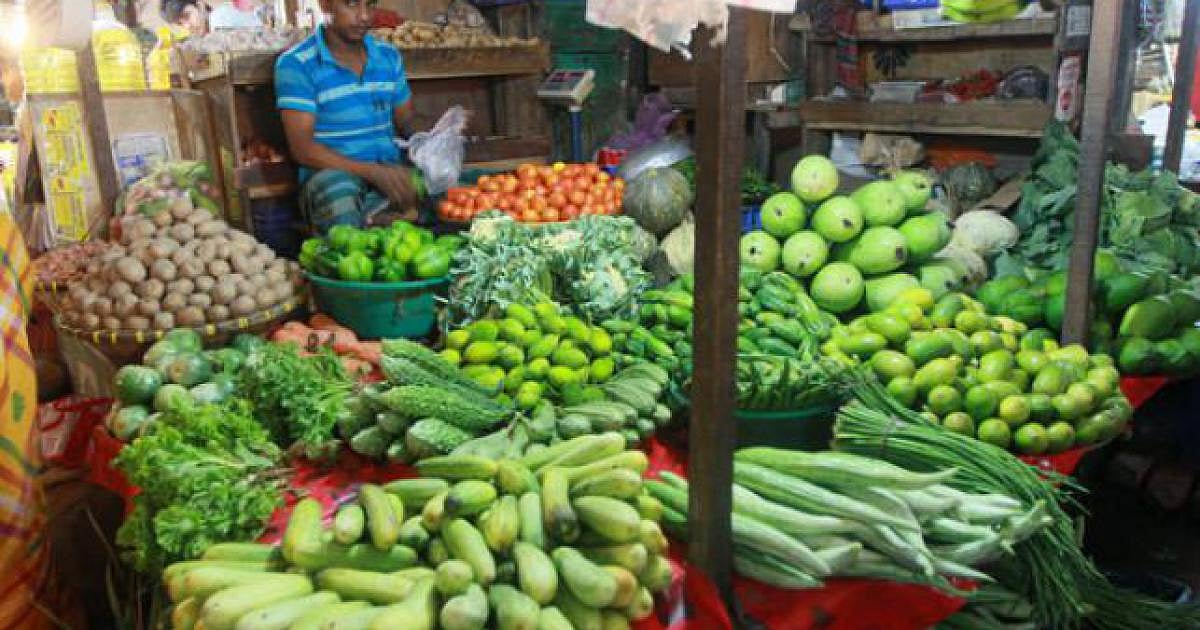
From Bogura to Dhaka
Multiple transfers and extortion increase vegetable prices
The collection of unofficial payments on agricultural produce begins at the market where farmers first bring their vegetables after harvesting.
From that point onwards, the produce changes hands multiple times before reaching consumers, with the price rising at every stage.
In addition to transport costs, extortion by transport owners’ and workers’ organisations along the route, as well as tolls collected by municipal leaseholders, are also added to the price of the produce.
To investigate the causes behind rising vegetable prices, this reporter travelled on Thursday evening on a vegetable-laden truck from Mahasthan market in Bogura to Jatrabari in the capital.
During the journey, the reporter spoke with farmers, commission agents, market leaseholders, traders, and transport workers.
The findings showed that on Thursday morning at Mahasthan market, farmers sold hyacinth beans at the wholesale level for Tk five per kilogram.
However, on Friday morning consumers bought the same beans at Tk 70 per kilogram at Mohammadpur kitchen market in the capital.
Similarly, green chillies that farmers sold in Bogura for Tk 36 per kilogram were selling in Dhaka for Tk 120.
Traders say the vegetables change hands at least five times before they reach consumers in the capital from the producing areas.
Farmers first take the harvested vegetables to the market, where middlemen and traders purchase them and deliver them to commission agents.
From there the vegetables travel by truck to various wholesale markets in the capital. Wholesalers or middlemen then purchase the produce from those commission agents.
Finally, retailers buy the goods from the middlemen and sell them to consumers.
Through this step-by-step process, intermediaries collect money at various stages on different pretexts from vegetables grown by farmers. As a result, prices increase and consumers ultimately bear the burden.
Farmers trapped by the “Dhalta” system
Shahidul Islam, a farmer from Pirgacha village in Bogura Sadar, sold 10 maunds of tomatoes at Mahasthan market on Thursday.
The price agreed for each maund was Tk 800. However, instead of receiving Tk 8,000, the trader paid him Tk 7,200.
Shahidul said, “I brought 10 maunds of tomatoes to the market, but one maund goes free. The trader takes 20 kilograms as ‘dhalta’, and another 20 kilograms go as market toll.”
Conversations with farmers revealed that growers must give two kilograms extra per maund to commission agents and traders when they sell vegetables. This additional portion is locally known as “dhalta”.
Furthermore, the leaseholder’s representatives collect another two kilograms per maund as market toll.
As a result, when farmers sell 10 maunds of vegetables at the market, they receive payment for only nine maunds.
Farmers say the collection of “dhalta” by holding them hostage has now effectively become an established rule in the market.
In addition, commission agents at Mahasthan market charge buyers a commission of eight per cent of the vegetable price.
After the produce reaches Dhaka, wholesale commission agents deduct another four taka per kilogram.
Taherul Islam, general secretary of the BNP in Raynagar Union and the leaseholder of Mahasthan market, claimed that the tolls were being collected in accordance with regulations and that no irregularities were taking place.
Shafiqul Islam, president of the Mahasthan Market Vegetable, Raw and Ripe Goods Traders and Commission Agents Association, told Prothom Alo that some vegetables rot during transportation from the commission markets to wholesale depots.
For this reason, the practice of taking two kilograms per maund as “dhalta” from all types of vegetables has been in place at this market for the past eight to 10 years.
“Extortion” in the name of arranging trucks
When the truck carrying vegetables left Mahasthan market, a man handed the driver a piece of paper.
The document, bearing the heading “Inter-District Truck Transport Workers’ Union, Bogura”, was issued to the driver while a man named Khayrul Islam (Khaja) collected Tk 500 from the driver.
Khayrul Islam is the president of the Mahasthan Pickup Van Owners’ Association.
Khayrul Islam said, “This is not extortion. Traders send vegetables worth millions of taka to wholesale markets in Dhaka, Chattogram, and Sylhet. Because goods are sometimes sent in unfamiliar trucks, there is a risk of losing the cargo. For that reason, we help arrange truck transport by recording the driver’s name and address, driving licence number, and other details on the consignment document. We also keep photocopies of the driver’s national identity card and driving licence. In short, we take responsibility for the traders’ goods.”
Extortion on the road somewhat less
On Thursday evening, a truck carrying 15 tonnes of vegetables departed from the wholesale depot at Mahasthan market for Dhaka.
The truck contained cucumbers, hyacinth beans, bottle gourds, potatoes, green chillies, and various other vegetables.
When the truck reached the Charmatha Bhaber Bazar area in Bogura town, the driver said that until recently people would stop cargo trucks there and collect Tk 300 as extortion. However, he added that such extortion no longer occurs now.
As soon as the truck entered the Sherpur municipality area of Bogura, a young man carrying a stick stopped it.
He issued a receipt and collected Tk 50. Speaking on condition of anonymity, the young man said that he was collecting the money on behalf of Ruhul Alam, the leaseholder of Sherpur Municipality.
When the truck reached Chandaikona, the driver, Rana Mia, said, “They used to collect Tk 100 here as well, but since it is late at night we have been spared.”
Before reaching the western toll plaza of the Jamuna Bridge, the driver and his assistant said that traffic police used to stop trucks there and collect money.
However, they added that the practice has decreased significantly over the past two weeks.
It was around 11 pm when the truck reached Elenga in Tangail. Highway police stopped the truck to inspect its documents.
After checking the driver’s licence and vehicle papers, the police officer said that he would file a case for carrying goods beyond the permitted capacity.
The driver eventually secured release after giving the driver’s assistant Tk 500 to cover “tea and snacks” for the police.
Around midnight the vegetable-laden truck arrived at Kaliakair market in Gazipur.
There, a man issued a receipt and collected Tk 100. Speaking anonymously, he said that he worked for the leaseholder of Kaliakair Municipality.
After unloading 50 sacks of cucumbers at that market, the truck continued its journey.
At about 2 am, the truck arrived at Shah Ali Market in Mirpur-1. The driver said that they usually had to pay Tk 100 in extortion there, although currently no such payment was required.
After unloading 50 sacks of cucumbers and 100 sacks of potatoes there, the truck proceeded to Karwan Bazar.
At that market, workers unloaded 50 sacks of cucumbers, 500 kilograms of hyacinth beans, and 20 sacks of green chillies before the truck headed to its next destination, Shyambazar in the capital.
After unloading 50 sacks of cucumbers at Shyambazar, driver Rana Mia said, “Even a month ago we had to pay Tk 100 to the lineman at Karwan Bazar and Tk 200 at Shyambazar. Now there is no extortion.”
At around 3:45 am, the truck reached Jatrabari. As soon as the truck stopped there, several men associated with the leaseholder rushed over. They took the driver’s assistant aside and demanded Tk 250.
After paying the money, workers unloaded 100 sacks of cucumbers. The truck quickly left Jatrabari before dawn in order to avoid possible harassment by the police.
A calculation showed that the driver had to pay Tk 150 at various points with receipts and a further Tk 400 without receipts while transporting the 15 tonnes of vegetables from Bogura to Jatrabari.
Prices multiply in Dhaka
Traders say it costs on average two taka per kilogram to transport vegetables from Mahasthan market in Bogura to wholesale markets in Dhaka.
Labour charges and the cost of sacks add another two taka per kilogram. In total, the transport cost from Mahasthan in Bogura to Dhaka comes to around four taka per kilogram.
At Mahasthan market on Thursday, cucumbers sold for Tk 12 per kilogram. However, on Friday morning consumers purchased the same cucumbers for Tk 40 per kilogram at Mohammadpur kitchen market in the capital.
Similarly, eggplant that sold for Tk 12 per kilogram in Bogura were selling for Tk 60 in Dhaka; carrots that sold for Tk 20 were selling for Tk 40; Diamond variety potatoes priced at Tk 8 to 11 per kilogram were selling for Tk 15 to 30; bottle gourds that sold for Tk 20 each were selling for Tk 70; drumsticks priced at Tk 100 were selling for Tk 160; and radishes that sold for Tk 20 per kilogram were selling for Tk 40.
These prices are approximately two to three times higher than the prices received by farmers.