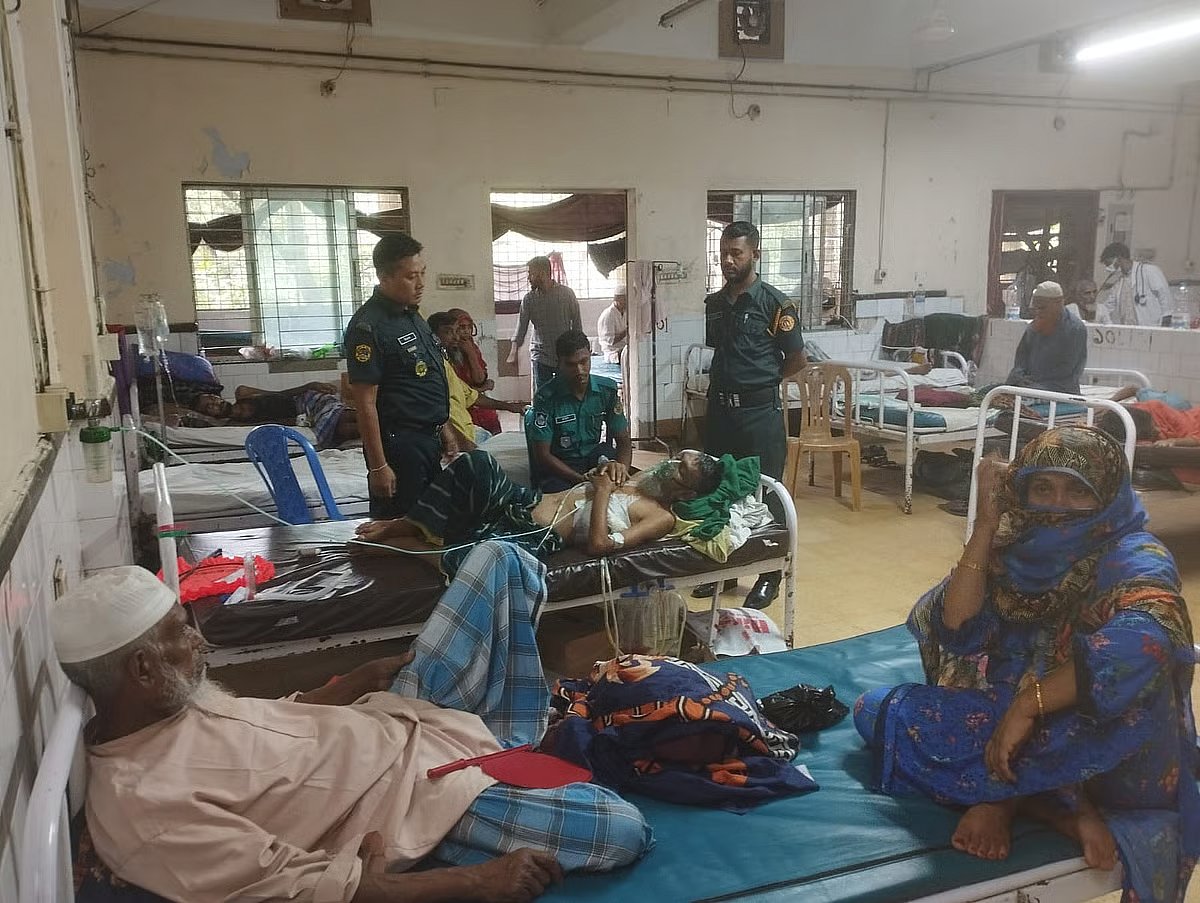
Chattogram Medical College: ‘Police beside my son’s bed, it’s very uncomfortable’
In ward no. 13 of Chattogram Medical College Hospital (CMCH), Hazera Begum sat beside her son’s hospital bed, visibly tired and frustrated. Her son’s bed is next to that of an accused person, surrounded by four police officers and prison guards. Hazera said she constantly feels uneasy. She always has to remain alert. Even leaving the ward or resting beside her son feels uncomfortable.
“I have been staying with my son day and night. The police are beside his bed — it feels very awkward,” she said.
Although CMCH has a 30-bed prison cell, it has been vacant for five years. In the absence of a separate facility, ill prisoners from various jails are being treated in general wards alongside ordinary patients.
Detainees under police custody also receive treatment there, accompanied by guards and police, creating discomfort for relatives of regular patients like Hazera Begum.
Senior police officials have acknowledged that providing treatment to prisoners in general wards poses security risks and makes it difficult to control the movement of outsiders. Despite repeated requests from prison and police authorities, the CMCH administration has yet to make the prison cell operational.
Currently, 10 inmates or detainees from prisons and police stations are receiving treatment at the hospital. Relatives of at least 15 nearby patients have complained of unease due to the constant presence of police and guards.
Arrestees injured during police operations are also brought to the hospital for treatment. As there is no functioning prison cell, they too are treated in regular wards.
During a visit, it was observed that Saiful Islam, an accused detained by Chandgaon Police Station, was being treated in the casualty ward, guarded by constables Md Siam and Md Zobayer.
“We feel constantly uncomfortable having two police officers guarding someone right beside us,” said Saleha Khatun, wife of another patient, Nurun Nabi.
The original prison cell was allocated in 2011 on the hospital’s ground floor but was later closed due to poor ventilation and lighting. In late 2019, the hospital authorities designated a new space on the second floor’s western wing — a room 75 feet long and 26 feet wide, designed to accommodate 30 beds, with 15 for male and 15 for female prisoners. However, the facility remains unused and neglected, with scattered equipment and unmaintained beds.
In late 2019, the hospital authorities designated a new space on the second floor’s western wing – a room 75 feet long and 26 feet wide, designated to accommodate 30 beds, with 15 for male and 15 for female prisoners. However, the facility remains unused and neglected, with scattered equipment and unmaintained beds.
The continuous deployment of police and prison guards to monitor inmates disrupts their regular duties. According to prison sources, inmates requiring advanced medical care are transferred to CMCH from 11 prisons across Chattogram, including those in Bandarban, Khagrachari, Rangamati, Cox’s Bazar, Noakhali, Feni, Lakshmipur and Cumilla.
Each prisoner requires daily supervision by six prison guards and four police officers. With the hospital already overcrowded, many general patients are forced to stay on the floor, while around 10 officers per inmate are engaged in guard duty, causing inconvenience to other patients’ relatives.
Even when prisoners are brought from other districts, they are guarded by Chattogram jail staff. Despite a shortage of guards compared to the number of inmates, six are assigned daily per prisoner for hospital duty.
In July, Chattogram Metropolitan Police Commissioner Hasib Aziz sent a letter to CMCH authorities, stating that although a prison cell exists in the hospital, inmates and detainees continue to be treated in various wards.
This situation has led to incidents of escape, including that of an accused in an arms case, Rafiqul Islam, who fled on 16 April while under treatment, still handcuffed. He was later re-arrested.
The letter further noted that without confining detainees to the prison cell, it is impossible to restrict outsider access, necessitating the deployment of 150–200 police personnel for hospital security — a strain on the city’s law enforcement operations.
To optimise manpower and security, a meeting held on 27 May at CMP Headquarters decided that except for those critically ill and requiring admission to the ICU or CCU, the rest would receive treatment in the prison cell.
Roish Uddin, Deputy Commissioner (Crime) of CMP, told Prothom Alo that if the prison cell were functional, around 150 additional police officers would not need to be assigned daily.
“It could be managed with just 10 to 12 personnel. Despite repeated requests, it still hasn’t been opened,” he said.
Md Sagir Mia, Deputy Inspector General (DIG-Prisons) of the Chattogram Range said, “If the prison cell becomes operational, additional guards will no longer be required, and security risks will be significantly reduced. Despite repeated reminders, the hospital authorities have yet to activate it.”
When contacted, Brigadier General Mohammad Taslim Uddin, Director of CMCH said, “There is currently a shortage of staff, but the prison cell will be made operational very soon.”