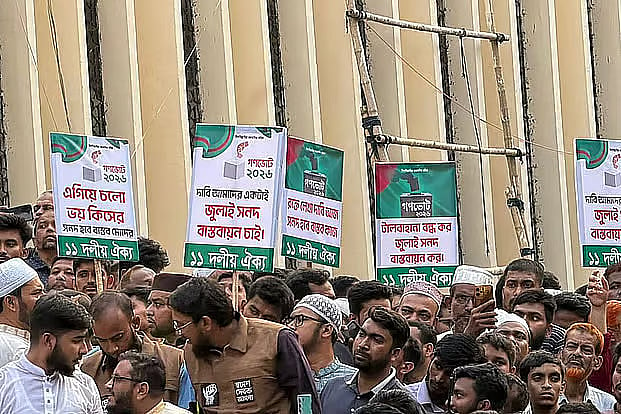
Jamaat wants to contest local govt elections on its own, what will other alliance partners do
Jamaat-e-Islam is considering contesting the upcoming local government elections independently, while some of its alliance partners hold differing views.
Jamaat, once a partner in the BNP alliance, participated in this year's 13th National Parliamentary Elections by forming an 11-party alliance. However, by mid-year, divisions have emerged within the alliance.
According to multiple sources within the 11-party alliance, if a settlement with Jamaat isn't reached, Bangladesh Khilafat Majlis and Khilafat Majlis are considering alternative electoral arrangements.
They are trying to involve the National Citizens' Party (NCP) in this discussion. Some other parties are in favour of a coordinated strategy similar to the national elections.
The Election Commission (EC) is preparing for elections at various levels of local government from October onward. Besides taking organisational preparation, different political parties are also organising their strategies.
According to sources, this will be the first major electoral test for parties under the new political reality since the 13th National Parliamentary Elections.
Therefore, nearly all parties see the local government elections as an opportunity to assess their organisational strength. Hence, discussions about candidates and settlements have started early.
Some parties in the 11-party alliance argue that if there isn't a coordinated effort in the local government elections, there might be confusion at the grassroots level. In areas where multiple alliance parties have a strong presence, not fielding a single candidate could split the votes.
On the other hand, Jamaat believes that local government elections are venues to test party organisational capability and local leadership. Therefore, running independently rather than through central settlements is realistic.
According to sources within the government and EC, the schedule for the local government elections might be announced at the end of August or in September. Initially, union Parishad and municipal elections are more likely, followed by City Corporation and other levels of elections in phases.
What Jamaat thinks:
Jamaat leaders argue that local government elections are not seat-based; it’s impractical to make central settlements for the numerous positions from union Parishad to City Corporation. This election is a field to build party organisational strength and local leadership. Therefore, each party should have the opportunity to test its organisational capability.
Jamaat's Assistant Secretary General Hamidur Rahman Azad told Prothom Alo that it took months to make settlements for the 300 seats in the national parliamentary elections. It's impractical to make similar settlements for many local government positions. In the past, elections have never been conducted as an alliance. However, if a settlement happens at the local level, there will be no central hindrance.
When asked about the talks of settlements excluding Jamaat, Hamidur Rahman Azad said he has no information on such discussions. If the situation arises, the matter can be considered then.
Dissatisfaction lingering in various parties
Although there was seat agreement after long discussions in the national parliamentary elections, there was dissatisfaction among several parties of the 11-party alliance for receiving fewer seats than expected. Although they compromised for greater political goals, the dissatisfaction hasn't completely subsided.
The greatest dissatisfaction was within the Khilafat Majlis led by Maulana Abdul Basit Azad and Ahmad Abdul Quader. Despite a settlement for 10 seats, the party demanded more. The party, not receiving a reserved women's seat, thinks that Bangladesh Khilafat Majlis is being given more importance than them in the alliance. On 25 July, Khilafat Majlis reported that it would no longer participate in any programme of the 11-party alliance.
Khilafat Majlis leaders say they will continue trying for a settlement with Jamaat for the local government elections. If that's not possible, they have two alternative plans: participating independently or contesting through settlements with a few parties outside Jamaat. However, they have stated that these discussions are still in the preliminary stages.
Leaders of Bangladesh Khilafat Majlis, led by Maulana Mamunul Haque, are also in favour of unified elections. The party's Joint Secretary General, on condition of anonymity, told Prothom Alo that if Jamaat wishes to participate independently, they should make it clear quickly. Then they will initiate discussions for agreements with other parties. Even parties outside the 11-party alliance can be part of this settlement.
In preliminary discussions, a response from NCP has also been received, according to a leader. He said discussions regarding local government elections might take place in the next meeting of the liaison committee of the 11-party alliance.
When asked, Bangladesh Khilafat Majlis's Ameer Maulana Mamunul Haque told Prothom Alo that like the parliamentary elections, they want to participate in local government elections as an alliance. However, if Jamaat goes alone, they will have to consider alternatives. What those alternatives might be will be decided through discussion.
However, AB Party Chairman Mujibur Rahman Manju feels there is little possibility of a central alliance of the 11 parties for local government elections. He told Prothom Alo, "It may happen in some local regions, districts, or upazilas."
What NCP will do:
Ahead of the local government elections, NCP is also making organisational preparations. The party's spokesperson, Asif Mahmud Shojib Bhuyain, is a potential candidate for the mayor post of Dhaka South City Corporation.
Party sources say he wants Jamaat's support for this post. However, Jamaat is preparing former DUCSU VP Shadik Kayem as a potential candidate for the same post, and related persons think there is little chance of agreement between the two parties in Dhaka South.
A source related to the 11-party alliance said that ahead of local government elections, NCP spokesperson Asif Mahmud has spoken with Bangladesh Khilafat Majlis's Ameer Maulana Mamunul Haque.
Maulana Mamunul Haque has also acknowledged the matter, saying Asif Mahmud communicated for assistance in his electoral activities.
No comment was received from Asif Mahmud regarding this matter. However, he had previously told Prothom Alo that he has a good personal relationship with Maulana Mamunul Haque and that NCP leaders also maintain regular communication with him.
NCP sources say that for the local government elections, the party is currently focusing on independent preparation. Since the schedule announcement isn't clear yet, no decision has been made regarding an electoral alliance or settlement. Informal discussions are ongoing with various parties.
NCP's senior joint convener Ariful Islam Adib told Prothom Alo on 21 July that NCP is currently preparing to contest independently, trying to strengthen its organisational position and familiarise candidates.
However, if it seems that making agreements in important city corporations can increase the chances of winning, there may be settlements among the 11 parties, either before or after the schedule announcement.
An indication that a settlement might be possible with NCP was found in Maulana Mamunul Haque's words from Bangladesh Khilafat Majlis.
He recently told Prothom Alo that there is a cordial relationship with NCP not only because of being in the alliance. However, there has been no discussion yet about contesting elections as an alliance with NCP.
No party has yet taken a final position regarding the local government elections. However, whether the elections will be centrally coordinated or parties will adopt different strategies based on local realities is already clear from the positions of the partners in the 11-party alliance. After the schedule announcement, the real picture of that position can also become apparent.