Load-shedding to ease from next week: Power Minister
Power, Energy and Mineral Resources Minister Iqbal Hasan Mahmud has stated that load-shedding will begin easing from next week.
He also said the government was preparing an inventory of all unused state-owned land to allocate for solar power generation.
The minister said solar energy now offered the only viable long-term solution, adding that the prime minister had instructed all ministries to identify unused land under their control.
“Railways is the biggest landowner and has a great deal of unused land. We are trying to identify those plots,” he said.
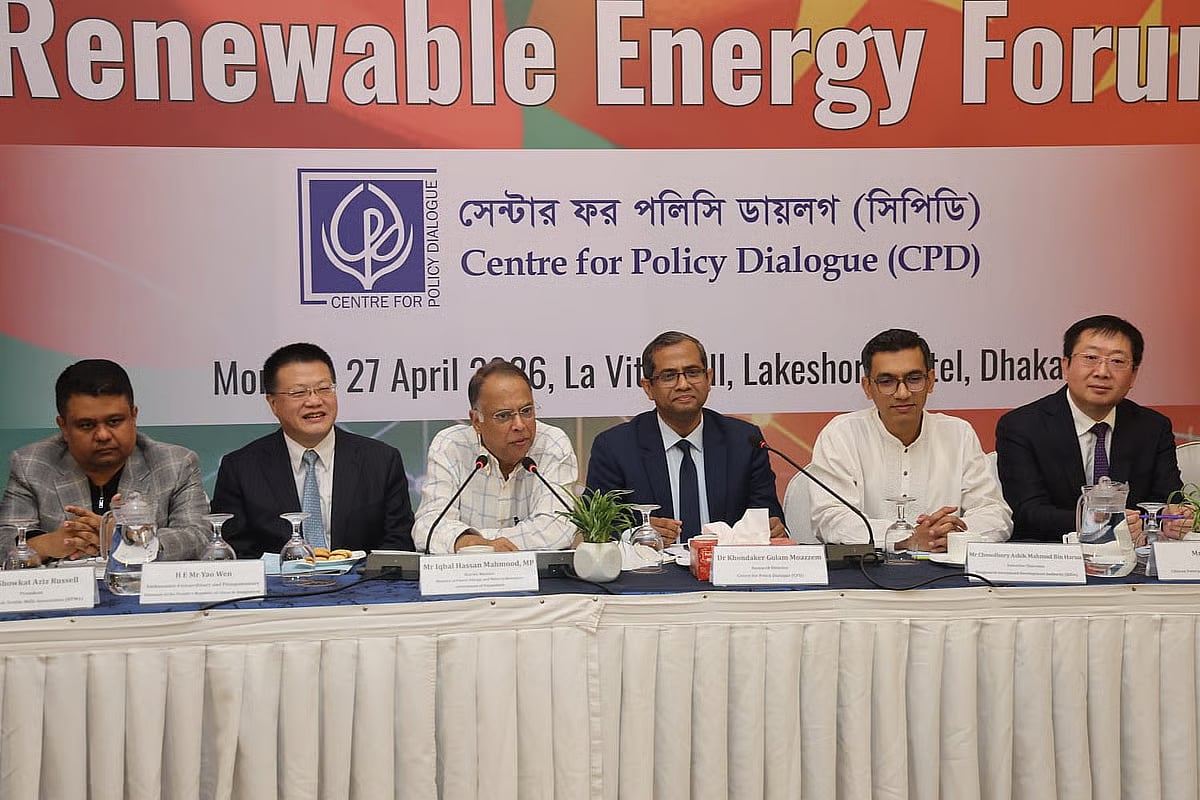
He made the remarks while speaking as chief guest at a seminar during the Fourth Bangladesh-China Renewable Energy Forum at a hotel in Gulshan on Monday.
The session was chaired by Khondaker Golam Moazzem, research director at the Centre for Policy Dialogue (CPD), where participants discussed challenges and policy priorities in the renewable energy sector.
Speaking at teh event, Chinese Ambassador to Bangladesh Yao Wen said uncertainty over global fuel supplies made cooperation in renewable energy increasingly important.
Iqbal Hasan Mahmud said 900 acres of land in Sirajganj alone remained unused and could be opened to private-sector investment.
“We want to generate 10,000 megawatts of renewable electricity over the next five years,” he said.
On the power crisis, the minister said the situation had worsened soon after he took office.
“My luck has been bad; load-shedding began just after I assumed responsibility,” he said. “There is Tk 56,000 crore (560 billion) in arrears in the public sector, so power companies are unable to buy oil and coal. But conditions should improve somewhat next week. Load-shedding will be brought down to 800–900 megawatts.”
Speaking at teh event, Chinese Ambassador to Bangladesh Yao Wen said uncertainty over global fuel supplies made cooperation in renewable energy increasingly important.
“No one can say when the war will end and when fuel supplies will return to normal,” he said. “So we can work together in the renewable sector.”
Capacity underused amid fuel shortages
Despite having power generation capacity nearly double peak demand, Bangladesh has been unable to utilise much of it because of fuel shortages, unpaid bills and technical constraints.
Sources at the Bangladesh Power Development Board (PDB) and Power Grid PLC (PGCB) say installed generation capacity now stands at nearly 29,000 megawatts. But in recent days output has not exceeded 14,000 megawatts, and for much of the day has hovered around 12,000 megawatts.
Demand is currently around 14,000 to 15,000 megawatts, resulting in load-shedding of roughly 2,000 to 2,500 megawatts.
Against this backdrop, the power minister has placed renewed emphasis on expanding solar power generation.