Questions raised over investigations into enforced disappearances, calls for amendments to bills
Human rights activists, lawyers and former members of the commission that investigated enforced disappearances have questioned a provision in two bills on human rights and enforced disappearances that would give the relevant law enforcement agencies the power to investigate allegations against their own forces.
They have called for amendments to the bills, warning that passing them without ensuring independent investigations would make it even more difficult to secure justice and accountability for enforced disappearances.
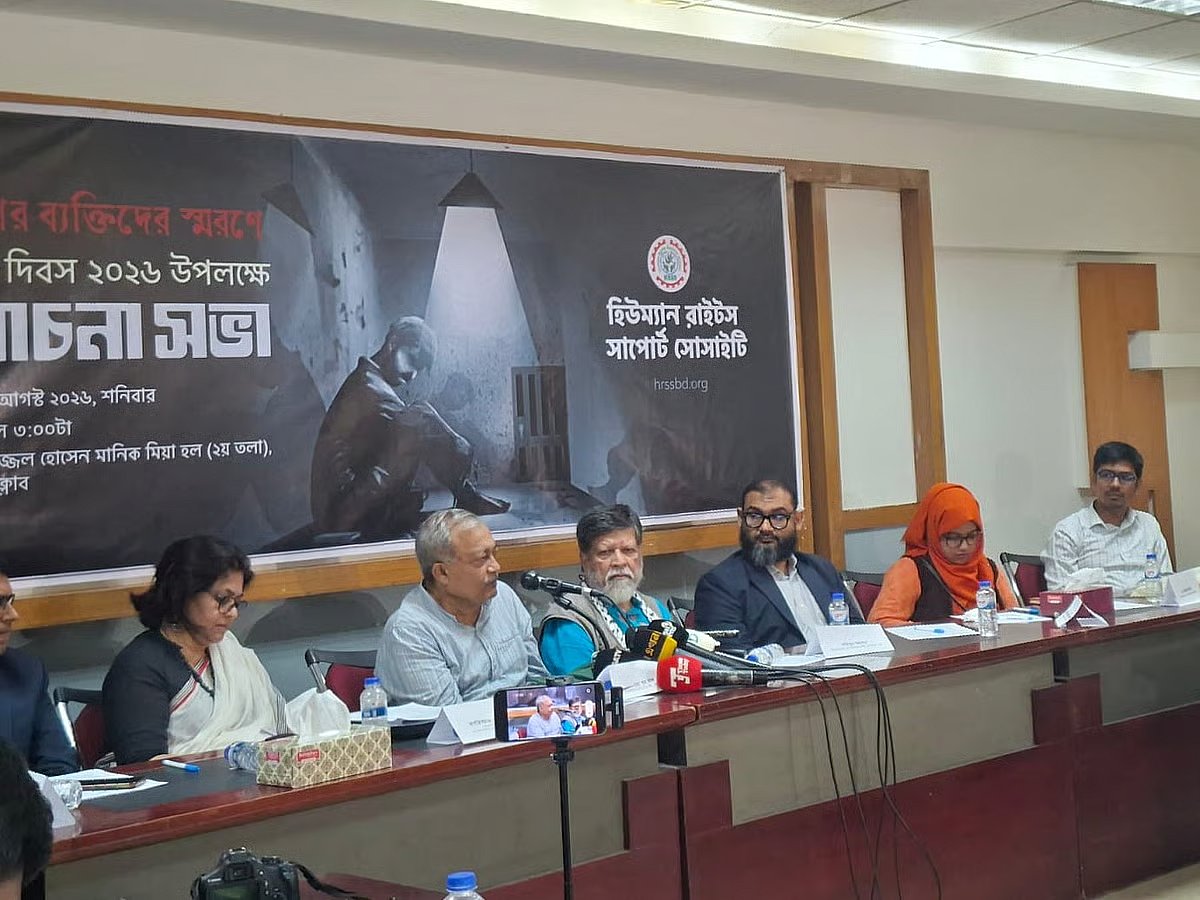
They made the remarks at a discussion held at the National Press Club in Dhaka on Saturday afternoon to commemorate victims of enforced disappearances. Human Rights Support Society (HRSS) organised the event ahead of International Day of the Victims of Enforced Disappearances on 30 August.
Victims of enforced disappearance and their family members, human rights activists, lawyers and civil society representatives attended the event.
Senior Supreme Court lawyer Sara Hossain said both the proposed laws on the National Human Rights Commission and prevention of enforced disappearances should provide for an independent investigation process.
“If the investigation process is not changed, people will essentially be deceived. You cannot be the judge of your own case,” she said.
She also said both laws were necessary.
Sara Hossain said there was no neighbouring country with such an arrangement. “The big test now is what the parliamentary standing committee will do with the two bills. It remains to be seen how much they will take expert opinions into account,” she said.
She also described the role of the courts as another major test. “Our courts have failed. Almost no one could approach the courts. …Those who did approach them did not get any kind of remedy there. …This is also a major test for the government: will they remain silent as before? Will they give the courts no direction…will they ignore the entire process? Or will they create an opportunity for accountability there for the first time?” she said.
Noor Khan Liton, a former member of the commission that investigated enforced disappearances, said it would be better not to have a law at all if the National Human Rights Commission was not given effective authority to investigate enforced disappearances allegedly carried out by law enforcement agencies.
“There is no point spending so much money to support five commissioners, giving them cars, security and offices if they cannot do this,” he said.
Noor Khan said the proposed law must give the National Human Rights Commission the authority to independently investigate enforced disappearances allegedly carried out by law enforcement agencies.
Keeping the commission dependent on the agencies by merely obtaining information from them or conducting inquiries through them would not ensure effective investigations, he said.
‘Will facilitate enforced disappearances’
Mir Ahmad Bin Quasem, also known as Barrister Arman, a Dhaka-14 lawmaker who was himself a victim of enforced disappearance during the previous Awami League government, said the current parliament was a gathering of people who had suffered persecution.
“There is no member of parliament here whose family or they themselves have not faced oppression or persecution over the past 17 years. A law that will facilitate enforced disappearances is now going to be passed by those very people who suffered,” he said.
Photographer Shahidul Alam said, “It is said that these laws are being framed in a way that benefits the security forces. But the security forces themselves are responsible for these things. And the responsibility of elected representatives is to control these security forces. If they do not control them but instead allow them to operate according to their wishes, then they are no longer representatives of the people.”
Shahidul Alam said, “I want to remind the government that…your job is not to please the security forces, nor is it to serve your own interests; you are supposed to work in the interests of the people who brought you here.”
‘Why are you leaving the door open?’
Nabila Idris, a former member of the commission on enforced disappearances, said, “The government repeatedly says, ‘We are not going to carry out enforced disappearances, so why are you so worried?’ If you are not going to carry out enforced disappearances, then why are you leaving the door open? If the door remains open, sooner or later someone will enter through it.”
Family members of victims of enforced disappearance also attended the event. They called for information about the whereabouts of their missing relatives and demanded that those responsible for enforced disappearances be brought to justice.
Liza Islam, sister of Miraj Sheikh, who has been missing since he was allegedly taken away in Mongla by people identifying themselves as Coast Guard personnel, called for information about her brother.
HRSS demands
HRSS Executive Director Ijajul Islam presented several demands on behalf of the organisation. These included locating Miraj Sheikh, who may have been a victim of enforced disappearance in Mongla, and others who went missing during the Awami League government; ensuring independent investigations into enforced disappearance cases; implementing the final recommendations of the Commission of Inquiry on Enforced Disappearances; ensuring trials for past enforced disappearances; amending the law on prevention of enforced disappearances; ensuring the right of families of victims to know the truth; and ensuring the independence of the National Human Rights Commission.
HRSS General Secretary Monirul Islam delivered the welcome address at the event. Others who spoke included International Crimes Tribunal prosecutor Shaikh Mahdi and Sabrina Ahmed, assistant human rights officer at the Bangladesh office of HCHR, among others.