Attacks on Prothom Alo, The Daily Star, and Chhayanaut
Govt's silence during attacks astonishing: Anu Muhammad
Professor Anu Muhammad has said that horrific incidents like the attacks on the offices of Prothom Alo and The Daily Star, and on Chhayanaut, have not occurred since the Liberation War.
He remarked that the government’s silence at the time of these attacks was astonishing.
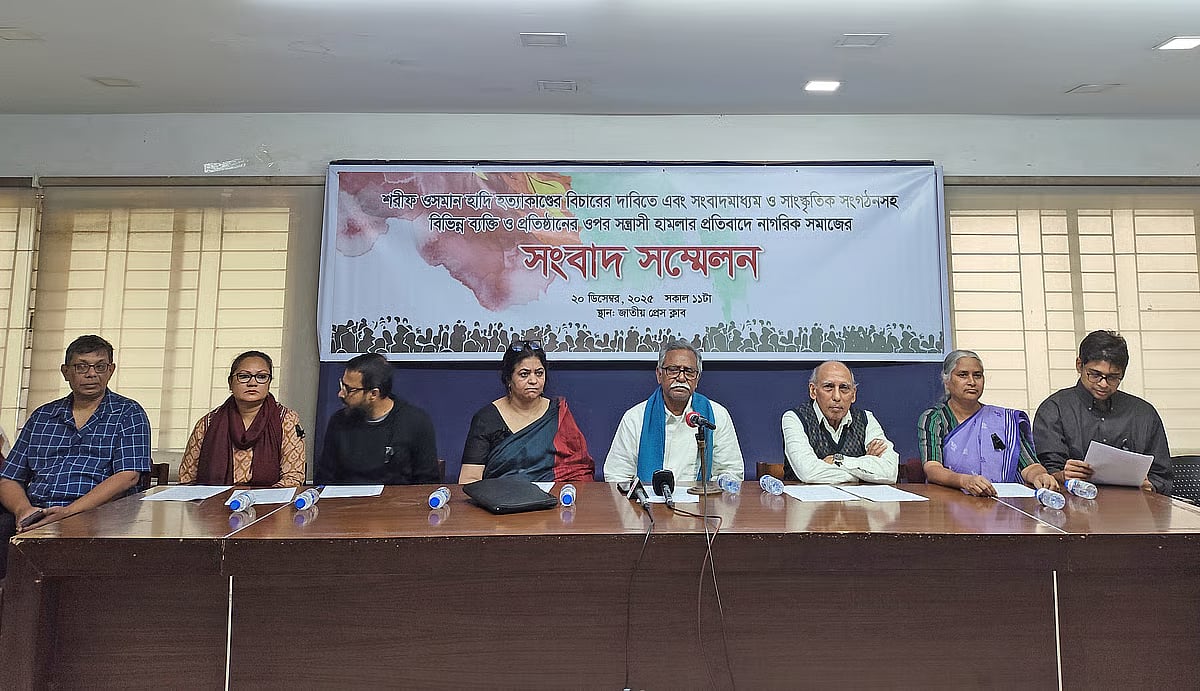
Anu Muhammad made these remarks at a press conference held on Saturday afternoon at the National Press Club, organised in protest against the killing of Sharif Osman Hadi and against terrorist attacks on media outlets, cultural organisations, and various individuals and institutions.
The press conference, organised under the banner of Nagorik Samaj, was attended by photographer Shahidul Alam; lawyer and human rights activist Sara Hossain; former member of the Constitutional Reform Commission Firoz Ahmed; Taslima Akhter, a member of the Political Council of the Ganosamhati Andolon; lawyer Manzur Al Matin; and many others.
Professor Anu Muhammad said, “The way Prothom Alo, The Daily Star, and Chhayanaut have been attacked one after another—such a terrifying experience has not occurred since the Liberation War. We never imagined that after fighting against an autocracy, after a mass uprising, such horrific incidents could take place.”
Pointing out that there is no minimum level of security for the media, Anu Muhammad said that although there is an institution called the government in the country, there is no clarity about who is making decisions and how. The attacks on Prothom Alo, The Daily Star, Chhayanaut, and Udichi were not sudden incidents, he said, noting that these names had been repeatedly mentioned for a long time.
Remarking that the intelligence agencies could not have been unaware that the attackers were going to strike, Anu Muhammad said it is necessary to ask why the intelligence agencies took no action and why the government failed to ensure security. He reiterated that the government’s silence during these attacks was astonishing.
Anu Muhammad noted that when these institutions were attacked, law enforcement agencies remained inactive. He questioned whether the government had become the principal patron of those carrying out terrorist attacks.
He said, “Do they want these attacks to happen? Do they want fear to spread in this country? Do they want creativity, cultural activities, and all efforts toward democratic transformation in the country to be marginalised or defeated? Do they want the emergence of a new autocracy or fascism?”
Referring to the attack on Editors’ Council President Nurul Kabir, Professor Anu Muhammad said, “Nurul Kabir was attacked after being labeled an agent of the Awami League. Yet we know that Nurul Kabir has been fighting against autocratic rule since the 1980s—not just for the past decade and a half—through his writings and activism.”
Anu Muhammad said that at present, anyone who speaks out against injustice, oppression, or various forms of terrorism is being attacked as a ‘collaborator of fascism.’
He said that in the case of Osman Hadi’s murder, a great deal of information about those involved was published on social media through citizens’ initiatives even before the government acted. Despite such information emerging immediately after the attack on Hadi, how did the killer manage to flee the country? Although the government spoke at length about Hadi’s murder, it showed no real activism in apprehending the perpetrator.
Citing examples from previous governments, Anu Muhammad said, “We have seen before how, in some murder cases—Toki, Sagor-Runi, Tanu—the government avoided entering the path of justice through inaction or various forms of deception. They did not want to bring the killers to light. During this government’s tenure, we are seeing similar incidents.”
He said that in the current situation, despite repeated attacks and killings, there appears to be no interest on the part of the government in apprehending the killers or attackers.
In this situation, Professor Anu Muhammad emphasised unity in three areas to build resistance. He said that the media must come together in a united resistance; political parties need a strong, united resistance in favor of democratic transformation, which is still insufficient; and all forms of citizen organisations must also unite in resistance.
Professor Anu Muhammad said that several programmes would be announced on behalf of civil society. At the press conference, lawyer Manzur Al Matin read out part of the written statement, the second part was read by former Constitutional Reform Commission member Firoz Ahmed, and the demands were presented by Anu Muhammad himself.