Govt has scope to control fuel prices: CPD
Amid the war between Iran and Israel, involving the United States, production and supply of oil and gas are being disrupted.
As a result, the price of crude oil in the global market has exceeded $100 per barrel.
However, the government still has some scope to control fuel prices in the domestic market, researchers of the private research organisation Centre for Policy Dialogue (CPD) said.
CPD Distinguished Fellow Mustafizur Rahman said the government has various policy instruments to determine how much of the international oil price will be reflected in the local market.
In addition to the profit of the Bangladesh Petroleum Corporation (BPC), there are various types of taxes on fuel in the country amounting to around 20–25 per cent.
When international fuel prices increase, the government has the opportunity to reduce these taxes to control prices. For example, during the tenure of the outgoing interim government, the 2 per cent advance income tax on fuel imports was withdrawn.
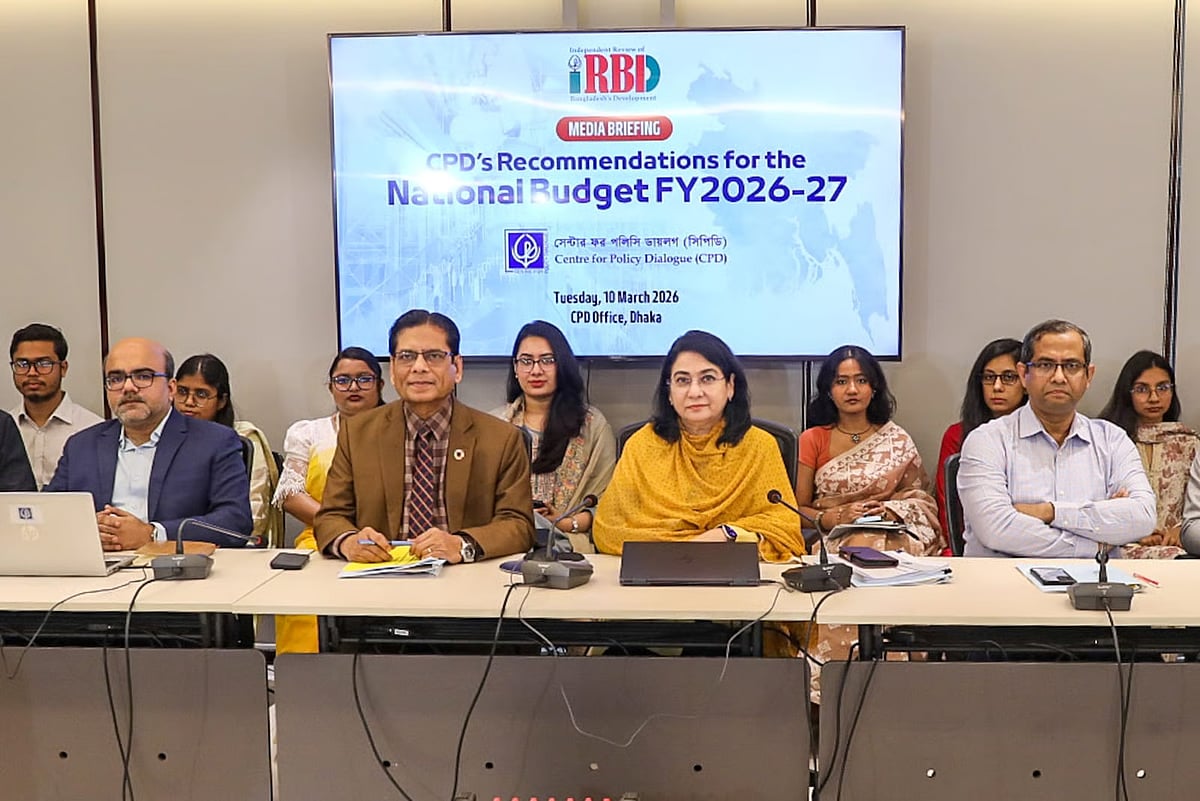
He made these remarks while responding to questions from journalists at a media briefing titled “CPD’s Recommendations for the Budget for FY 2026–27” at CPD’s office in the capital’s Dhanmondi today, Tuesday.
CPD Executive Director Fahmida Khatun delivered the opening remarks and the keynote presentation. CPD Research Director Khandaker Golam Moazzem was also present.
Mentioning that the country currently has several weeks’ stock of diesel, octane and other fuels, Mustafizur Rahman said Bangladesh’s major problem is the absence of a permanent strategic reserve of fuel oil, which exists in neighbouring countries. If such reserves existed, it would be possible to provide assurance to the market during times of crisis.
Currently, due to panic buying, there is a tendency to collect more fuel than the actual demand. If this increases, it becomes difficult for any country to meet the demand immediately. Therefore, it is important to bring confidence to the market and provide assurance.
The CPD Distinguished Fellow said the government is currently making spot purchases to manage the fuel situation. The agreement to import diesel through a pipeline with India is being reactivated. In addition, if necessary, arrangements are available to import fuel from alternative sources, including Malaysia. The main objective here is to ensure the availability of fuel. At the same time, the government must also ensure that purchasing fuel at higher prices does not put pressure on foreign exchange reserves. In that case, loans could be taken from the Islamic Development Bank (IsDB).
Mustafizur Rahman said it is important to reduce pressure on reserves when purchasing fuel oil, because reserves are also crucial for important matters such as food security and fertilizer imports. To deal with the current situation, along with a short-term coordinated plan, it is necessary to build a strategic reserve of fuel oil in the medium term, which will provide assurance to the market and even help avoid panic buying in the future.
CPD Executive Director Fahmida Khatun said there are challenges both inside and outside the country at present. In this situation, it is extremely important to take specific and strategic policy measures. For policymakers, the main priority now should be to establish macroeconomic stability. To achieve this, specific initiatives will be required to control inflation, ensure discipline in the revenue system, increase investment, and create employment.
Fahmida Khatun also said the upcoming budget for the next fiscal year will be the first budget of the newly elected government of the Bangladesh Nationalist Party (BNP). It is an important opportunity for the government to begin implementing its electoral commitments and demonstrate effective leadership in revenue management and efficiency in public expenditure.
She added that to address the current instability, alongside achieving economic stability, necessary reform activities must continue to strengthen the long-term foundations of the economy.