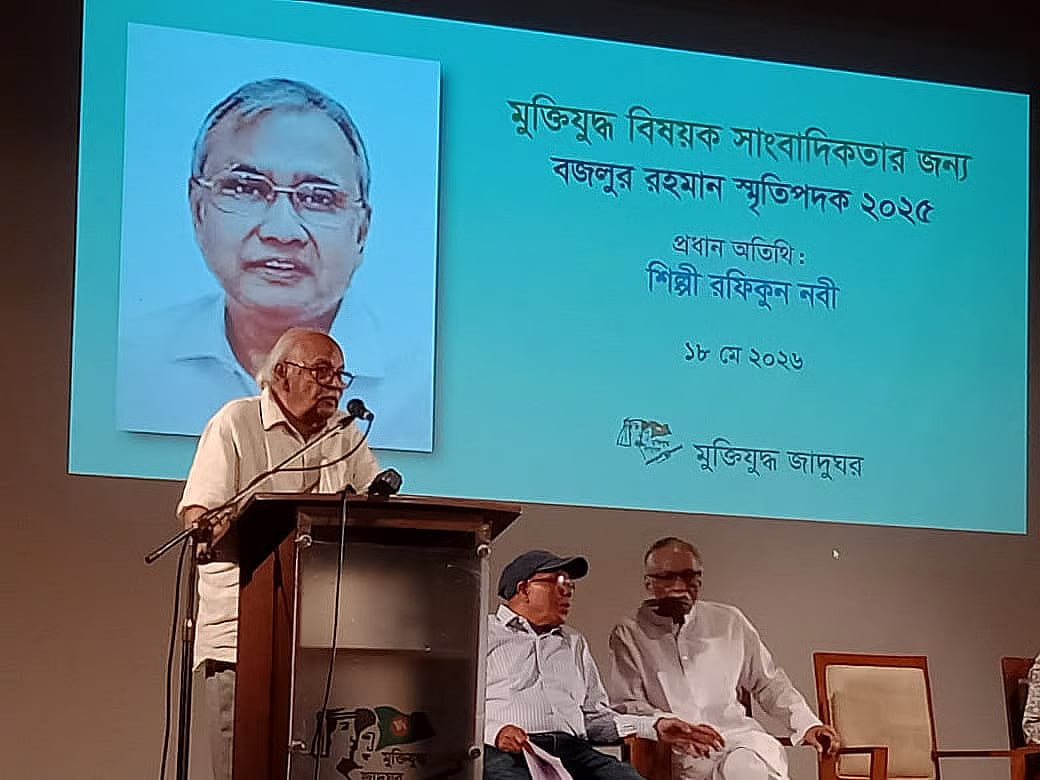
Attempts to make people forget Liberation War alarming: Artist Rafiqun Nabi
The vandalism of sculptures and various monuments intertwined with the memory of the Liberation War across different parts of the country is not merely a destructive activity; rather, it reflects an attempt to make people forget the Liberation War, remarked the eminent artist Rafiqun Nabi (Ranabi).
He described this trend as deeply alarming as well.
Following the July mass uprising, attacks were carried out on various institutions and monuments dedicated to the memory of the Liberation War across the country. Referring to this, Rafiqun Nabi said those acts of vandalism had taken place in several locations, including Meherpur. Sculptures and installations were also defaced in Dhaka.
“These can be rebuilt, but the underlying reason behind why they were destroyed is what truly makes us apprehensive,” he said.
Artist Rafiqun Nabi made these remarks while speaking as the chief guest at the presentation ceremony of the ‘Bazlur Rahman Memorial Award 2025’.
The awards were presented at a ceremony organised at the Liberation War Museum auditorium in Agargaon, the capital, on Monday afternoon.
This year, three journalists from the print, online, and electronic media categories received the award for their outstanding journalism on the glorious Liberation War of Bangladesh.
Among them, Ahmad Ishtiak, a Correspondent for The Daily Star, won in the print and online category, while Ahmed Reza, Senior Correspondent at Jamuna Television, and Partha Sanjay, Special Correspondent at Ekattor Television, received the awards in the electronic media category.
This award is presented in memory of Bazlur Rahman, the late editor of Daily Sangbad and a recipient of the Independence Award. Bazlur Rahman passed away suddenly in 2008. Subsequently, the Liberation War Museum introduced this award through the initiative of his wife and former Agriculture Minister, Matia Chowdhury. For over a decade, this award has been regularly presented for the best reports on the Liberation War in print and electronic media. It carries a cash prize of Tk 100,000, along with a crest and a certificate.
Artist Rafiqun Nabi believes that such incidents were orchestrated out of a deliberate “desire to make people forget” the Liberation War. However, noting that the memories of the Liberation War can never be erased, he said, “We were part of the Liberation War, we witnessed the Liberation War, and we carry those memories within us. It is impossible for us to deviate from that.”
Rafiqun Nabi also described living while upholding the spirit of independence as a responsibility. He mentioned that the firsthand experience of the Liberation War remains vivid to this day for their generation.
He further noted that the role of the younger generation fills him with optimism. Referencing videos, journalism, and various other works based on the Liberation War, he said, “The new generation is still vocal about these matters. Seeing this gives me courage.”
Youth are history’s flag bearers now
Mofidul Hoque, trustee and member-secretary of the Liberation War Museum, delivered the concluding remarks at the event.
He stated that this initiative for Liberation War-based journalism is not confined merely to celebration or formality; rather, it poses a profound question of accountability before the new generation of journalists.
He observed that those born long after the Liberation War are also expressing their commitment to history today through their reports and investigations. He expressed his hope that this sensitivity and empathy will bring a new dimension to future journalism.
Mofidul Hoque noted that the flag of history is now in the hands of the youth, and their endeavor to gain the strength to bear that responsibility is their greatest inspiration.
He stated that the history of journalism in Bangladesh is inextricably linked with the history of the Liberation War. Recalling the attacks on newspapers right at the onset of the genocide in 1971, he said that journalism in this country is not merely a profession, but a part of the nation’s sacrifice and struggle.
Mofidul Hoque stated that the more the new generation of journalists engages with the history of the Liberation War and the vast archives of the museum, the more journalism rooted in new thoughts, new humanity, and a sense of responsibility will flourish.
The event was presided over by Professor Golam Rahman, Chairman of the award’s jury board and former Chairman of the Department of Mass Communication and Journalism at Dhaka University.
Noting that it is alarming for the nation that many young people still fail to distinctly understand the history of the Liberation War, the Language Movement, and other mass movements, he said that presenting the accurate history of the Liberation War to the new generation is the greatest responsibility of our time.
Golam Rahman stated that the Liberation War was the culmination of a long political struggle against the exploitation and deprivation of the Bengalis, with which the nation’s self-sacrifice and glory are intertwined. Therefore, there is no scope to distort or belittle this history.
He praised the hard work and dedication of journalists in producing Liberation War-based reports, noting that despite various limitations and pressures, they are performing the crucial task of preserving the nation’s memory.
People still retain trust in news media
Sarwar Ali, a trustee of the Liberation War Museum, delivered the welcome address at the ceremony. He noted that the role of journalists in the independence struggle of Bangladesh was exceptionally vital. During the Pakistani regime, the editors and journalists of the time courageously highlighted before the public the democratic and nationalist movements that had developed against political, economic, and social discrimination.
Sarwar Ali remarked that despite the spread of misinformation on social media, people still rely on the news media for reliable information.
Highlighting the importance of investigative journalism in bringing the history of the Liberation War to the new generation, he mentioned that this year, the archives and research materials of the Liberation War Museum were opened up to journalists. As a result, young journalists have been able to produce high-quality investigative reports based on the Liberation War.
At the award ceremony, Mozammel Hossain Manju, a member of the Bazlur Rahman Memorial Award jury board, announced the name of the winner and read the citation for the print media category, while Sohrab Hassan, another member of the jury board, announced the names and read the citations for the winners in the electronic media category.
Donation to the Liberation War Museum
The ‘Mir Ashraful Haque Research Fund’ has provided a one-off donation of Tk 10 million to the Liberation War Museum to advance research activities aimed at strengthening the study of peace and harmony, establishing truth and justice, and analysing the background and objectives of the history of the Liberation War—particularly the genocide and atrocities committed in 1971.
The income generated from this permanent fund will be utilised for research into genocide, the Liberation War, and peace education, as well as for the dissemination of research-driven knowledge.
The ‘Center for the Study of Genocide and Justice’, a research institution under the Liberation War Museum, will be responsible for managing the fund.
On behalf of the Mir Ashraful Haque Research Fund, Professor Mobinul Hoque from the Department of Economics at the University of Saskatchewan, Canada, handed over the check of Tk 10 million to Sarwar Ali, trustee of the Liberation War Museum.