Bay of Bengal Conversation
Without reconciliation, society remains deeply divided
Justice for crimes is essential. At the same time, reconciliation is needed. Without it, society remains deeply divided. In Bangladesh, it is essential to ensure justice and accountability for crimes committed during the Liberation War, violence in the hill tracts and the July mass uprising. Reconciliation is equally necessary.
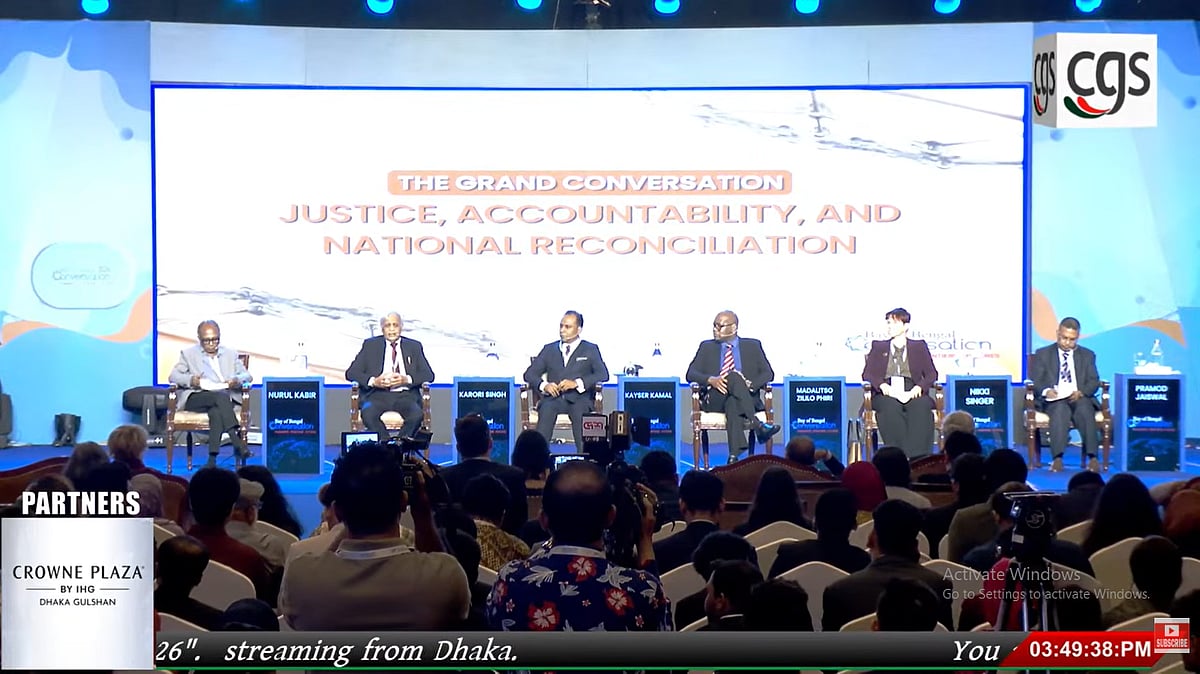
These issues emerged in discussions at a session titled ‘Justice, Accountability and National Reconciliation’ at the Bay of Bengal Conversation 2026, organised by the Centre for Governance Studies (CGS).
The session was held at a hotel in the capital on Monday. It was the final day of the three-day event.
Teachers and researchers from Bangladesh, South Africa, Cambodia, India and Nepal spoke at the session about the need for justice, accountability and reconciliation.
However, Bangladesh’s Deputy Speaker of Parliament Kayser Kamal, who took part in the session as a panelist, said reconciliation efforts around the world had often failed because they were used as a political shield to protect those involved in state violence from legal consequences.
“National reconciliation without justice is not peace; it is merely a temporary pause in conflict,” he stated.
Citing a United Nations report, Kayser Kamal said as many as 1,600 people had lost their lives during the July mass uprising, with children accounting for 12 to 13 per cent of the deaths.
“This fearless and uncompromising generation fought to build a new country where every citizen would enjoy equal rights and perpetrators would be brought to justice,” he said.
It is worth noting that the UN fact-finding team estimated that as many as 1,400 people may have been killed during the July mass uprising up to 5 August 2024. The government’s list, meanwhile, puts the number of martyrs at 843. No new applications have been received.
Kayser Kamal said everyone was aware that “evil forces” were now desperately trying to regain their political relevance through acts of violence. “Unfortunately, some groups at home and abroad are speaking on their behalf in the name of reconciliation,” he said. “Such thinking will push the country towards a new conflict, the consequences of which could be extremely grave and unimaginable.”
“I want to state this in the clearest and most unequivocal terms: there is no scope for reconciliation with the ousted Awami League (whose activities have been banned in the country),” he said.
The session was moderated by Pramod Jaiswal, research director at the Nepal Institute for International Cooperation and Engagement. He said justice was necessary, but without reconciliation, society could remain deeply divided.
According to Jaiswal, accountability must be clearly distinguished from retribution. In most South Asian societies, he said, accountability was often conflated with revenge.
He said that reconciliation does not mean reaching complete agreement about the past. Nor does it mean forgetting or forgiving serious wrongs or crimes. Rather, it means creating an environment in which individuals and communities can coexist with dignity, acknowledge historical grievances and rebuild trust in one another within state institutions.
Professor Karori Singh of the University of Rajasthan said people entrusted with institutional responsibilities tended to become authoritarian. Against the backdrop of South Asia, he said, such authoritarianism was creating problems in Sri Lanka, Bangladesh and Nepal.
Madalitso Zililo Phiri, a researcher at the University of the Witwatersrand in South Africa, said the country’s Truth and Reconciliation Commission had been a prerequisite for imagining a new society. The commission had faced considerable criticism, he said, because liberal institutions and democratic arrangements had failed to fulfil all their promises of equality.
Nikki Singer, executive director of Cambodia’s Centre for Peace and Conflict Studies, said Cambodia had suffered a civil war and that reconciliation efforts had begun even before 1991.
Under a national reconciliation process, Khmer Rouge rebel fighters were reintegrated into mainstream society and disarmed in 1998, she said.
Singer said many Cambodians held a personal belief that they could not move forward if they focused solely on blaming people for the past. They also considered what kind of future and legacy they wanted to leave for their children and grandchildren.
Another speaker at the session was Nurul Kabir, president of the Editors Guild and editor of New Age. He said those responsible for crimes in 1971 were still not prepared to acknowledge their wrongdoing. Instead, they continued to seek to justify their actions against humanity.
There is also the problem of the Chittagong Hill Tracts. We can still see hardline nationalist positions among the parties involved in the conflict, he said.
“Similarly, there has been no sign of remorse from those who killed pro-democracy protesters in 2024. They are still accusing the protesters of being extremists and radicals,” he said.
These problems must certainly be resolved, Nurul Kabir said. To make that possible, the parties concerned must be persuaded to acknowledge that they had made mistakes.
He believed this would one day be possible. “Only then can we begin a new journey towards building a society founded on equality, social justice and human dignity,” he said.