Internet prices to rise by 20pc under proposed government policy: ISPAB
Internet service providers in Bangladesh have warned that the government’s proposed policy will increase internet costs for consumers by at least 20 per cent, due to the introduction of various new fees and charges.
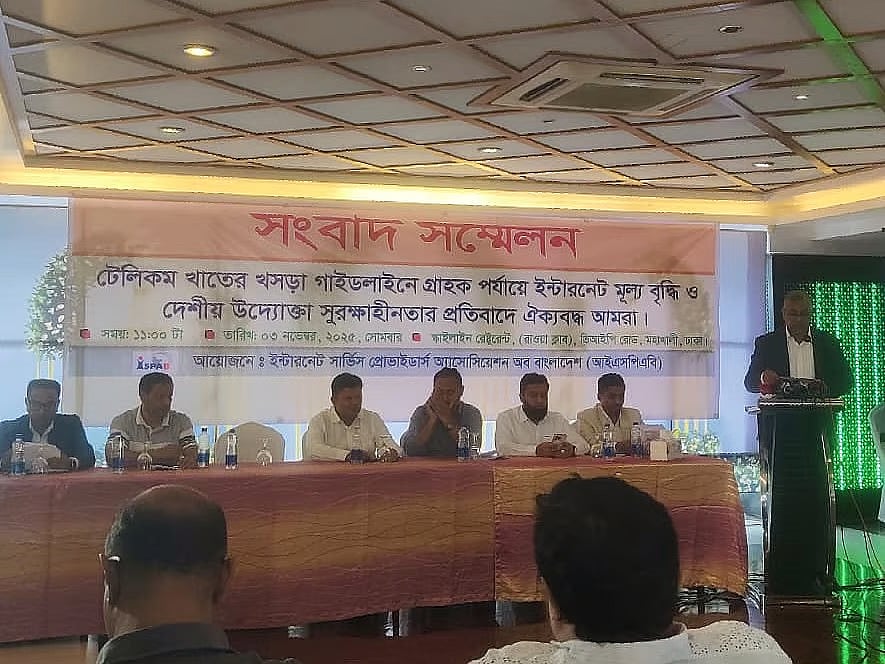
Calling for responsible leadership in handling the issue, the Internet Service Providers Association of Bangladesh (ISPAB) has urged political parties to intervene. The remarks came at a press conference organised by ISPAB today, Monday, at a hotel in the capital.
Recently, the Bangladesh Telecommunication Regulatory Commission (BTRC) drafted a set of guidelines for Fixed Telecom Service Providers (FTSPs), which the ISPAB has opposed.
Under the new guidelines, FTSP operators will have to share 5.5 per cent of their revenue and contribute 1 per cent to the Social Obligation Fund (SOF). In addition, their procurement costs will increase by 14 per cent.
ISPAB President Aminul Hakim said that the government has deviated from its original purpose regarding the telecommunications sector and is now acting inconsistently with public interest. “The government is moving in the wrong direction,” he said.
Presenting a comparison between the existing and proposed policies, Aminul Hakim explained that under the current framework, the government receives 21.45 per cent in total, through revenue sharing, the SOF, and VAT.
However, under the new policy, that figure will rise to 40.25 per cent. The ISPAB president warned that the policy would widen the gap between urban and rural areas.
“The government that came to power fighting against inequality is now promoting it,” Aminul Haque remarked. “On one hand, they are talking about reducing internet costs, while on the other hand, they’re driving prices up themselves.”
The ISPAB president also pointed out that while the government has set a licence fee of USD 10,000 (approximately Tk 12 lakh) for Starlink, local ISPs have to pay Tk 2.5 million (Tk 25 lakh) for the same. “Why is Starlink being given such a privilege?” he questioned.
ISPAB further stated that under the proposed draft guidelines, mobile operators would be explicitly allowed to provide fixed connectivity through fixed wireless access and last-mile fibre connections.
This, they argued, would create severe unfair competition for local ISPs, who have built their networks with domestic investment, and would ultimately have a negative impact on consumers.