If Sheikh Hasina returns to surrender, she will likely be arrested first
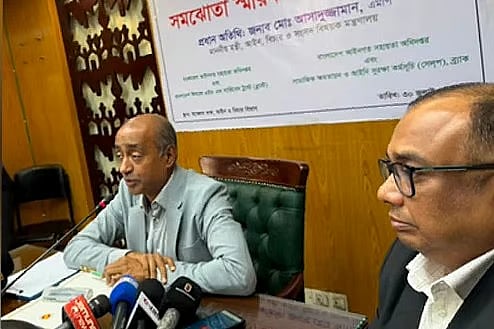
Law Minister Md. Asaduzzaman has said that if Bangladesh's ousted prime minister Sheikh Hasina, now staying in India, returns to the country, the law will take its own course. He said that if Sheikh Hasina returns to Bangladesh and seeks to surrender, she may be arrested even before she gets the opportunity to do so.
The law minister made the remarks today, Thursday, in response to questions from journalists at an event held at the Ministry of Law in the Secretariat. The event was organised to mark the signing of two separate Memorandums of Understanding (MoUs) between the Department of Legal Aid of Bangladesh (DLAB), the Bangladesh Legal Aid and Services Trust (BLAST), and BRAC''s Social Empowerment and Legal Protection Programme.
Journalists asked the law minister about the government’s plans regarding comments made in various interviews by Sheikh Hasina, who was removed from power through a student-people uprising, that she intends to return to Bangladesh next December.
In response, the law minister said, “First of all, how do you know whether the Ministry of Foreign Affairs is trying to secure her (Sheikh Hasina’s) extradition or not? Of course, it is trying, I can tell you that. Secondly, even if a person is a death-row convict, if they are a Bangladeshi citizen and want to come to Bangladesh and surrender out of respect for the country’s laws, they may be arrested even before they can surrender. But they do have that right. If she actually comes, the law will take its own course. We will not do anything outside the law. We will exercise the authority that the law has given us.”
A journalist asked how Sheikh Hasina would return since she does not have a passport. In response, the law minister said, “How she will come is her problem. It is not my problem. When she enters our territory, once she comes within that jurisdiction, I will apply the law in accordance with the authority that the law has given me.”
The law minister was also asked about the presidential election. In response, he said, “This has not yet come up for discussion. I have already explained the constitutional interpretation. The Constitution states that a new president must be elected within 90 days from the day the president resigns. The question was whether we would call a special session. Since there is a period of 90 days, and our next session must be called within 60 days, counting from the end of the previous session until the next one, these two timelines coincide. That is why I am saying that, at present, I do not see the necessity of calling a special session. If the government feels it is necessary, it certainly can call one.”
A press release from the Ministry of Law stated that at the event, Law Minister Md. Asaduzzaman said the government is working to further strengthen the alternative dispute resolution (ADR) system in order to reduce the backlog of cases. To this end, alongside government initiatives, partnerships have been established with private organisations that have long been involved in legal aid and mediation activities. As a result, the tendency to file new cases in courts will decrease, and litigants will receive faster and more effective services.
The law minister said a review had found that in 20 districts of the country, the rate of new cases filed under specific laws between March and May 2026 had declined by more than 62 per cent compared with the same period of the previous year. He described this as a positive outcome of alternative dispute resolution activities and said it was encouraging for the future.
The law minister urged the judiciary to promote the ADR process further. He said that if suitable pending cases were resolved through mediation, pressure on the courts would be significantly reduced. He added that the government was prepared to introduce necessary legal reforms for this purpose.
Under the memorandum of understanding, with assistance from BLAST, legal aid will be provided to workers in Dhaka, Gazipur, and Chattogram on a pilot basis through the appointment of court paralegals. At the same time, successful mediations conducted by BLAST will receive legal recognition, and arrangements will be made to issue the necessary certification for filing cases in court when mediation fails.
Under a separate memorandum signed with BRAC’s Social Empowerment and Legal Protection Programme (SELP), activities will include training and certification of professional mediators, legal recognition of successful mediation, submission of necessary reports in cases of unsuccessful mediation, and joint monitoring activities.
Those present at the event included Additional Secretaries of the Law and Justice Division SM Ershadul Alam and Md. Khadem Ul Qayes, Director General of the Department of Legal Aid of Bangladesh Md. Manzurul Hossain, Associate Director of BRAC’s Social Empowerment and Legal Protection Programme (SELP) and Gender Justice and Diversity Programme, Shashwati Biplob, Honorary Executive Director of BLAST Sara Hossain, along with relevant officials from the Law and Justice Division, representatives of development partner organisations, and members of the media.