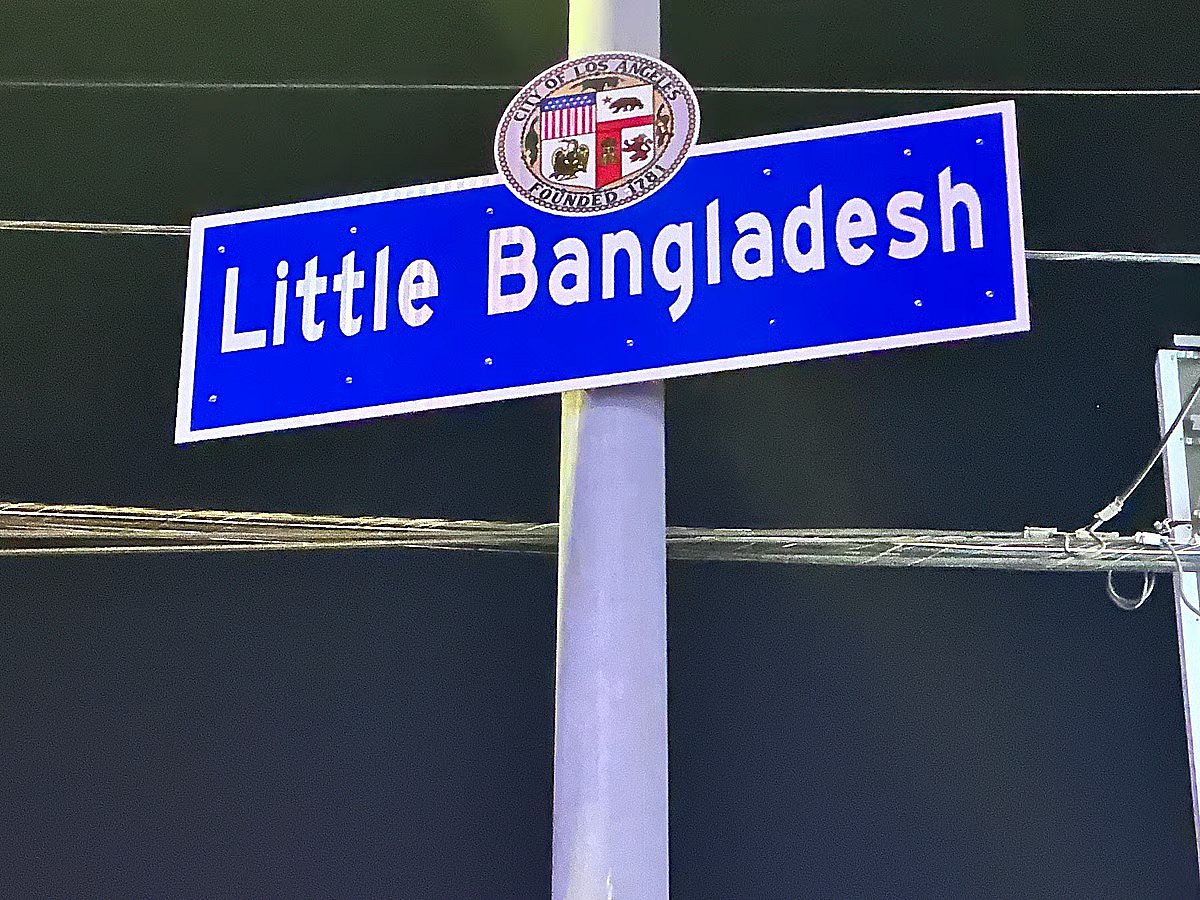
'Little Bangladesh': A touch of homeland in Los Angeles
The picturesque city of Los Angeles in the United States, known for its glitz and glamour, holds a small piece of Bangladesh within it.
Stand on the stretch of Third Street, from New Hampshire to Alexandria Avenue, and for a moment you might forget you’re in Los Angeles.
The sight of a blue street sign reading ‘Little Bangladesh’ and the lively buzz of the area will make you feel like you’re walking through a busy road in Dhaka.
For many Bangladeshis living far from home, this area offers a comforting sense of belonging, prompting many to make it their home.
Just three miles away from Hollywood’s dazzling lights, this small enclave feels like a dream come true, a place where Bangladeshi expatriates rediscover the joy, warmth, and cultural spirit of their homeland.
At first glance, the strong presence of Bangladeshis and their native culture may come as a surprise, yet this ‘Little Bangladesh’ has truly flourished in Los Angeles, California, officially recognised by the city itself.
Though the surroundings, lined with shady trees, city traffic, and the hum of American life, remind visitors of California, the scent of Bangladeshi food, the sight of shop signs written in Bangla, the chatter of people, and the familiar bustle of shops together create a distinct essence of Bangladesh in this distant land.
A city within a city
As you stroll along Third Street, a row of Bangladeshi shops greets you- grocery stores, beauty salons, restaurants, mobile shops, and money transfer counters line the narrow sidewalks. The aroma of fried samosas, puris, peaju, and kebabs drifts through the air, evoking the feeling of being back in Old Dhaka or Mirpur rather than in Los Angeles.
While walking down the street, you’ll hear the familiar cadence of the Bangla language coming from the shops. Rabindra Sangeet and modern Bangla songs play in the background. Passers-by greet one another in Bangla. Young crowd gather in front of shops, chatting over muri, chanachur, or tea. Small television screens inside display Bangladeshi news channels, while others watch dramas on YouTube or debate politics. It truly feels like a city within a city.
Anjuman Ara Shiuly, general secretary of the Bangladesh Unity Federation of Los Angeles, an organisation formed by expatriate Bangladeshis to promote social, cultural, and community activities, told Prothom Alo, “Little Bangladesh is the heart of our community.’
“It’s not just a place to live it’s where we preserve our culture, heritage, and social ties. We want both new and older generations to participate in this community and remain connected to their roots through cultural and social activities,” she added.
Sharif Hasan, a Bangladeshi expatriate who has lived in Little Bangladesh for 15 years, said, “I used to live near the airport. When I first came from Bangladesh, I felt very lonely, as there were no Bangla speakers or familiar food nearby. But after moving here, I never felt homesick again. On weekends, I come to these Bangla eateries, eat, and hang out with friends.”
Another expatriate, Ruman Mia said, “Even though I live in North Hollywood, I come to Little Bangladesh to shop. Sitting at shops like ‘Kasturi’ or ‘Deshi’ with a cup of tea makes me feel like I’m back at a local hotel in Bangladesh. Whenever I come here, I meet someone I know.”
Tareq Hasib, who works at one of the stores here, said, “I’ve been working here for about a year. We get all kinds of visitors- students, businesspeople, and long-time immigrants. They gather for small chats, share stories from home, and talk politics.”
Memories on the signboards
Every signboard in Little Bangladesh carries a touch of home, ‘Kasturi’, ‘Deshi’, ‘Sonar Bangla’, ‘Swadesh’, ‘Amar Bangla’, ‘Bangla Bazar’, ‘Noya Kitchen’, ‘Asian Mart’. The names themselves feel like fragments of Bangladesh stitched together across the streets. Inside, the colourful shelves, banners, and logos resemble Dhaka’s Karwan Bazar or New Market.
The restaurants attract not only Bangladeshis but also Pakistanis, Indians, and Nepalis looking for familiar South Asian cuisine. Even Mexicans stop by for milk tea. On weekends crowds multiply, some come for lunch or dinner, others for tea, spicy biryani, or simply for chitchats.
A short walk away on Vermont Avenue stands the confectionery ‘Alauddin Sweets’, offering rows of sweet treats like rasgulla, sandesh, and lal mohon displayed behind glass counters, tastes that instantly transport visitors back home.
The story of Little Bangladesh
The story of Little Bangladesh began in the 1960s when a few Bangladeshi students arrived in Los Angeles for higher education. Over time, they found jobs, started businesses, and gradually built a community around nearby colleges, universities, and Islamic centres.
Initially, there were only a handful of shops, but as the years passed, groceries, restaurants, salons, and other businesses flourished.
In 2010, the Los Angeles City Council officially recognised the area as ‘Little Bangladesh’. Then-ayor Antonio Villaraigosa said, “This is not just a name, it’s a way to recognise of the contributions made by the Bangladeshi community.”
Kazi Mashhurul Huda, who coordinated the ‘Little Bangladesh Formation’ and convened the ‘Little Bangladesh Beautification Project’, wrote a book on its history. He told Prothom Alo that over 10,000 Bangladeshis now live in the area. They haven’t just survived here, they’ve enriched the city’s economy and culture, he said.
A favourite place for students
Around 2,000 Bangladeshi students study in California, with nearly half living in Los Angeles. Many of them choose to stay in Little Bangladesh, where they work part-time to support their education. Between long hours of study and work, they gather at the local Bangla cafes to relax with tea or a hot meal late into the night.
One such student named Basit Chowdhury said, “Coming here feels like walking through a market or street in Dhaka. It brings back memories of home.” Another student, Farzana Rahman, added, “For us, Little Bangladesh means family, friends, and cultural identity all in one place.”
Russell Mahmud, president of the Bangladesh Students’ Association of California, said, “Our aim is not just to support students with accommodation or studies. We want Bangladeshi students in Los Angeles to take part in Little Bangladesh community life, preserve their culture, and proudly represent Bangladesh on the world map.”
Mosques and Islamic centres
Another vital aspect of life in Little Bangladesh is its religious centres. Several mosques surround the area, some established as early as the 1960s, around which Bangladeshi Muslim immigrants began settling at first. These mosques host not only the five daily prayers but also Eid congregations, Islamic lectures, and religious gatherings.
On ay Muslim-centric religious occasions, the entire area lights up beautifully, reminiscent of Eid celebrations in Bangladesh. The mosque committees actively support the community, helping with housing, employment, and even funeral arrangements for the needy.
Abdul Mannan, president of a local mosque, said, “In the Little Bangladesh area, we assist Bangladeshis with housing, jobs, and especially funeral services for those in need. Community service is our top priority.”
Festivals and cultural events
Various organisations in Little Bangladesh celebrate Bangladeshi national, religious, and cultural festivals. From ‘Chaand Raat’ Mela on the eve of Eid and Bangladesh Day Parades to Bangladesh Mela, Ananda Mela, Folk Music Festivals, Nazrul festival, Lalon festival, Baishakhi Mela and observances of International Mother Language Day, Independence Day, and Victory Day, the community stays lively throughout the year.
Organisations such as the Bangladesh Unity Federation of Los Angeles, Uttaran Cultural Group, Taranga of California, and Muslim Ummah of North America also arrange social, cultural, and religious programmes.
Cultural personality Shipar Chowdhury said they work to spread Bangladeshi literature and music among expatriates and non-Bangla speakers alike.
With support from the Bangladeshi community in Los Angeles and the California State University, Northridge, the works and songs of our national poet Kazi Nazrul Islam are being promoted internationally, an effort praised by the Government of Bangladesh, Bangla Academy, and the Nazrul Institute.
Five groups of expatriates live in Little Bangladesh- long-term immigrant families, newcomers who have started jobs or small businesses, students, small entrepreneurs, and those actively involved in cultural and community life.
Morshedul Islam, head of the Uttaran Cultural Group said, “Little Bangladesh is more than just a neighbourhood for Bangladeshi expatriates, it’s a direct representation of Bangladesh’s culture, history, and heritage.”
“From food and clothing to music, literature, and festivals, it’s like a miniature Bangladesh. Through our organisation, we encourage Bangladeshi children living here to engage in cultural activities, so they grow up proud of their heritage,” he added.