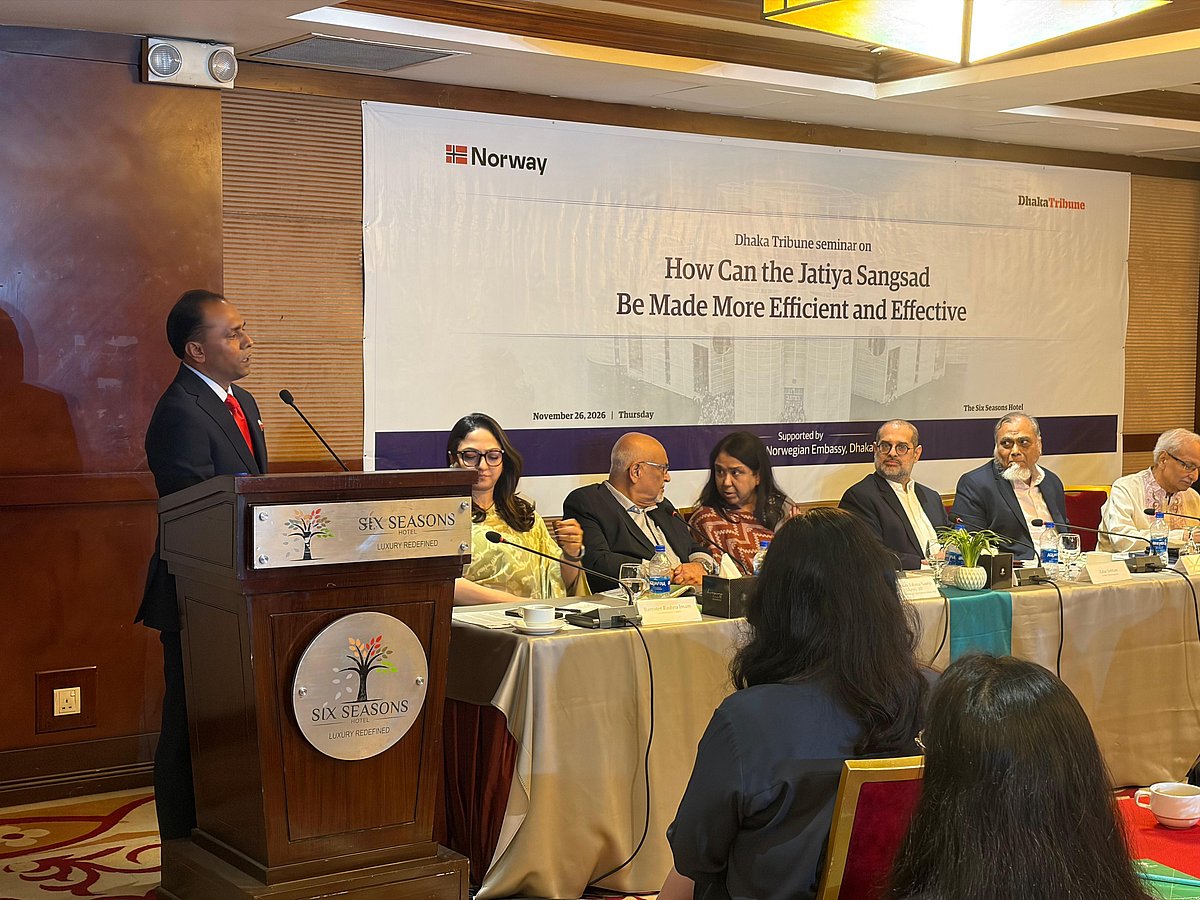
Deputy Speaker calls for amending Article 70, independent Parliament Secretariat
Deputy Speaker of Parliament Kayesar Kamal has called for amending Article 70 of the Constitution to give lawmakers greater freedom to vote independently and establishing an independent parliamentary secretariat to strengthen the Jatiya Sangsad’s ability to hold the government accountable.
Speaking at a seminar in Dhaka on Thursday, he said Bangladesh’s parliamentary history had seen both democratic progress and serious setbacks, with some parliaments strengthening democratic institutions while others had weakened them and become rubber stamps for the executive.
The current parliament has an opportunity to correct those mistakes and make the institution more effective, he said.
Kamal identified Articles 70, 76, 77 and 79 of the Constitution as requiring attention. He called for revising Article 70 to ensure that MPs can exercise greater independence while retaining safeguards on matters of national interest.
He also stressed the need to enact a law under Article 76(3) to make parliamentary standing committees more independent and effective in scrutinising the executive.
“Unless that law is passed, we cannot oversee or scrutinise executive functions effectively,” he said.
On Article 79, the Deputy Speaker called for an independent parliamentary secretariat staffed by its own officials, rather than relying on civil servants deputed from other government offices.
He also urged competent professionals, particularly young people, to enter politics and contribute to strengthening Parliament.
Kamal was speaking at a seminar titled ‘How Can the Jatiya Sangsad Be Made More Efficient and Effective,’ organised by Dhaka Tribune with the support of the Royal Norwegian Embassy in Dhaka. The event brought together policymakers, political representatives, academics and experts to discuss parliamentary institutions, democratic governance and accountability.
Political scientist Professor Rounaq Jahan said many of the reforms being discussed had already been recommended in a 2012 study on Parliament, but few had been implemented.
She said MPs should prioritise national legislation and oversight instead of focusing mainly on development projects in their constituencies. However, this would require political parties and their leaders to clarify the division of responsibilities between MPs and local government representatives.
“Unless it is the party decision, unless it is a decision by the political leadership, you cannot expect individual MPs to suddenly change their priorities,” she said.
Jahan also called for a parliamentary code of conduct, annual disclosure of MPs’ financial assets and declarations of conflicts of interest.
Saiful Alam Milan, a member central executive committee of Bangladesh Jamaat-e-Islami and a lawmaker from Dhaka-12, said the July uprising had created an opportunity to rebuild Parliament after 15 years of authoritarian rule, during which elections lost credibility and the legislature largely became a rubber stamp for government decisions.
He criticised parliamentary procedures that allow the Speaker to waive requirements for advance notice and circulation of bills. Citing the passage of 94 bills in 25 working days during the first session, he said two civil service bills had been passed in just eight minutes without discussion.
He also questioned the passage of the Invest Bangladesh Bill on the same day it was approved by the Cabinet, without scrutiny by a parliamentary committee.
“Parliamentary safeguards must be protected as an institution, regardless of who holds power,” he said.
Milan called for opposition representation in the chairmanship of standing committees, at least two Opposition Days in every parliamentary session, a citizen petition system and public hearings by parliamentary committees. He also urged Parliament to limit the use of presidential ordinances and implement the July Charter.
“A strong opposition is not a threat to a strong government. It is a safeguard against a weak democracy,” he said.↳
Dr Badiul Alam Majumder, founder-secretary of Citizens for Good Governance (Sujan), said Parliament’s responsibilities included lawmaking, oversight of the executive, financial scrutiny and public deliberation. He stressed that the people, not Parliament, were sovereign under the Constitution.
He called for stricter eligibility requirements for MPs, proper scrutiny of candidates’ declarations of assets and liabilities, and greater representation of women and different sections of society in Parliament. He also proposed laws on parliamentary privileges and MPs’ codes of conduct, including mandatory declarations of conflicts of interest and annual financial disclosures.
“These are people's representatives. They belong to political parties, but they must work in the interests of the people rather than the party,” he said.
Badiul Alam Majumder said the July Charter, signed by all parties with a written commitment to its full implementation, had clearly stipulated that four important parliamentary committee chairmanships should go to the opposition. However, although the 13th Parliament had formed 50 standing committees, only one chairmanship—the Public Accounts Committee—had been given to the opposition. He said the commitment had not been reflected in practice and stressed that the agreed provisions should be implemented.
Dr Debapriya Bhattacharya, a distinguished fellow at the Centre for Policy Dialogue (CPD), said the country's parliamentary history showed how two-thirds majorities had sometimes been used to undermine democracy. The current parliament, which also enjoys such a majority, should learn from that experience.
“The first lesson to making an effective parliament is possibly how to harness the two-thirds majority,” he said.
He called for making better use of existing parliamentary mechanisms, including standing committees, and increasing opposition participation in their work. He also proposed reforming Article 70 to allow MPs to vote independently, except on confidence motions, budgetary matters and international treaties.
Bhattacharya further said public hearings outside Parliament could also help make lawmakers more accountable to citizens, he said.
Norwegian Ambassador to Bangladesh Håkon Arald Gulbrandsen distinguished between parliamentary efficiency and effectiveness. Efficiency, he said, meant using parliamentary time and resources properly, while effectiveness meant fulfilling constitutional and democratic responsibilities.
He identified institutional independence, strong parliamentary committees, meaningful opposition participation and quality debates as important conditions for an effective legislature. MPs must also have adequate support, time and access to information to scrutinise government policies and hold ministers accountable.
The ambassador said a balance was needed between preventing disruptions that waste parliamentary time and allowing protests and heated debates as legitimate forms of democratic representation.
NCP Joint Convener and lawmaker Nusrat Tabassum Joty, constitutional expert Rashna Imam, and independent politician Tasnim Jara, among others, spoke at the seminar.
Zafar Sobhan, editor of Counterpoint, moderated the seminar.