'80pc people say Sharia to ensure security, justice, prevent corruption'
Many Bangladeshis believe introducing Sharia, or Islamic law based on the Qur’an and the Hadith, might be helpful in ensuring justice and fairness in governance.
This has been revealed in a study conducted by a global platform of researchers, RESOLVE Network.
It is a global consortium of researchers and research organisations in agreement that factors contributing to community vulnerability and resilience to violent extremism are contextual.
“More than 80 percent of respondents agreed with the statements that Sharia would ensure basic service provision, personal security, and justice, as well as discourage corruption,” read the executive summary of the research brief.
The face-to-face representative survey was conducted in 4,067 households in Bangladesh in April 2017.
Bangladeshi professor of political science at Illinois University of US Ali Riaz and senior research associate at BRAC University’s Institute of Governance and Development Syeda Salina Aziz prepared the research brief.
It said respondents indicated overwhelming support for key democratic principles, such as elected representatives, an independent judiciary, freedoms of speech and assembly, and property rights.
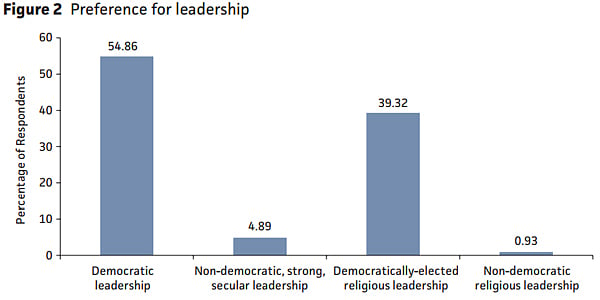
The questionnaire was designed to understand Bangladeshis’ preferred form of leadership and the type of leaders they considered to be best positioned to establish order and stability in the country.
“In response to a question about their leadership preferences, 55 percent expressed a strong preference for democratic, secular leadership; 39 percent voiced support for a democratically elected religious leader. Only a small minority preferred non-democratic leadership, whether secular or religious,” said the research brief.
They strongly endorse democratic values, including the importance of elected representation, an independent judiciary, freedom of expression and association, and the security of individual property rights.
“However, many are dissatisfied with the effectiveness and impartiality of the government. Many citizens do not feel they are fairly governed by elected representatives. They feel their rights are being impinged on and the judiciary is not free from political interference. While many citizens indicate they do not want to return to military rule.
“Nevertheless, most also supported granting the military control of the government during times of crisis when elected civilian leadership appears to be failing.
“Many see Sharia as one way to ensure better governance, to ensure fairer justice and to reduce corruption. There is widespread support for the implementation of facets of Sharia including harsh physical punishments and modest dress codes for women,” according to the executive summary of the research brief.
“Support among non-Muslim minorities for those facets of Sharia to be integrated into governance is lower but still significant,” said the executive summary.
“Large minorities feel that they are not governed fairly by elected representatives, that their freedoms of speech and assembly are increasingly restricted, and that the judiciary is subject to political interference.
“These findings are cause for concern among the country’s democratic leaders. They demonstrate a lack of confidence in the way the current political system is operating and an ongoing search by citizens for alternatives,” said the researchers.
Respondents additionally expressed widespread support for whippings or cutting off of hands for theft and for stoning for adultery.
There are divergent views on democracy and Sharia among key demographics. Male respondents placed greater importance on democratic values. Support for Sharia was notably stronger in rural areas and among women.
In the implementation of certain aspects of Sharia - with respect to wearing veil, hijab, or niqab, in particular - women almost unanimously supported their right to make choices about what they wore; a significant minority of men disagreed.
However, significant sections of the non-Muslim community in Bangladesh were willing to support some of the aspects of Sharia, such as harsh punishments for violations of the law.
While this divergence deserves greater study, this survey demonstrates that citizens are beginning to look to alternative systems of governance to address what they perceive as poorly performing political representatives, corruption in judicial system, and increasingly restricted fundamental rights, read the executive summary of the survey.