Dhaka-Beijing ties to reach new heights
During Prime Minister Tarique Rahman’s visit to Beijing, Bangladesh and China have announced plans to elevate bilateral relations to a new height. In addition to strengthening their partnership to build a ‘shared future’ for the peoples of the two countries, the two sides also discussed the proposed China-Myanmar-Bangladesh Economic Corridor. Beijing also expressed interest in the development of Chattogram and Mongla ports.
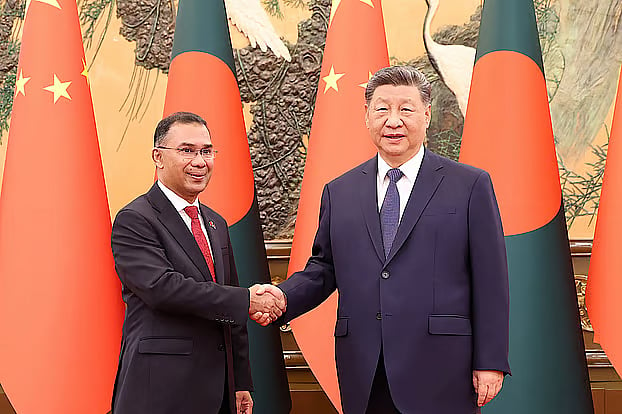
On the final day of his visit to China, Prime Minister Tarique Rahman held talks with Chinese President Xi Jinping on Friday morning. During the talks, Xi Jinping stated that regardless of any changes in the global landscape, China will remain Bangladesh's ‘trustworthy good friend,’ ‘good neighbour’ and ‘good partner.’ The two top leaders participated in delegation-level meetings and also held a one-on-one discussion.
Following the conclusion of the Bangladesh Prime Minister's three-day state visit, a 14-point joint statement was issued by both countries. In addition, the Chinese Foreign Ministry released a statement yesterday following the meeting between Tarique Rahman and Xi Jinping.
Yesterday morning, Prime Minister Tarique Rahman paid tribute at the monument built in memory of Chinese heroes at Tiananmen Square. Subsequently, Zhao Leji, Chairman of the Standing Committee of China's National People's Congress, paid a courtesy call on Prime Minister Tarique Rahman at the Great Hall of the People in Beijing.
Afterward, the Prime Minister held a meeting with Chinese President Xi Jinping at the Great Hall of the People. The final program of the Prime Minister's state visit to Beijing was a visit to the Museum of the Communist Party of China (CPC).
Tarique Rahman returned to Dhaka from Beijing last night after concluding his first-ever visit to China as Prime Minister.
Following the conclusion of the Bangladeshi prime minister’s three-day state visit, the two countries issued a 14-point joint statement. In addition, China’s Ministry of Foreign Affairs released a statement after the meeting between Tarique Rahman and Xi Jinping.
Earlier on Friday morning, Prime Minister Tarique Rahman paid tribute at the Monument to the People’s Heroes in Tiananmen Square. He later met Zhao Leji, Chairman of the Standing Committee of China’s National People’s Congress, at the Great Hall of the People in Beijing.
The prime minister subsequently held official talks with President Xi Jinping at the Great Hall of the People. His final engagement in Beijing was a visit to the Museum of the Communist Party of China (CPC).
Concluding his first visit to China as prime minister, Tarique Rahman returned to Dhaka from Beijing on Friday night.
Chinese foreign ministry statement
During the meeting between Chinese President Xi Jinping and Bangladeshi Prime Minister Tarique Rahman, the two leaders announced a decision to elevate bilateral relations to a higher level.
According to a statement from China's Ministry of Foreign Affairs, China has always attached great importance to the development of Beijing-Dhaka relations and remains steadfast in its good-neighborly and friendly policy toward the people of Bangladesh.
The Chinese President conveyed China’s continued support for Bangladesh in safeguarding its national independence, sovereignty and territorial integrity and in rejecting foreign interference. Xi Jinping mentioned that China is ready to strengthen ties at various levels to advance the relationship, deepen strategic communication, increase political mutual trust and continue supporting each other on their respective core interests and key concerns.
The Chinese President stated that China supports Bangladesh’s new government in its governance efforts and is prepared to advance cooperation with Bangladesh under the high-quality Belt and Road Initiative (BRI). He also called for advancing the development of the China-Myanmar-Bangladesh Economic Corridor to further strengthen regional connectivity.
Describing China as a valuable and trusted partner of Bangladesh, Prime Minister Tarique Rahman said that China is a great nation that holds an important position in Bangladesh's foreign policy. He expressed satisfaction that bilateral relations have reached a new stage in the new era. Under the strong leadership of President Xi Jinping, China has achieved significant development, and Bangladesh has much to learn from China's modernization.
To achieve its own modernisation goals, Bangladesh hopes to strengthen inter-party exchanges, advance Belt and Road cooperation and expand collaboration and exchanges in trade and commerce, connectivity, agriculture, technology, green energy, education and healthcare.
Bangladesh is firmly committed to the One China Policy. Bangladesh recognises that Taiwan is an inseparable part of Chinese territory, opposes any form of ‘Taiwan independence’ efforts, and firmly supports the authority of UN General Assembly Resolution 2758.
The concept of building a community with a shared future for mankind and the four global initiatives proposed by President Xi Jinping are vital for maintaining world peace, development, and international justice and fairness.
Beijing seeks China-Myanmar-Bangladesh corridor
Beijing has once again brought forward a proposal for an economic corridor extending from Bangladesh to China via Myanmar to ‘expand the scope’ of connectivity and the economy. China has also expressed interest in working on the modernisation of Chattogram and Mongla ports.
Mahdi Amin, spokesperson for the Prime Minister’s Office (PMO), told journalists that this proposal was presented during the meeting between Prime Minister Tarique Rahman and Chinese President Xi Jinping at the Great Hall of the People.
At a press conference in Beijing following the meeting, Mahdi Amin said a proposal was made regarding how an economic corridor can be established from Bangladesh to China via Myanmar, with the primary objective of expanding the scope of Bangladesh's economy, increasing economic exchange, and further strengthening the multimodal transport system.
Notably, the concept of a China-Myanmar-Bangladesh Economic Corridor is not new. It is a proposed regional economic and connectivity route under China’s Belt and Road Initiative (BRI). The core goal of this corridor is to establish direct commercial and structural links from China’s southwestern Yunnan province to Bangladesh via Myanmar.
In the 1990s, the Bangladesh-China-India-Myanmar Economic Corridor was proposed, which became known as BCIM. The initiative received interstate recognition around 2013. Meetings were held at various levels. However, due to India’s geopolitical objections and reluctance regarding China's BRI, the BCIM economic corridor initiative did not progress further.
Subsequently, excluding India, China planned to expand its existing ‘China-Myanmar’ Economic Corridor to connect directly with Bangladesh. Even while BCIM was stalled, China brought the matter of advancing a trilateral initiative to the discussion table by excluding India.
The proposed corridor would start from Kunming, the capital of China's Yunnan province, and reach Mandalay in Myanmar. From there, one part would extend to Yangon in Myanmar, and another part would reach the Kyaukphyu deep-sea port in Rakhine State. China's proposal is to later connect this link with Bangladesh's Chattogram and Cox's Bazar regions from Myanmar's Rakhine through road and railway networks.
The proposed corridor is expected to create opportunities for significant Chinese investment in Bangladesh’s roads, railways, ports and special economic zones. It could also facilitate easier access for Bangladeshi products to the vast markets of China and Southeast Asia.
It is said that if this corridor is established, opportunities will be created for massive Chinese investment in Bangladesh’s roads, railways, ports, and special economic zones. Access for Bangladeshi products to the vast markets of Southeast Asia and China will also become easier.
Stating that China has expressed interest in working on the modernization of Chattogram port, the PMO spokesperson said, "We want to work on how we can turn this port into a regional hub through modernization, ensuring services not only for Bangladesh but also for other countries. At the same time, China has expressed interest in upgrading and further modernizing Mongla port."
Mahdi Amin added that China has expressed interest in providing assistance regarding the implementation of modern medical systems in healthcare. Many people from Bangladesh go abroad for medical treatment. China is interested in opening doors for them by simplifying the visa process and providing other forms of assistance.
Joint statement
The 14-point joint statement states that both sides have decided to take several steps to elevate the relationship to the next level. To this end, emphasis has been placed on maintaining the continuity of high-level communication. Both sides agreed to establish a mechanism for strategic dialogue at the Foreign Minister level.
Additionally, they agreed to explore the possibility of initiating a "2+2" dialogue mechanism involving diplomacy and defense.
China will provide assistance and support to Bangladesh, according to its capacity, for the Teesta River Comprehensive Management and Restoration Project. In this regard, it will cooperate to expedite feasibility studies and related work on the project involving experts from both countries.
China will strengthen cooperation with Bangladesh in trade, e-commerce, industry, supply chains, and investment sectors to enhance Bangladesh's export capacity and jointly protect the multilateral trading system.
Gratitude was expressed to China for providing 100% duty-free access, which will create a favorable environment for investment by Chinese enterprises. Both sides agreed to jointly advance the modernization and expansion project of Mongla Port and the development project of the Chinese Economic and Industrial Zone in Chattogram.
China will provide assistance and support to Bangladesh, according to its capacity, for the Teesta River Comprehensive Management and Restoration Project. In this regard, it will cooperate to expedite feasibility studies and related work on the project involving experts from both countries.
China expressed support for Bangladesh's participation in BRICS and its application to become a partner of the Shanghai Cooperation Organization (SCO). Bangladesh and China agreed that it is urgent to firmly safeguard the outcomes of victory in World War II and oppose any attempts to resurge fascism and militarization.