Governance deficits, mismanagement and partisan influence threaten implementation of BNP manifesto: TIB
The Bangladesh Nationalist Party (BNP) government has begun formulating and implementing ministry- and sector-specific plans in line with commitments made in its election manifesto. However, shortcomings in governance persist across ministries and sectors, a Transparency International Bangladesh (TIB) research report says.
According to the TIB report, there is also a lack of firm and specific positions and policy guidance on combating corruption and irregularities. Mismanagement and partisan influence remain evident, while the absence of risk analysis-based strategies continues to be a concern.
Taken together, these factors risk becoming major obstacles to fulfilling the commitments outlined in the BNP’s election manifesto, it added.
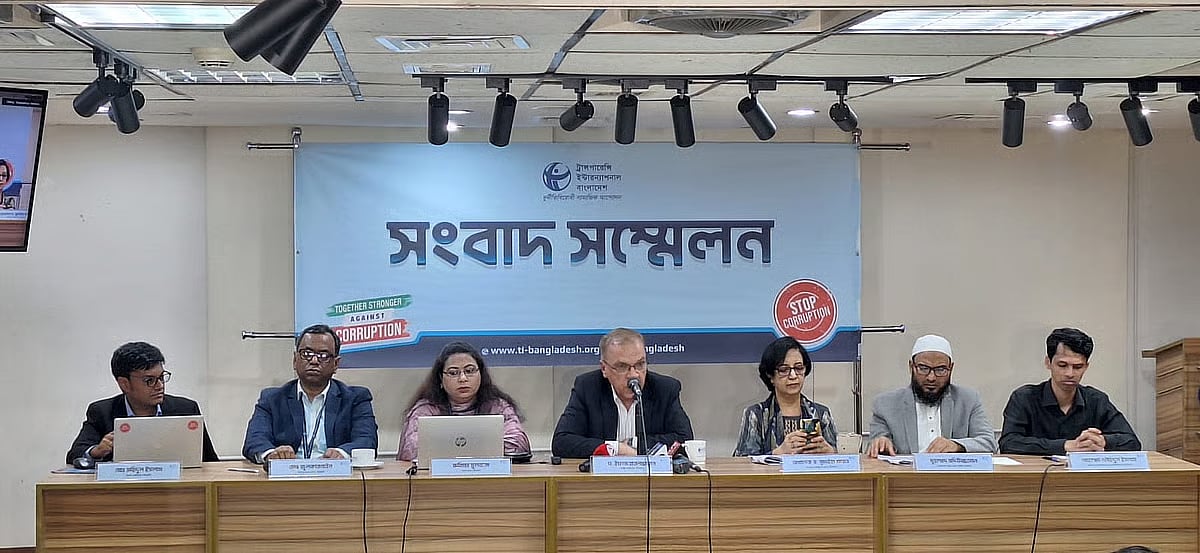
The report “The First 100 Days of the Government Following the 13th National Parliamentary Election: Monitoring the Implementation of Commitments on Good Governance and Anti-Corruption”, was unveiled at a press conference held at TIB’s office in Dhanmondi, Dhaka, today, Sunday.
It was released by TIB Executive Director Iftekharuzzaman and presented by Senior Research Fellow Md Zulkarnaine and Research Fellow Razia Sultana.
According to the report, although the government moved quickly after assuming office to improve law and order, declared zero tolerance towards mob violence and issued stern warnings against extortion, significant problems remain in markets, transport services, bus terminals and truck terminals. Incidents of extortion, drug trafficking, theft and robbery continue at noticeable levels. Allegations of political and administrative patronage persist in these sectors. The report notes that attempts by a minister to legitimise extortion attracted widespread criticism.
The study also found that within the government’s first 100 days, no visible initiative had been taken to constitute major institutions such as the Anti-Corruption Commission (ACC), the Human Rights Commission (NHRC)and the Information Commission. As a result, efforts to curb corruption, protect human rights and ensure the free flow of information face long-term risks.
According to TIB, despite repeated declarations from the highest levels of government regarding good governance and anti-corruption efforts, a visible culture of “now it is our turn” has emerged among many ruling-party leaders, activists and supporters, as well as among sections of the bureaucracy, business community and various professional groups.
The report states that politically and factionally motivated appointments and postings continue in the police, civil administration, government institutions, Bangladesh Bank, commercial banks, local government bodies and educational institutions. Such practices, it argues, are inconsistent with the BNP’s electoral commitments.
TIB further observed that the rise of various religious forces during the tenure of the interim government and the continuation of violent and conspiratorial activities targeting Bangladesh’s pluralistic, multi-faith and culturally diverse society have persisted under the elected government.
The report cites recent attacks on the historic Shah Ali shrine in Dhaka and on a pir in Kushtia as examples. It warns that such incidents represent an alarming signal for the nation, undermining free thought, cultural and social diversity, peaceful coexistence and tolerance.
The report commends the government’s initiative to convert 97 of the 133 ordinances promulgated during the interim government’s tenure into law. However, it argues that by repealing or postponing several important laws for further review, the BNP government has effectively signalled a retreat in significant areas such as judicial independence, human rights protection, anti-corruption efforts and the prevention of enforced disappearances.
According to the report, several laws related to judicial independence, human rights and anti-corruption could have been enacted with only minor amendments. Instead, the government chose to repeal or suspend them. At the same time, a number of laws that strengthen the authority of the executive branch have been passed.
TIB concludes that while the government’s first 100 days have been encouraging and full of potential in certain respects, the lack of a clear roadmap and concrete initiatives for ensuring good governance, preventing corruption and, in particular, establishing accountable government remains a matter of concern.
Also present at the press conference were TIB Adviser for Executive Management Professor Sumaiya Khair, Director of Research and Policy Muhammad Badiuzzaman, Research Associate Md Shahidul Islam and others.