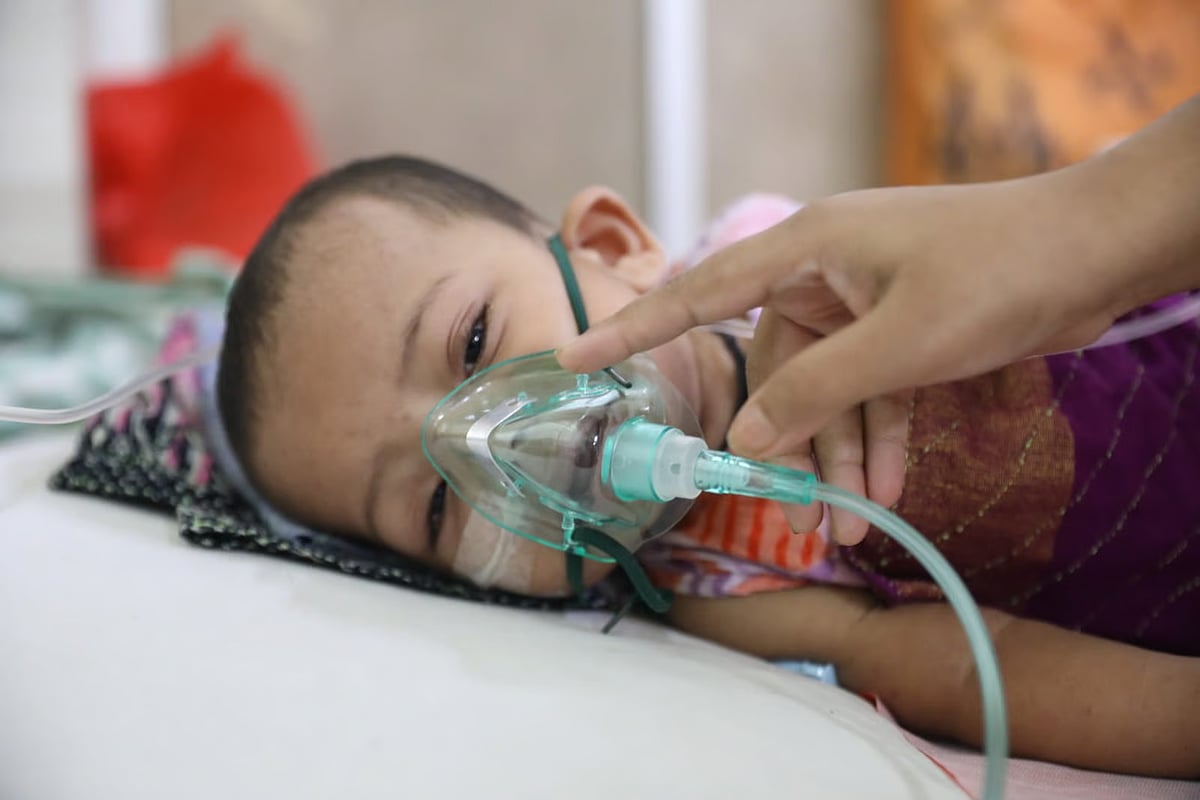
Measles: Shortage of testing kits in the country again
A shortage of measles testing kits has once again disrupted diagnostic services. Due to the limited supply of kits, the government’s public health institute has been unable to test an adequate number of samples.
Several thousand samples collected from across the country have accumulated in the institute’s laboratory.
In Bangladesh, measles testing is conducted exclusively at the laboratory of the Institute of Public Health.
A visit to the institute in Mohakhali, Dhaka, on Tuesday revealed that the shortage of kits has significantly constrained testing capacity.
The Director of the institute, Md Mominur Rahman, told Prothom Alo, “We are able to test around 100 samples per day.” He declined to provide further details.
Multiple attempts were made to contact the Director General of the Directorate General of Health Services (DGHS), Professor Pravath Chandra Biswas, by telephone for comment on the shortage.
He did not respond to the calls. A text message was also sent, but no reply was received.
Laboratory sources at the Institute of Public Health reported that samples from approximately 5,000 patients, sent from government hospitals nationwide, have accumulated.
Testing has slowed due to the shortage of kits, and the number of stored samples is expected to increase further before new supplies arrive.
Following the spread of measles across much of the country, public demand for testing has risen sharply. Parents of children exhibiting measles-like symptoms are seeking confirmation through laboratory tests.
Testing is also necessary to determine whether deceased children succumbed to measles or other causes.
In some cases, hospitals prefer to confirm a diagnosis of measles before discharging patients. Delays in obtaining test results have, in many instances, prolonged hospital stays.
The health authorities, including the Institute of Public Health, faced a similar situation last month. On 19 April, Director Md Mominur Rahman told Prothom Alo that the World Health Organization supplies the measles testing kits.
The laboratory does not use kits from any other source. A single kit can test 90 samples and the institute has the capacity to examine up to 300 samples per day.
Since 15 March, a total of 263 children have died in the country from measles or measles-like symptoms. Of these, 54 children died after laboratory confirmation of measles.
Officials at the institute stated that the World Health Organization supplied 60 kits on the evening of 19 April. It had indicated that a further 100 kits would be delivered on 30 April or 1 May; however, this has not yet taken place.
When contacted on Tuesday, a relevant official of the World Health Organization told Prothom Alo, “100 kits will be available within one and a half to two weeks.”
The same official, along with representatives of the Institute of Public Health, stated that a decision had been taken to urgently supply Bangladesh with 30 measles testing kits from the WHO South-East Asia Regional Office in Delhi. These kits are expected to arrive in the country within one week.
Several public health experts monitoring the measles situation told Prothom Alo that there has been a lack of sufficient urgency on the part of the government in procuring kits, as well as from development partners in supplying them.
They noted that, during such a critical period, kits should have been procured or delivered in the shortest possible time.
Anticipating a potential shortage, the Institute of Public Health had written to the World Health Organization on 8 February requesting 60 kits. Those kits were eventually received on 19 April.
Commenting on the matter, public health expert Abu Jamil Faisal told Prothom Alo, “It is unfortunate that there is a shortage of diagnostic kits during this measles outbreak. Had the health authorities and the WHO office in Dhaka fulfilled their responsibilities properly, such a situation would not have arisen. They cannot evade accountability. To prevent such circumstances in the future, alternative sources for procuring kits must be identified.”
6 more children die
In the past 24 hours (from 8:00 am on Monday to 8:00 am on Tuesday), six more children have died in the country due to measles or measles-like symptoms.
Among them, two children—whose infections had been confirmed as measles—died in Dhaka. The remaining four children exhibited measles-like symptoms; one death each was reported in Khulna and Rajshahi, and two in Sylhet.
These figures were reported in the measles update released yesterday by the Directorate General of Health Services.
Since 15 March, a total of 263 children have died in the country from measles or measles-like symptoms. Of these, 54 children died after laboratory confirmation of measles.
According to data from the Directorate General of Health Services, since 15 March this year, 42,979 children have shown symptoms consistent with measles.
During this period, 29,831 children have been admitted to hospital with such symptoms, of whom 26,368 have since recovered and returned home.