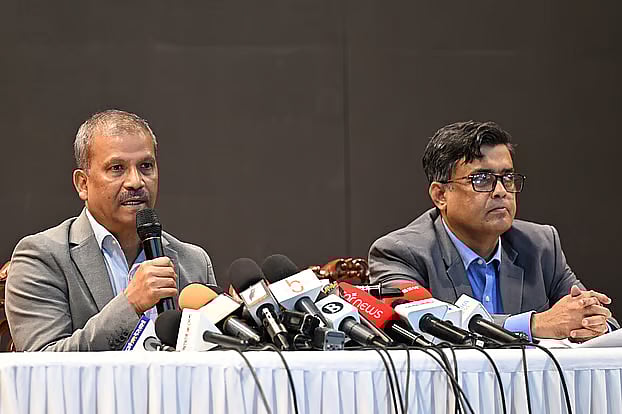
Law adviser's briefing
Govt moves to bring Sheikh Hasina back
Law Adviser Professor Asif Nazrul has said that a letter is being sent to India to bring back the deposed former Prime Minister Sheikh Hasina—sentenced to death for crimes against humanity committed during the July mass uprising—and former Home Minister Asaduzzaman Khan.
At the same time, a decision will soon be made on whether any kind of ‘approach’ can be taken to the International Criminal Court to facilitate the return of these convicted individuals.
He said this at a press conference held on Thursday afternoon at the Foreign Service Academy in the capital, arranged to brief the media on the decisions of the meeting of the Advisory Council of the interim government. Chief Adviser’s Press Secretary Shafiqul Alam was also present.
The Law Adviser said that a letter is being sent to India for the extradition of Awami League President Sheikh Hasina and former Home Minister Asaduzzaman Khan, both sentenced to death for crimes against humanity. Since they are now convicted, the government believes that India has an added responsibility to return them. The letter reminds India to fulfill its obligations under the extradition treaty to meet the people of Bangladesh’s desire for justice. At the same time, a decision will soon be made on whether any approach can be made to the International Criminal Court to facilitate the return of these convicted individuals.
On 17 November, the International Crimes Tribunal sentenced the deposed Prime Minister Sheikh Hasina to death for crimes against humanity committed during the July uprising. Former Home Minister Asaduzzaman Khan was also sentenced to death alongside her. Another accused, former police chief Chowdhury Abdullah Al-Mamun, was sentenced to five years in prison.
Referendum, law, and the caretaker government
The Appellate Division of the Supreme Court has annulled the verdict given 14 years ago that had struck down the 13th Amendment, which introduced the caretaker government system in the Constitution. Today, Thursday, the country’s highest court disposed of the appeal against that verdict and the related review petition. The ruling states that the provisions related to a non-partisan caretaker government have now been revived and activated. These provisions will be effective based on their applicability for future implementation.
At the press conference on the matter, the Law Adviser said that today, Thursday marks a historic verdict. After a long struggle, the caretaker government system has been established, ensuring free and fair elections. During the tenure of the caretaker government, several credible elections were held, and ruling parties were defeated. This was considered normal. Unfortunately, however, under the leadership of a former judge, a verdict declared it illegal. Subsequently, the then Awami League government took advantage of this and abolished it through the 15th Amendment.
Professor Asif Nazrul said that initially the 15th Amendment had been declared illegal in a verdict a couple of months ago. Today, the earlier highly controversial ruling by former Chief Justice Khairul Haque, which had declared the caretaker government system illegal, has been annulled.
The Law Adviser further stated that the caretaker government system can now be considered revived. However, it will only take effect after the next national parliamentary elections, because the caretaker government comes into play once the parliament is dissolved. Since the parliament currently does not exist, the caretaker government will be formed within 15 days after the next parliament is dissolved, in accordance with the High Court’s instructions.
Regarding the need for legislation to hold a referendum, the Law Adviser said that the government will issue a decree on the referendum soon. He expressed hope that this will happen within the next three to four working days.