Digital industry
Started with Tk 500,000, now pays Tk 80m per month in salaries
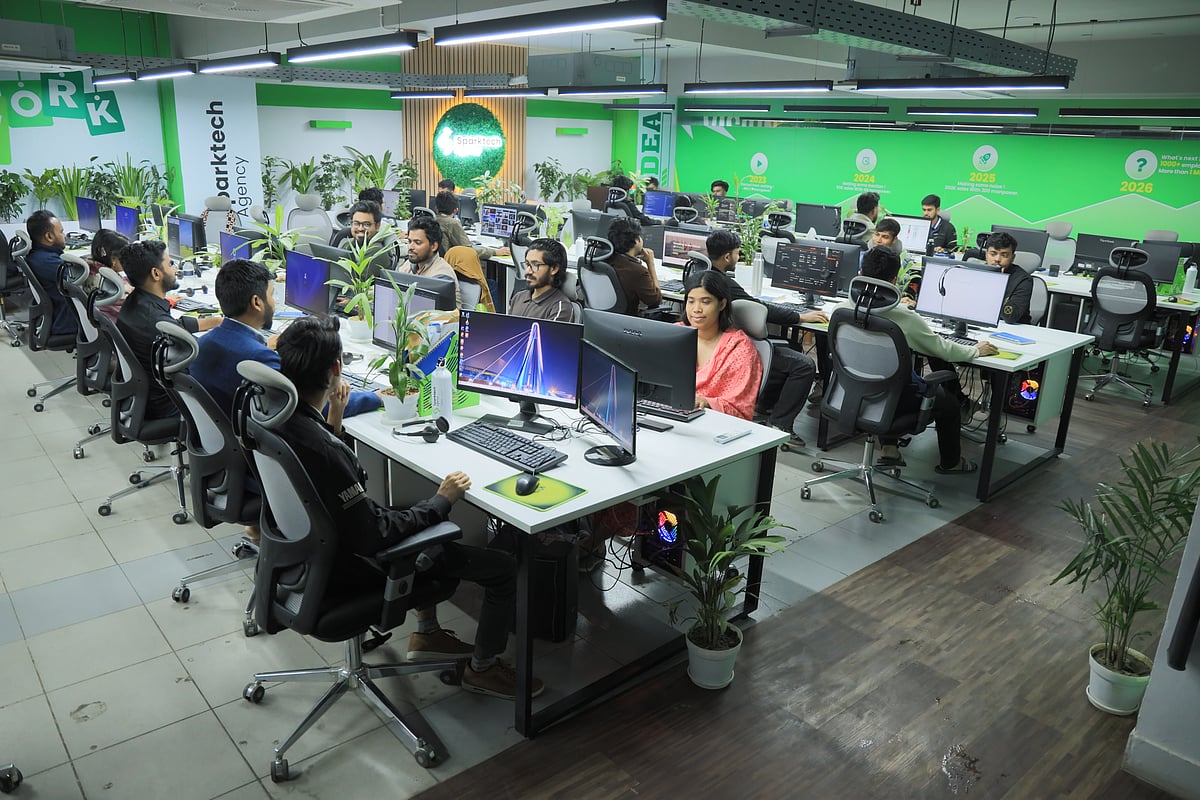
The journey of the technology firm Bdcalling IT began in 2017 with an investment of just Tk 500,000 and a team of seven employees. Over the past eight years, the organisation has expanded severalfold.
What started as a small enterprise has evolved into the Betopia Group, a conglomerate comprising 22 companies. Its workforce has grown to nearly 4,000. The company that began with half a million taka now pays Tk 80 million each month in employee salaries alone.
The founder and Chief Executive Officer (CEO) of the Betopia Group is engineer Muhammad Monir Hossain. Starting entirely from scratch, he has transformed Betopia into one of Bangladesh’s fastest-growing technology groups.
However, Monir Hossain’s entrepreneurial journey began earlier, in 2013, when he started working independently on international freelancing platforms such as oDesk and Elance. As his workload steadily increased, he went on to establish Bdcalling IT.
In its early days, the company operated in areas such as web design and development, mobile app development, visual and creative design, data entry and digital marketing. Today, new services including artificial intelligence (AI), cloud solutions and data centres have been added under the Betopia Group.
The group has also invested in renewable energy, electrical equipment, supply chains and infrastructure development. In addition, it provides end-to-end technology services in industry-specific sectors such as fintech, healthcare, energy and infrastructure.
At present, the group’s operations extend to 78 countries worldwide, including the United States, the United Kingdom, Canada, Japan, Brazil and the Philippines. However, approximately 80 to 90 per cent of its total business is US-based.
Annual revenue of Tk 2 billion
Two years ago, in December 2023, Prothom Alo published a report on Bdcalling’s operations. At that time, the company employed 400 people and earned around Tk 25 million per month (Tk 300 million annually). Over the past two years alone, the workforce has increased by 900 per cent, while revenue has risen nearly sevenfold.
To date, Tk 450 million has been invested in the Betopia Group. Of this, Tk 30 million came from bank loans, while Tk 420 million was invested from the group’s own funds.
In the last financial year, the combined annual revenue of all Betopia Group companies stood at Tk 2 billion. The group pays approximately Tk 80 million per month in salaries and contributed Tk 2.5 million in government revenue during the last fiscal year.
Betopia Group CEO Muhammad Monir Hossain said, “Our employees are highly dedicated, skilled and creative. This is the key to our success. I dream for the country, for the people—I want to create employment. My employees share and realise that vision.”
Working with artificial intelligence
The Betopia Group has increased its investment in artificial intelligence and emerging technology-driven sectors. As one of the pioneering initiatives in the country, it has begun establishing an AI-based data centre equipped with high-performance GPU infrastructure. This will make it easier to operate AI and machine learning applications through the data centre.
Alongside investment in AI, the group has set its sights on rapid expansion in global markets. It is selling services through local representatives in the United States, Europe, the Middle East, East Asia and Africa. At the same time, it aims to take the products of other local technology companies to international markets.
Monir Hossain said the company has built its own data centre in Bangladesh under its own management, enabling it to provide services to local organisations at lower costs through its in-house facilities.
“The global freelancing market is worth between USD 60 and 80 billion. Meanwhile, the AI and cloud market is approaching the trillion-dollar mark. Most local and global organisations are undergoing AI transformation. By selling these services, we can significantly increase foreign currency earnings. For this, we need skilled manpower, appropriate technology, data centres and suitable hardware. If import duties on AI-related hardware, including GPUs, are reduced, Bangladeshi companies will be far more competitive in the global market,” Monir Hossain said.
What are the challenges?
According to Monir Hossain, Bangladesh’s IT and AI sectors currently face several fundamental challenges. He said one of the biggest challenges is the high cost and limited availability of internet bandwidth. Although prices are said to be falling, in reality they remain expensive compared to international standards. In particular, the two-tier licensing structure often doubles or even triples costs.
“The second challenge in this sector is uninterrupted electricity,” he said. “Even a temporary power outage effectively brings our business to a standstill. Therefore, it is essential to adopt green energy over the long term and establish a sustainable power supply system. The third challenge is the shortage of skilled manpower and high-tech infrastructure. There is also a lack of skilled software engineers and Python developers. Without overcoming these limitations, we cannot become competitive in the global AI and technology market.”
He identified the fourth challenge as weak national branding. “Unlike India or the Philippines, Bangladesh has not yet developed strong brand value as a recognised IT or software hub. If Bangladesh’s skilled workforce and success stories are promoted globally, international clients’ confidence will increase.”
Over the past decade and a half, significant investment and promotion have taken place in the country’s freelancing sector, and many freelancers have emerged at the individual level.
However, Monir Hossain believes that freelancing does not create sustainable long-term employment. He said that due to intense global competition, freelancers’ incomes are often unstable.
“That is why our focus should be on building local companies that work directly for international markets. This will create stable employment within the country,” he stated.