Common people, the victims
Altaf Hossain taught at a school in Gaibandha. Natore's Imadur Rahman, Sirajganj's Islam Hossain, Barisal's Abul Kalam and Noakhali's Zamir Hossain, were drivers. Enam Hossain of Chittagong and Mizanur Rahman of Noakhali were shopkeepers. They all had one thing in common. All of them were victims of the current political violence, though none of them were involved in politics.
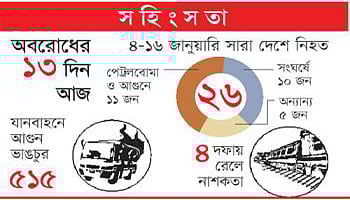
These seven are not the only ones. Over the last 12 days of the blockade, 26 persons were killed, 19 of whom were members of the general public. Five, including women and children, were burnt alive when a bus was set on fire in Mithapukur, Rangpur. The 10 persons undergoing treatment in the burn unit of Dhaka Medical College Hospital are all workers. And over 500 persons have been injured in the blockade programme. Most of them are common people. People are now in fear when they leave their homes for work.
A similar situation had arisen in 2013 before the elections, during the hartal (general strike) and blockade programmes of the opposition. According to the non-government human rights organisation, Ain O Salish Kendra (ASK), 507 persons were killed in political violence in 2013. Of them, 196 were common citizens. Most of them died in arson attacks, petrol bomb explosions, cocktail bomb blasts or political clashes.
Political violence has broken out again, centred on the first anniversary of the tenth parliament election. People again are being killed in the violence.
Mizanur Rahman, chairman of the National Human Rights Commission, has expressed grave concern over the loss of lives. He told Prothom Alo on Saturday, BNP had wanted to hold a public gathering on 5 January. That is their political right. However, the government did not allow them to hold the rally, using the possibility of violence as an excuse. It would have been better if the government clarified what they meant by possible violence. However, the terror being spread in the name of the blockade is totally unacceptable.
Mizanur Rahman said, "A democratic movement can never be violent. We have seen a similar situation in the past. It is the common people who are victims of all movements. They have no security. People are being burnt to death. Politicians should remember that they have no right to kill people in the name of politics."
The 20-party alliance, including BNP and Bangladesh Jamaat-e-Islami, have been carrying out a blockade programme since 6 January, demanding the resignation of the Awami League government which came to power on 5 January last year for the second term, through a "one-sided" election. The violence began on 4 January. From then till yesterday, 26 persons were killed. Of them, 11 were killed in petrol bomb explosions and in burning vehicles, and 10 were killed in clashes. Five were killed during BNP-Jamaat clashes with law enforcers and Awami League activists. Seven of the killed, including these five, were political activists. During this period, about 250 vehicles were set on fire and over 300 cars were smashed. Most of the vehicles owners were common citizens.
The cruelest incident took place on 13 January in Mithapukur, Rangpur. The persons killed in the incident were Rahima Khatun of Kurigram, her son Rahim Badsha and daughter Jesmin Akhter, and Tasiran Begum of Rangpur and a two-year-old child. Nilufar Begum, wife of the deceased Rahim Badsha, yesterday said, "My husband earned a living by selling peanuts in Dhaka. What was his fault? We are not involved in politics. Why did they burn him to death? Why did they burn by mother-in-law and sister-in-law to death?"
Abul Kalam, driver of a private car, was burnt when a petrol bomb was hurled at his car in Eskaton on 8 January. This 26-year-old young man finally succumbed to his injuries after seven days of treatment at the Dhaka Medical College Hospital burn unit. His mother Safia Begum told Prothom Alo, "My son had nothing to do with politics, yet he was burnt to death. We were surviving so long with the six thousand taka he had sent us. Now how will we survive?"
Enam Hossain, shopkeeper of Reazuddin Bazar, was returning from Feni to Chittagong by truck on 12 January as there were no buses. He was killed in an attack by miscreants along the way, at Jorarganj. On the same day, driver Zamir Hossain was killed in Noakhali town when trying to flee from picketers.
NGO worker Al Masud is now undergoing treatment at the burn unit, after petrol bombs were hurled at his bus on the way to Dhaka from Narayanganj. His sister Fatema Zohra said, "What have we common people done? We are not in politics, why should we be attacked?" Truck driver Murad Hossain of Jessore was asleep in his vehicle. He was seriously injured when his truck was set on fire on 7 January. He died on 11 January. Similarly, on 15 January bus helper Tofazzel Hossain was burnt to death when miscreants set fire to the bus at Kaliakoir, Gazipur.
Miscreants threw a petrol bomb into a bus on 11 January at Gaibandha, setting passenger Asadul Miah on fire. Another passenger Parvez Miah, jumped out of the bus window, and was immediately killed under the wheels of a truck.
A recent report of Ain O Salish Kendra on the human rights situation of the country in 2013 stated that a new chapter of killing has begun with sudden ambushes, petrol bombs and setting vehicles on fire.
Mohammed Nur Khan, ASK director (inquiries and investigation), said, in the struggle to remain in power or to come to power, it is always the common people who die. He said, "It is unfortunate that these killings are never brought to justice. The politicians must come forward to resolve this state of affairs."