Constitution doesn’t support vacancy in CJ office
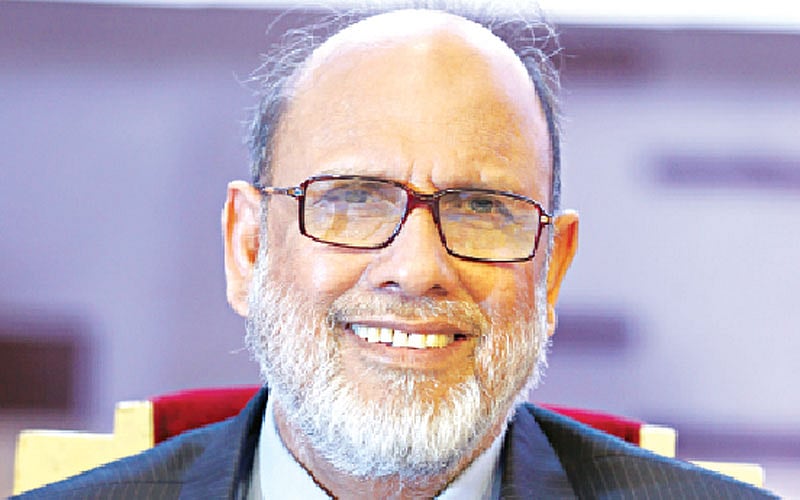
All past records of leaving the office of chief justice vacant have been broken after justice SK Sinha had resigned from his position on 11 November.
And for the third time in the 46 years since the country’s independence, there has been delay in appointing a chief justice.
This, stakeholders say, has created uncertainty in the appointment of judges to both the Appellate and High Court divisions.
The acting chief justice, Md Abdul Wahhab Miah, himself has not taken oath, so there is hardly any legal scope for him to administer the oath of office of new judges, according to some jurisrs.
Attorney general Mahbubey Alam, however, told Prothom Alo that nothing has stopped because of this.
Asked about inadequate number of judges in the Appellate Division and the High Court. he said the state belongs to the people. "Technical questions are not more important. If necessary, he can conduct the oath.”
In the meantime, the term of the office order giving the senior-most judge of the Appellate Division Md Abdul Wahhab Miah responsibility as chief justice, has expired. He had been given charge till 20 November or until chief justice Surendra Kumar Sinha resumed office.
Prothom Alo's investigation reveals that it is the norm to issue office order if persons in constitutional posts go on extended leave. In 1986 when comptroller and auditor general (CAG) AK Azizul Huq went on a month’s leave, the president appointed the senior most auditor Shamsuddin Ahmed Bhuiyan as acting CAG in accordance to article 130 of the constitution.
Following the president’s order, on 8 December 1986 finance secretary M Mustafizur Rahman issued a gazette in this regard. The acting CAG had been given a monthly allowance of Tk 300 for the purpose. He had been initially given charge for one month, but remained in the post for almost a year. In fact, the chief justice even swore him in.
Former law minister Abdul Matin Khasru told Prothom Alo that an office order should be issued in this regard, but perhaps this has not been done as a permanent appointment will be made shortly.
Many legal experts feel nowhere in the world is the office of the chief justice left vacant for an unspecified period of time.
Only once was the appointment of a chief justice delayed in the United States. A recess or acting chief justice was appointed then. In India, not a single day was the office of chief justice vacant.
Bangladesh law is different from that of India or Pakistan. In Pakistan, even an acting chief justice must take oath, though the acting chief justices refrain from taking any important decisions. The 87th report placed in India’s Rajya Sabha last year stated that only with the approval of the incumbent chief justice can the question of appointing an acting chief justice arise. No acting chief justice can remain in office for more than a month.
An amicus curie of the 16th amendment case, on condition of anonymity, told Prothom Alo that the office of chief justice fell vacant the very day that the chief justice resigned. That is what the law says. It may be constitutional for an acting president or speaker to remain in office indefinitely, but this does not apply to the office of chief justice, he said.
Article 152 of the constitution defines the chief justice as a specific individual, which has not been done in the case of the president or the speaker. It states that the “the President means the President of Bangladesh elected under this Constitution or any persons for the time acting in that office,” and “the Speaker means the person for the time being holding the office of Speaker pursuant to article 74.” And Article 54 states that if the president is ill or unable to discharge functions of office, the Speaker will discharge those functions.
Then again, Article 74 (3) states that if the Speaker is acting as President, the functions of the Speaker will be performed by the Deputy Speaker. Under the constitution, the president, chief justice and the speaker can conduct oath taking. But the constitution deems the ‘chief justice’ as the ‘chief justice of Bangladesh’.
When asked under what rules the present acting chief justice will receive salary and allowance, former CAG M Hafiz Uddin Khan told Prothom Alo, there was a strong question of ethics here. "If an acting chief justice is made to serve in that position for an extended time, why will he receive the same pay and allowance as the judge of the Appellate Division?"
According to the law of 1978, the chief justice receives higher salary than the judges of the Appellate Division. His monthly salary is Tk 110,000. This is Tk 5,000 more than that of an Appellate Division judge. The chief justice’s domestic aid and sumptuary allowance is also Tk 9,000 more than that of Appellate Division judges.
Hafiz Uddin Khan said, “It is unthinkable that while the office of chief justice remains vacant, the acting chief justice will be deprived of his due allowances without any justified reason. He can’t even use the chief justice’s chamber or residence.”
Law minister Anisul Huq had told the media that there is no problem in the acting chief justice conducting oath as Article 97 of the Constitution had given him the power to perform the duties of the chief justice.
The aforesaid amicus curie, in this regard, said that it would not be wise to interpret the constitution in a manner that can cause disruption. The Supreme Court is incomplete without the chief justice. According to the constitution, the duly appointed individuals must remain under all circumstances in the offices of the prime minister and the chief justice.
According to Article 48 (3), “in the exercise of all his functions, save only that of appointing the Prime Minister pursuant to clause (3) of article 56 and the Chief Justice pursuant to clause (1) of article 95, the President shall act in accordance with the advice of the Prime Minister.” Article 94 (2) states, “The Supreme Court shall consist of the Chief Justice, to be known as the Chief Justice of Bangladesh”. Clause 3 states the chief justice will sit in the Appellate Division. And clause 4 states that the chief justice will be independent in exercising his judicial functions. And Article 95 (1) says that the other judges will be appointed in consultation with the chief justice.
Recently retired High Court judge Kamrul Islam Siddiqui, remarked to Prothom Alo, “It goes against the spirit of the constitution to keep the office of chief justice vacant. What will happen if the acting chief justice is unable to carry out his duties?”
Several legal experts, on condition of anonymity, have expressed the same views, saying that the chief justice plays a direct role in four constitutional bodies, including the Supreme Court. He conducts the oath not only of Supreme Court judges, but also of the chief election commissioner and election commissioners, the CAG and the member of the Public Service Commission.
In India and Pakistan, the president can make any junior judge an acting chief justice. But in Bangladesh, if the present acting chief justice goes on leave or falls ill, there is risk of the constitution becoming ineffective.
When justice Muhammad Habibur Rahman had been acting chief justice for 10 months, he did not conduct any oaths. According to the constitution of 1972, the chief justice would swear in the president. In 2011 the responsibility was shifted from the chief justice to the speaker. The 1972 constitution provided for the chief justice to conduct the oaths of the speaker and the deputy speaker as well. This was changed in the fourth amendment of 1975 and the president was bestowed with this responsibility. This remains so.
When drawing up the 1972 constitution, it was said that the president would appoint an acting chief justice if he deemed it necessary. In the constitution handwritten by professor Anisuzzaman, he added in Article 97, if the president satisfactorily deemed necessary. Law experts feel this created a serious restriction under the president. This ‘satisfactorily’ term implies it is not up to the personal whims of the president.
At the last week’s conference of the judiciary, in the presence of the president, acting chief justice Md Abdul Wahhab Miah pointed to the disproportionate ratio of cases and judges and called for immediate appointment of judges at all levels. The attorney general told Prothom Alo in this regard, these are not big issues in matters of the state. The competence and reputation of the judiciary must be improved. The lack confidence must be dispelled.
Prothom Alo investigations find, when chief justice Badrul Haider Chowdhury went on retirement on 31 December 1989, complications arose over appointing the most experienced judge Shahabuddin Ahmed as chief justice. On 2 January 1990, the Supreme Court Bar Association at an emergency meeting reached a consensus to appoint the senior-most judge of the Appellate Division as chief justice. The present acting chief justice Md Abdul Wahhab Miah had chaired that meeting, signing the document which stated that there could be no delay after the office of chief justice fell vacant. The chief justice must be appointed with no delay. It was the constitutional norm and tradition to appoint the oldest serving judge of the Appellate Division as chief justice.
In the decision, all judges of the Supreme Court were asked to respect the policy of seniority. Copies of the decision were sent to then president HM Ershad, vice president Moudud Ahmed who was also holding office of the law minister, and all judges of both divisions of the Supreme Court. This was sent to the media as well.
While this decision had no legal binding upon the judges, this had ethical guidelines, according to senior lawyer AY Mashiuzzaman. He said, though seniority has been superceded at times since then, the decision remains intact and all members of the Supreme Court Bar are obliged to follow this. He said, “We had feared that Ershad, irate at the judgement in the case to scrap the 8th amendment, may supercede justice Shahabuddin Ahmad. Not long before that, chief justice Kemal Uddin Hossain had been removed. When justice Munim was then made chief justice, we boycotted him. We did not allow him to sit in court for three years. So we appeal to other junior judges of the Supreme Court not to take up the office of chief justice.”
Attorney general Mahbubey Alam, however, told Prothom Alo, the Supreme Court Bar is not any statutory institution. He said the question of seniority was completely up to the president. No judge was lesser than the other, he argued, adding that they all had the same authority. “It would not be correct to compare the present president with Ershad. In the US, if the chief justice dies, new appointments are even made from outside.”
The Bar meeting in 1990 took place on a Tuesday and commenced at 1:15 in the afternoon, presided over by the vice president of the Bar Mohammad Ullah. Among those present at the meeting, Shamsul Huq Chowdhury, Khandakar Mahbub Uddin Ahmed (later a BNP member of parliament), Shawkat Ali Khan, Aminul Huq (later attorney general), ANM Gaziul Huq (language movement hero) and Sudhangshu Shekhar Haldar (later Awami League member of parliament), have passed away. Speaking at the meeting in favour of appointing the chief justice on the basis of seniority were Ameer-Ul Islam, Abdul Baset Majumdar, and KS Nabi (later Awami League’s attorney general). Abdul Baset Majumdar told Prothom Alo he remembers the 1990 decision.
When asked about the Bar’s present decision, Bar president Zainul Abedin told Prothom Alo, “There hasn’t been any discussion as yet about the vacant office of chief justice. A meeting will be held today (Tuesday) and the matter will be discussed then.”
The law minister Anisul Huq has said, if need be, the chief justice may not even be appointed for the next one year.