The other side of growth: North sees rise in the poor
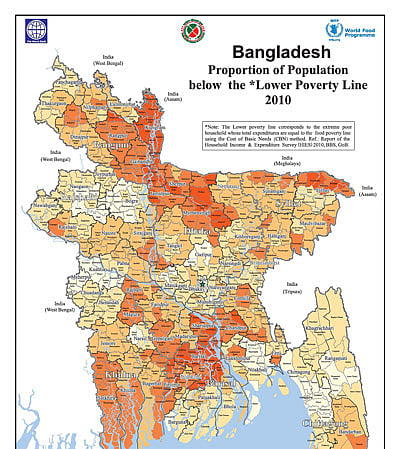
The fruits of much hyped economic growth have hardly reached the people in the north, as even official statistics show, the number of the poor has increased in five districts of the region in about half a decade.
Whereas around 75 per cent of the Bangladeshis are living above poverty line and some of them are even in rich and middle class brackets, the picture in Kurigram is opposite -- 71 per cent people there are poor, according to Bangladesh Bureau of Statistics (BBS). The rate of poverty was 64 per cent six years ago.
In cross-country comparison, Narayanganj, an industrial hub with a river port, has the lowest ratio of the poor -- only 2.6 per cent -- among its population.
Despite accelerated growth and rise in per capita income, income disparity has widened between the north and three economically advanced regions -- Dhaka, Chattogram and Sylhet, as reflected in the poverty map, prepared by the World Bank, on the basis of BBS' househld income and expenditure survery.
Accordingly, half of the 10 most poverty-stricken districts belong to northern Rangpur division and they are Kurigram, Rangpur, Dinajpur, Gaibandha, and Lalmonirhat. Five other most poverty-ridden districts are Bandarban, Khagrachhari, Jamalpur, Kishoreganj, and Magura.
Economist Hossain Zillur Rahman called it a puzzle as to why poverty is on rise in the north which was once dubbed monga (seasonal famine-like situation) region before the country reduced poverty significantly in recent decades.
"Why is poverty not coming down in this region despite 6-7 per cent in gross domestic product (GDP)?... So, there are serious questions about the growth itself," said Zillur, a former caretaker government adviser and Power and Participation Research Centre (PPRC) executive chairman, who earlier carried out research on monga-prone region.
Overall, poverty has deteriorated in the said districts of the north, found the WB report that has expressed concern at the situation.
The country's economic growth, it pointed out, has failed to bring the poor families out from poverty. Such growth is not helping to create jobs, the report added.
Hossain Zillur observed that the growth has increased due primarily to higher investment in road construction and other infrastructure development. "But, these roads have failed to draw new investments. Thus, the impact of the growth is not reaching the people at the grassroots," he said emphasising the need for conducting thorough research on why growth has failed to reach all.
Ragpur had 42.3 per cent of its population as poor in 2010 but the ratio increased by nearly five per cent to 47.2 in 2016, according to the BBS.
The ratio of the poor in Rajshahi division declined only one per cent to 29 per cent, indicating a stagnation in poverty situation.
But, the rate of poverty has risen in Kurigram, Dinajpur and Lalmonirhat in the past six years.
In Dinajpur, the poverty rate has surged to 64 per cent from 38 per cent in more than half a decade. Poverty ratio has also risen to 42 per cent from 34 per cent in Lalmonirhat.
Poverty situation has not witnessed any significant changes in five of eight Rangpur division districts -- at 47 per cent in Gaibandha, at 44 per cent in Rangpur, at 32.3 in Nilphamari, at 23.4 per cent in Thakurgaon and at 26.3 in Panchagargh.
The BBS report found that most of the people in Kurigram could not buy food for their family members. And they could hardly spend money on medication, education and clothes.
However, the overall poverty rate in the country has declined by seven per cent from 31 per cent to 24.3 during the period.
Currently, according to the BBS, 39.3 million out of 162 million population of the country are living below the poverty line.
The country's top 10 per cent people hold command over 38 per cent of the national resources, up from 35 per cent six years ago.
* This story, originally published in Prothom Alo print edition, has been rewritten in English by Toriqul Islam and edited by Khawaza Main Uddin