Islami Bank-2
S Alam went to Arastoo’s home and told him, “you have to step down”
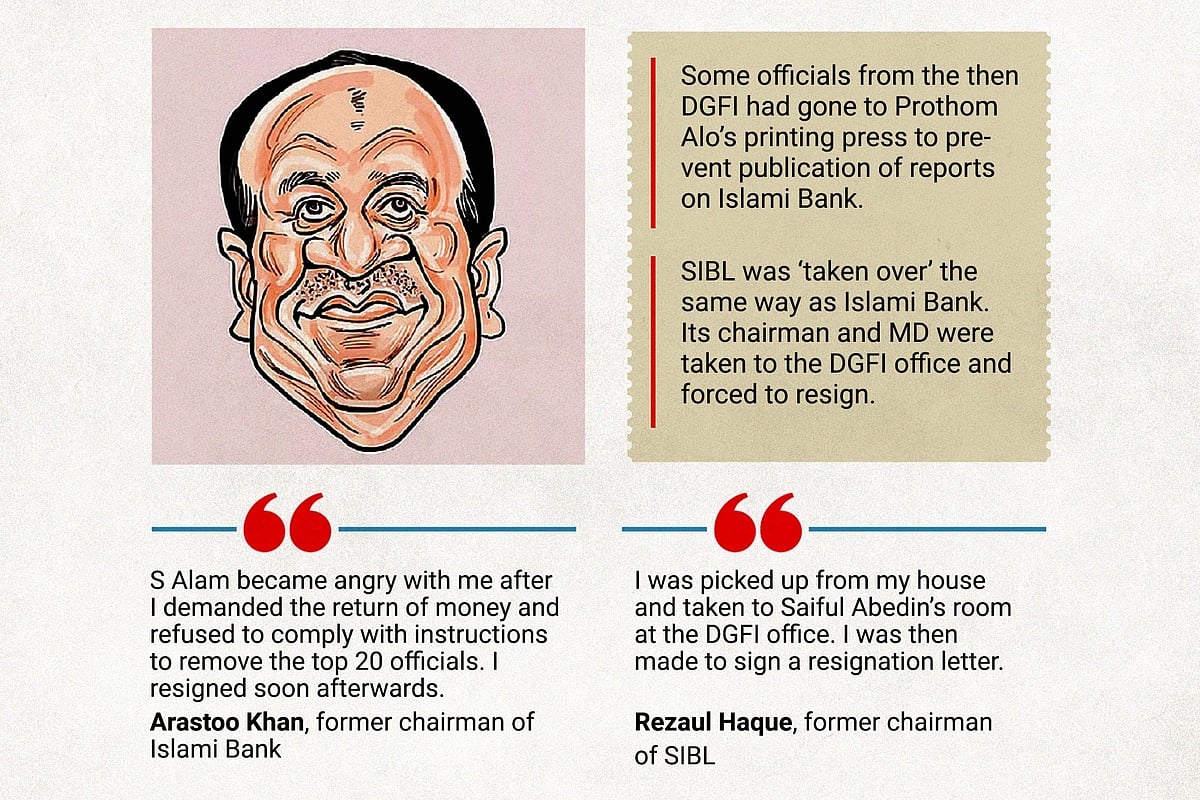
Former DGFI officials went to Prothom Alo’s press in an attempt to prevent publication of reports concerning Islami Bank
SIBL was taken over using the same method employed in the case of Islami Bank. Its chairman and MD were taken to DGFI headquarters and compelled to resign
After establishing control over Islami Bank through what insiders described as a “DGFI-engineered” board meeting on 5 January 2017, S Alam Group began installing its own people throughout the bank. At the same time, employees already working at the bank who were considered favourable to the new controllers were promoted to senior positions.
At the time, two major disagreements emerged between Islami Bank chairman Arastoo Khan and S Alam Group chairman Saiful Alam Masud. The disputes centred on the sidelining of senior bank officials and efforts to recover loans extended to several other banks under S Alam’s influence.
At one stage, Saiful Alam visited Arastoo Khan’s residence and told him, “You have to step down.” Arastoo Khan resigned soon afterwards.
Arastoo Khan himself spoke to Prothom Alo about the matter. In addition, two former directors of Islami Bank, two former top officials, and one person who later received an important position at the bank recounted the inside story of this takeover to Prothom Alo. None wished to be named.
Prothom Alo also spoke to multiple sources at Bangladesh Bank, S Alam Group, and various institutions and agencies.
This is the second instalment of a two-part investigation. The first part, titled ‘“Hey, who are you people?” — The story of a bank takeover’, described how S Alam seized control of Islami Bank and the role played by certain officials of the Directorate General of Forces Intelligence (DGFI), including its then director general Mohammad Akbar Hossain.
The changes to Islami Bank’s board of directors were front-page news in Prothom Alo on 6 January 2017 under the headline: “A ‘Peaceful’ Change at Islami Bank.” The word “peaceful” appeared within quotation marks because it had been used by the bank’s outgoing chairman Mustafa Anwar. The quotation marks were intended to signal that the claim of a “peaceful” transition was open to question.
After receiving news of the board meeting, this correspondent was sent by Prothom Alo management to the Radisson Blu Dhaka Water Garden. Security personnel blocked entry. Even after identifying himself and explaining that he was there to cover the Islami Bank board meeting, security staff said that no journalists had been authorised to enter.
DGFI sought to ensure that details of the bank takeover did not become public. On the night of 5 January 2017, DGFI personnel led by a senior officer arrived at Prothom Alo’s printing press while preparations were underway for the first edition of the following day’s paper. They entered the press and demanded to know what was being written and printed for publication. They threatened to shut down the printing operation that night if their demands were not met.
There were already indications that the meeting had been orchestrated by DGFI. However, nobody was willing to speak openly. Even the outgoing chairman and managing director of Islami Bank — both of whom spoke to Prothom Alo at the time — refused to provide details “out of fear”.
A review of reports published by other leading newspapers in the country shows that they too merely reported the board changes without probing further.
DGFI sought to ensure that details of the bank takeover did not become public. On the night of 5 January 2017, DGFI personnel led by a senior officer arrived at Prothom Alo’s printing press while preparations were underway for the first edition of the following day’s paper. They entered the press and demanded to know what was being written and printed for publication. They threatened to shut down the printing operation that night if their demands were not met.
DGFI officials remained at the Prothom Alo press until deep into the night. A senior official responsible for the Dhaka region also went to a hospital in the capital where Prothom Alo editor Matiur Rahman was undergoing treatment, although he was unable to meet him. Printing eventually began much later than scheduled after DGFI personnel left the premises.
The day after the board reshuffle, Prothom Alo management assigned this correspondent to investigate the events behind the change in ownership and control. The aim was to uncover what had really happened.
Numerous individuals connected to Islami Bank were interviewed by this correspondent. Through these discussions, it became possible to establish S Alam’s involvement. However, at the time, no one was willing to discuss the role of DGFI.
Multiple sources indicate that towards the end of that year, he was summoned by the highest echelons of the then-government and instructed to assume the chairmanship of Islami Bank. He took office accordingly.
The following day — 7 January 2017 — Prothom Alo published a front-page report headlined, “Changes at Islami Bank to free it from Jamaat influence.” The report highlighted S Alam’s involvement in the process.
Prothom Alo subsequently continued publishing reports on Islami Bank on a regular basis. On 24 November 2022, the newspaper’s lead headline read, “‘Nasty November’ for Islami Bank.” That report detailed how billions of taka had been siphoned out of the bank through loans issued under various names. The report sparked nationwide discussion.
Prothom Alo sent written questions seeking the response of DGFI regarding the role of its former officials. However, the agency did not provide any official comment. An official, speaking on condition of anonymity, told Prothom Alo that the organisation was unaware whether any DGFI personnel had been involved in such activities at the time. He added that even if any officials had been involved, none of them remained in active service.
Arastoo’s exit after only one and a half years
On 5 January 2017, during a Board of Directors meeting at the Radisson Blu Hotel, the S Alam Group appointed Arastoo Khan, a former Secretary, as the Chairman of Islami Bank for a three-year term. However, he resigned before completing even half of his tenure.
Following his retirement from government service in January 2016, the government had appointed Arastoo Khan as the Chairman of Commerce Bank. At that time, S Alam Group seized control of the bank, but retained Arastoo Khan in his position.
Multiple sources indicate that towards the end of that year, he was summoned by the highest echelons of the then-government and instructed to assume the chairmanship of Islami Bank. He took office accordingly.
In the early stages of the S Alam takeover, the group did not withdraw loans directly from Islami Bank. Instead, Islami Bank deposited Tk 35 billion into First Security Bank, Union Bank, and Global Islami Bank—all owned by S Alam. These institutions were already in the midst of a liquidity crisis; consequently, depositing funds there was considered a poor investment decision.
While the term for these deposits was three months, Islami Bank failed to recover the funds even after a year. This led to a heated altercation between Arastoo Khan and Saiful Alam.
I took charge of the bank under high-level orders. S Alam became incensed when I demanded the return of the money taken from the bank and refused to sack the top 20 officials. I resigned immediately following this.Arastoo Khan, former Chairman of Islami Bank, to Prothom Alo on 26 April 2025
Further friction arose regarding the removal of senior officials from Islami Bank. Two well-informed sources claim that Arastoo Khan was summoned to the Prime Minister’s Office (PMO). Present at the meeting were Saiful Alam, a director of Islami Bank, the late Shamim Mohammad Afzal (then Director General of the Islamic Foundation), and Abul Kalam Azad, then the Principal Coordinator for SDG Affairs at the PMO. Azad, who became an Awami League MP in the controversial 2024 elections, was arrested following the July mass uprising.
During the meeting, Saiful Alam and Shamim Afzal demanded the dismissal of 20 top officials from Islami Bank. Arastoo Khan refused. However, under subsequent pressure from intelligence agencies, two high-ranking officials—Md. Amirul Islam (Head of International Trade) and Mohammad Abdus Sadek Bhuiyan (Head of Human Resources)—were removed.
Following these disputes over fund recovery and staff dismissals, Saiful Alam visited Arastoo Khan’s residence in April 2018 and demanded his resignation. Arastoo Khan resigned shortly thereafter, on 26 April 2018.
At the time, Arastoo Khan told Prothom Alo, “I have resigned as I could no longer manage the pressure of work. The bank was preventing me from spending time with my family.”
However, on 26 April last year, Arastoo Khan told Prothom Alo, “I took charge of the bank under high-level orders. S Alam became incensed when I demanded the return of the money taken from the bank and refused to sack the top 20 officials. I resigned immediately following this.”
“The bank suffered no losses during my tenure as Chairman. I made the bank more inclusive by appointing non-Muslim officials. People of all faiths deposit money in this bank; therefore, everyone has the right to work there. Furthermore, I had initiated a drive to recruit more female staff,” he added.
Following the forced resignations of the Chairman and Managing Director, senior officials were systematically ousted. In their stead, junior staff, known to be close to S Alam, were catapulted into senior management. Many of these individuals had previously served at the bank’s Khatunganj branch in Chattogram, where S Alam was a prominent borrower.
Islami Bank has historically had few female employees. Sources reveal that out of 19,079 current staff, only 918 are women (less than 5 per cent), whereas the industry average for women in the banking sector is approximately 17 per cent. Furthermore, there are only 36 employees from religious minority backgrounds.
The ‘US$2 billion man’
Following the forced resignations of the Chairman and Managing Director, senior officials were systematically ousted. In their stead, junior staff, known to be close to S Alam, were catapulted into senior management. Many of these individuals had previously served at the bank’s Khatunganj branch in Chattogram, where S Alam was a prominent borrower.
For instance, Miftah Uddin, a native of Banshkhali, Chattogram, was working at the Khatunganj branch. On the very day S Alam established control over the bank, he was promoted to Assistant Vice President. Within 18 months, he received four further promotions. By December 2020, he had become Executive Vice President, remaining in charge of the Khatunganj branch throughout. He was later brought to the head office as Deputy Managing Director (DMD) and tasked with approving large-scale loans.
Similarly, Mohammad Sabbir was promoted to Vice President and transferred to the Khatunganj branch on the day of the ownership change. After successive promotions, he too became a DMD. Prior to Miftah Uddin, he held the responsibility for approving major credit facilities.
The promotions of Miftah and Sabbir were in direct violation of the bank’s internal policies, which require at least 20 years of experience for appointment to the post of DMD—a criterion neither met.
Another official, Mohammad Habibur Rahman, was promoted to Assistant Vice President on the day of the takeover. Following four promotions between 2019 and 2021, he was placed in charge of the International Services Department.
Several Islami Bank officials refer to Habibur Rahman as the “Two Billion Dollar Man”, alleging he facilitated the laundering of $2 billion under the guise of foreign trade. His presence caused significant unrest within the bank. In November 2023, he was transferred from Islami Bank to SIBL (another S Alam-controlled bank) as a DMD.
AM Shahidul Amran received rapid promotions in 2017, 2019, 2020, and 2022 before being posted to the Managing Director’s office. Sources at the bank suggest he acted as a conduit for instructions from the S Alam Group, which the then-Managing Director, Mohammed Monirul Moula, was obliged to follow. Mohammed Monirul Moula is currently incarcerated on corruption charges.
Mohammad Kaiser Ali, who was the Khatunganj branch manager at the time of the takeover, was promoted to Executive Vice President that same day. Within a year, he became a DMD, and by July 2019, he was elevated to Additional Managing Director (AMD). Additionally, in April 2023, Akij Uddin, personal secretary to Saiful Alam, joined as a DMD.
Following the July uprising, these officials have absconded and remain in hiding.
Regional favouritism and mass recruitment
In addition to installing loyalists in senior roles, S Alam began a mass recruitment drive primarily targeting residents of Patiya, Chattogram—the ancestral home of Saiful Alam.
Human Resources records show that in 2016, the bank employed approximately 12,700 staff. By 2024, this figure had surged to nearly 24,000. Under S Alam’s tenure, some 10,000 new employees were recruited.
I was taken from my home to DGFI headquarters and made to sign a resignation letter in the office of Saiful Abedin.Rezaul Haque, Former chairman of SIBL
An audit conducted after the July uprising revealed that 70 per cent of those hired during the S Alam era were from Chattogram, with 45 per cent specifically from Patiya. A significant portion of these appointments were made without any formal job advertisements or competitive examinations.
Following the uprising, the appointments of approximately 5,000 staff were annulled. These individuals are currently protesting the decision, despite revelations that many possessed forged academic certificates or had failed to attend mandatory examinations.
From 2017 until 5 August 2024, the nominated and independent directors of the bank included incumbent President Mohammed Shahabuddin, Dhaka University Professor Nazmul Hasan (who later went on to become chairman of Islami Bank), Chittagong University professors Saleh Jahur and Selim Uddin, retired military officer Abdul Matin, former police officer Abdul Mabud, former banker Zainal Abedin, as well as Abu Asad, Khurshid-ul-Alam, and Zillur Rahman, along with accountants Mohammad Solaiman and Mohammad Nasir Uddin, Fashiul Alam, Borhan Uddin Ahmed, Mohammad Sirajul Karim, Kazi Shahidul Alam, Mohammad Kamrul Hasan, Kamal Hossain Gazi and so on.
During the period of S Alam’s control until the political transition in August 2024, the bank’s Managing Directors were Abdul Hamid Miah (2017–2018), Mahbub-ul-Alam (2018–2020), and Mohammad Monirul Moula (2020–2025). The latter remains in custody.
Taking control of 7 banks
During the tenure of the previous Awami League government, control was consolidated by S Alam Group not only over Islami Bank but also over six other banks and one financial institution.
These included Social Islami Bank, First Security Islami Bank, Union Bank, Al-Arafah Islami Bank, Global Islami Bank, Commerce Bank, and Aviva Finance (formerly Reliance Finance).
According to allegations, control over these institutions was established through the acquisition of shares held in both disclosed and undisclosed names. Under Bangladesh’s Bank Companies Act, no single family is permitted to hold more than 10 per cent of shares in a bank, and shares held through proxies are subject to confiscation.
Social Islami Bank (SIBL) was taken over using a process similar to that applied in Islami Bank. In 2017, S Alam purchased shares in SIBL. On 30 October that year, the bank’s chairman Major (retd.) Mohammad Rezaul Haque, executive committee chairman Anisul Haque, managing director Shahid Hossain, and company secretary Humayun Kabir were taken from their residences to the DGFI headquarters, where they were compelled to submit resignation letters. At the time, the DGFI was led by Major General Mohammad Saiful Abedin.
Rezaul Haque recently told Prothom Alo, "I was taken from my home to DGFI headquarters and made to sign a resignation letter in the office of Saiful Abedin."
Multiple sources further claimed that S Alam, his brother Abdus Samad Labu, and son-in-law Belal Ahmed were present at the DGFI director general’s office at the time.
The subsequent board meeting formalising the ownership transition was held at The Westin Dhaka in Gulshan, where S Alam was also present. Following the restructuring, Professor Anwarul Azim Arif was appointed chairman (later deceased). Kazi Osman Ali, Additional Managing Director of FSIBL, was appointed managing director, while Belal Ahmed, Vice Chairman of NRB Global Bank, became Chairman of the executive committee.
Among the newly appointed directors was Zebaunnesa Akhter, wife of former DGFI director general Molla Fazle Akbar, who had previously served as chairman of Union Bank, also owned by S Alam Group.
Following the political transition after the fall of the Awami League government, Bangladesh Bank restructured the boards of several affected banks and initiated a merger process involving five institutions, including Union Bank and SIBL.
However, while regulatory actions have been taken, most of the officials and directors allegedly involved in facilitating the takeover and approval of large-scale lending remain beyond legal accountability. S Alam and members of his family are currently residing abroad.
Scale of lending and financial exposure
Investigations suggest that S Alam Group obtained substantial loans—both directly and indirectly—from the seven banks and one financial institution under its influence, as well as from other banks.
Following the July mass uprising, a joint investigation team was formed to probe allegations of money laundering and financial irregularities involving the former prime minister Sheikh Hasina’s family and 11 major business conglomerates, including S Alam Group.
A meeting chaired by Bangladesh Bank Governor Moshtaqur Rahman was held at Bangladesh Bank on 10 March, attended by managing directors of affected banks. It was reported that Islami Bank suffered the most severe losses due to exposure to S Alam Group. Other affected institutions included Janata Bank, Rupali Bank, UCB, Southeast Bank, Premier Bank, Mercantile Bank, and Commerce Bank.
According to Bangladesh Bank data, total direct and indirect exposure linked to the group is estimated at Tk 225,030 crore. Islami Bank has been assigned responsibility for tracing and recovering S Alam’s assets. As many as 10 non-disclosure agreements (NDAs) will be signed as part of recovery efforts, three of which have already been completed.
Islami Bank Managing Director Omar Faruk Khan told Prothom Alo on 21 February that multiple initiatives had been undertaken to recover funds from S Alam Group, though no significant recovery had yet been achieved.
He added that international audit firms had been engaged and that efforts were underway to trace and repatriate funds transferred abroad, though the process would take considerable time.
Response from S Alam Group and ongoing dispute
Meanwhile, on 3 May, a public statement published in several newspapers in the form of an advertisement by S Alam Group rejected the allegations, claiming that loans taken by other individuals or entities were being wrongly attributed to the group.
It argued that S Alam Group is a family-owned industrial conglomerate and that liabilities must be properly identified and verified.
The statement further questioned why, if liabilities were as extensive as claimed, the identities of borrowers and the structure of ownership were not being transparently disclosed.
In response, Islami Bank’s acting managing director Altaf Hossain told Prothom Alo on 3 May that all loans taken by S Alam Group—both in declared and undisclosed forms—had been identified through domestic and international audit firms, as well as by Bangladesh Bank.
He added that cases had already been filed and the matter was now sub judice.
Islami Bank now
According to the bank’s annual reports, Islami Bank Bangladesh PLC recorded a profit of approximately Tk 447 crore in 2016. By 2025, this figure had fallen sharply to Tk 137 crore. During the same period, the proportion of non-performing loans rose dramatically—from 4.25 per cent to 49 per cent. The bank’s classified loans have now exceeded Tk 92,000 crore.
Foreign investors’ shareholding in the bank has also declined significantly. It fell from 63 per cent to 17.91 per cent (as of March 2026). Meanwhile, under the interim government, around 82 per cent of the shares linked to S Alam Group were reportedly frozen by Bangladesh Bank due to ownership and control concerns.
Sources claim that S Alam Group has once again become active in seeking to regain influence over Islami Bank Bangladesh PLC. This suspicion has intensified following the recent leave of the bank’s Chairman M Zubaidur Rahman and Managing Director Omar Faruk Khan.
Zubaidur Rahman is currently abroad on a one-month leave and Omar Faruk Khan remains in the country. Their leave was approved at the bank’s board meeting on 12 April.
Omar Faruk Khan had originally sought 15 days’ leave. However, following the advice of Bangladesh Bank, he was granted 49 days of leave.
Two internal sources within Islami Bank suggest that following the July mass uprising, individuals with links to Jamaat-e-Islami have gained influence within the institution. Some previously dismissed officials have reportedly been reinstated in senior positions. According to these sources, the temporary removal of the chairman and managing director was intended to prevent the bank from drifting back under Jamaat influence.
The matter was raised in the first session of the 13th Jatiya Sangsad (national parliament) on 30 April, when BNP Standing Committee member Salahuddin Ahmed stated that bank takeovers had occurred both during the Awami League era and under the interim administration.
He remarked that in some cases intelligence agencies had summoned individuals to hotels, while in others takeovers were carried out openly under religious slogans such as “Naraye Takbir, Allahu Akbar”, describing the methods as different in style but similar in intent.
Meanwhile, the BNP-led government introduced amendments to the Bank Resolution Ordinance (2025), allowing former owners to return under certain conditions, including partial repayment and formal undertakings. The ordinance has since been passed in parliament, sparking controversy across political and financial circles.
On 21 April, member of parliament Hasnat Abdullah asked in Parliament whether the government had any special plan in the current financial year to recover loans from S Alam Group. He also questioned whether any agreement had been reached to reinstate the group without full repayment, and whether there was any understanding between the government and S Alam Group regarding these issues.
In response, Finance Minister Amir Khasru Mahmud Chowdhury stated that BNP’s politics does not allow any scope for negotiated settlements within economic governance. He added that the amendment to the Bank Resolution Act was not intended to facilitate the return of any party.
The implications of the amendment remain to be seen in the coming months.
It may be asked: what does all this “bank looting” have to do with the public?
The answer lies in macroeconomic reality. Rising dollar prices, declining foreign reserves, and increasing household expenses are all indirectly linked to the instability and mismanagement within the banking sector.