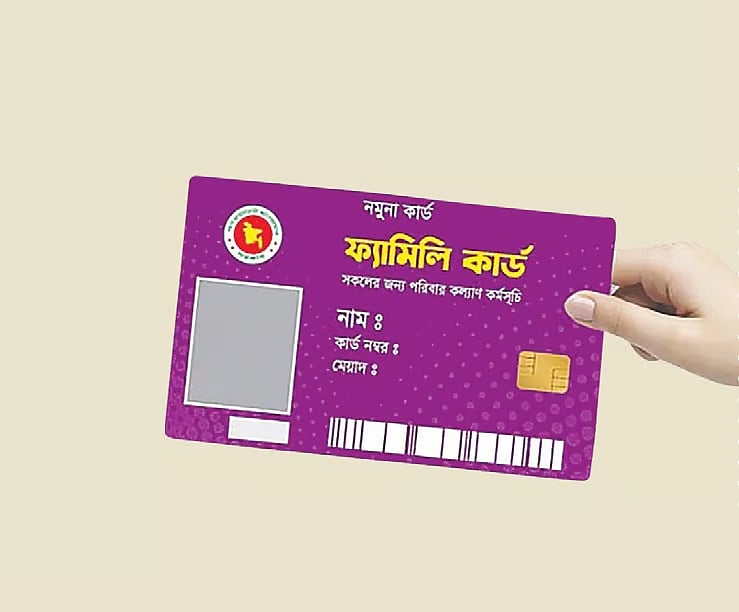
The BNP government is set to introduce a “Family Card” programme to ensure women’s empowerment. The authorities will distribute the card on a pilot basis from 10 March, with plans to gradually provide it to all families across the country.
The initiative has generated considerable public interest, as people in the country have endured prolonged economic hardship.
There was a major shakeup during the covid-19 pandemic, when many people lost their jobs and poverty increased.
Before the economy could fully recover from the pandemic, the Russia–Ukraine war began, which further affected the national economy. As a result, the prices of many essential commodities rose significantly.
At the same time, nearly 100 existing social protection programmes in the country have failed to provide adequate support to all poor people.
These programmes often suffer from duplication, overlapping activities, and allegations of irregularities or corruption in selecting beneficiaries. In this context, experts consider the family card to be a major social and economic initiative.
The Bangladesh Nationalist Party (BNP) had been promoting the idea of a family card even before the start of the national election campaign.
The programme appears at the very beginning of the party’s election manifesto as one of its key commitments.
The manifesto states that the government will introduce family cards to support marginalised and low-income families, ensuring that they receive 2,500 taka per month or essential commodities of equivalent value. The amount of financial support will gradually increase over time.
As part of the initial implementation, the government has already launched a pilot project under the family card programme.
The project will operate in 14 locations: the Korail slum and the Bhashantek Baganbari slum in the capital, Pangsa in Rajbari, Patiya in Chattogram, Bancharampur in Brahmanbaria, Lama in Bandarban, Khalishpur in Khulna, Char Fasson in Bhola, Derai in Sunamganj, Bhairab in Kishoreganj, Bogura Sadar, Lalpur in Natore, Thakurgaon Sadar and Nawabganj in Dinajpur.
Under the initial project, ward no. 6 of Kulanj Union in Derai has been selected as the project area.
Suchitra Roy, deputy director of the District Social Services Office in Sunamganj, told Prothom Alo, “A four-member ward committee started work here on 26 February. The survey work has finished and the data entry process is almost complete. After completing the remaining formalities, we hope to launch the programme in Sunamganj on 10 March.”
The programme will also operate in Lama upazila of Bandarban District.
Milton Muhuri, deputy director of the District Social Services Office, told Prothom Alo, “We have completed the field-level work here. We are ready to distribute the cards on 10 March.”
Inquiries at various districts and the Department of Social Services reveal that the survey and data entry work have already been completed.
Printing of the family cards will finish by 9 March. On 10 March, Prime Minister Tarique Rahman will formally inaugurate the family card programme at the Korail slum in Dhaka.
On the same day, beneficiaries will receive the first month’s financial assistance on their mobile phones.
Five-tier committees will oversee beneficiary selection and programme implementation.
These include upazila committees (or city committees in urban areas), union committees, municipal committees (in towns), and ward committees. Above all of these bodies, a cabinet committee will supervise the programme.
The minister of finance will serve as the chair of this committee, while the secretary of the Ministry of Social Welfare will act as the member-secretary.
A national technical and information management (data management) committee will also operate under the system, headed by the director general of the Department of Social Services.
What is the card and who will receive it
According to the official policy document, the family card is essentially an integrated social protection programme.
Similar programmes in Brazil have significantly reduced poverty. India and Indonesia also operate family-based assistance programmes that have demonstrated notable success.
Speaking to Prothom Alo at the secretariat last week, Professor AZM Zahid Hossain, minister for social welfare, said that the Ministry of Social Welfare would hold primary responsibility for implementing the family card programme.
However, a total of 14 ministries—including the ministries responsible for women and children, education, information technology, finance, and planning—will be directly involved in its implementation.
He said, “We are starting with a pilot project. At one stage, every family in the country will receive this card. However, marginalised and poor families will receive priority.”
The government will issue the card in the name of the mother or the female head of the household.
The cardholder must be at least 18 years old. The card will contain all essential citizen information. The authorities plan to transform it into a “Universal Social ID Card” by 2030.
Official documents state that political interference will not influence the selection of families. A scientific and automated method will determine the socio-economic category of each household.
Families without land or housing, households with members with disabilities, female-headed families, and disadvantaged communities—including Hijra, Bede, and ethnic minority groups—will receive priority for financial or food assistance.
Financial challenges
The Ministry of Finance has prepared action plans for six programmes that appear on the new government’s priority list.
The family card programme is among them. Under the initially proposed four-month pilot project, the authorities plan to issue cards to 40,000 families.
The estimated expenditure for these four months stands at Tk 387 million (38.7 crore).
After the pilot project concludes, the government may decide to introduce the family card nationwide. In that case, the finance division will take the necessary steps regarding budget allocation and fund disbursement.
However, the Ministry of Finance has also highlighted several potential challenges. For instance, providing direct cash assistance could increase pressure on inflation.
In such a situation, the authorities will need to increase supply in the economy. The ministry has also recommended conducting a small-scale study on the issue after the completion of the initial pilot project.
The Ministry of Finance believes that the additional financial commitments associated with the family card could increase the budget deficit. To address this concern, policymakers could adopt several measures.
These include increasing revenue collection by improving the tax-to-GDP ratio, implementing the programme gradually to keep the deficit within a tolerable range, reducing costs by avoiding duplication with other programmes, and ensuring proper coordination between income and expenditure.
A unified stream of assistance
Bangladesh currently operates nearly 100 social protection and assistance programmes.
Once the family card system becomes operational, the authorities plan to bring all cash allowances and Trading Corporation of Bangladesh (TCB) assistance under a single card system.
Ziauddin Hyder, former senior health officer at the World Bank and adviser to the BNP chairperson, told Prothom Alo, “The existing assistance programmes have several shortcomings. Bias has appeared in the selection of beneficiaries. In many cases, people who deserve assistance have been excluded from the list, while others have received multiple benefits simultaneously. The introduction of the family card will bring these assistance programmes under a single system. The right people will receive support, and the initiative will prevent the waste of resources.”
Policymakers state that whether the support comes in the form of cash or food assistance, it will go directly to women.
Women will also be able to save from this support. They believe that both assistance and savings will contribute to women’s empowerment.
Commenting on the initiative, Selim Raihan, professor of economics at the University of Dhaka and executive director of the South Asian Network on Economic Modelling (SANEM), told Prothom Alo, “This is undoubtedly a good initiative. It is important to remember that the country has around 100 social protection programmes, implemented by nearly 25 ministries. These programmes contain duplication and repetition, and there have been allegations of corruption. The introduction of the family card could bring these social protection programmes under a unified framework.”
Selim Raihan added, “The family card programme may require around Tk 600 billion (60,000 crore) annually, in addition to administrative costs. In that case, securing the necessary financing could become a major challenge.”