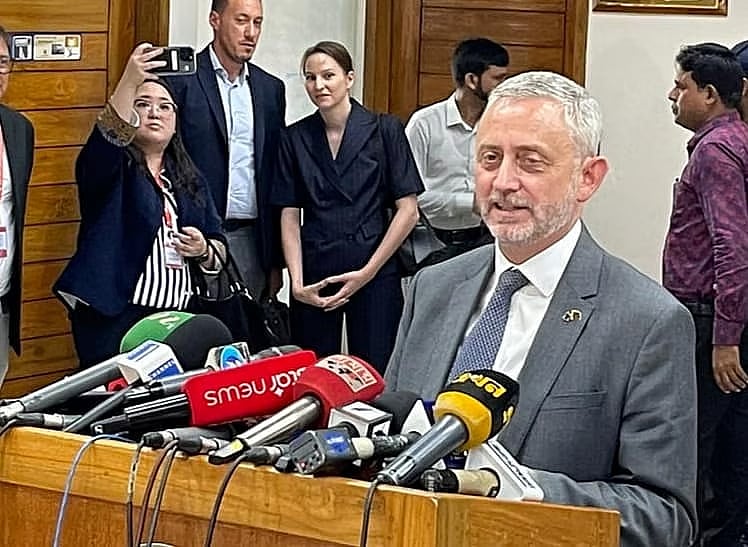
Freedom of expression doesn’t mean inciting violence, EU Ambassador at Dcab Talks
European Union (EU) Ambassador to Bangladesh Michael Miller has stated that the EU, which is committed to the rule of law and human rights, stands in favour of freedom of expression and the right to peaceful assembly.
However, freedom of expression does not mean that any individual or organisation may incite violence; therefore, the EU opposes incitement to violence and the spread of hatred, he added.
Michael Miller made these remarks yesterday, Monday, while responding to questions from journalists at the “DCAB Talk” held at the National Press Club in the capital.
The Diplomatic Correspondents Association, Bangladesh (DCAB) hosted the dialogue.
The EU Ambassador noted that in his view, the government’s measures to address the recent situation in Bangladesh have been proportionate to the circumstances, though multiple issues emerging simultaneously are complicating the situation.
Asked about the ongoing political violence in the country, Michael Miller underscored the boundary between peaceful expression and conflict, stating that while dissent may be voiced in a democratic society, there is a clear limit.
According to him, when actions become unlawful, disrupt public order and safety, and when individuals or organisations fail to avoid conflict—instead actively encouraging it—such conduct can under no circumstances be accepted.
Referring to the founding values of the European Union, the EU Ambassador remarked that any institution built on respect for the rule of law and human rights, including the EU, will say “yes” to freedom of assembly and freedom of expression, but firmly “no” to incitement to conflict or hatred.
When asked whether recent clashes would impede EU operations, Michael Miller replied, they were currently witnessing various challenges in Bangladesh.
However, whenever they speak with government authorities, they convey a clear message that steps taken to manage the situation must be proportionate—and in his assessment, the measures taken to handle the situation (in curbing violence) had been proportionate.
Emphasising that the EU wishes to see stability in Bangladesh, the envoy of the 27-nation European bloc in Dhaka said that achieving this requires ensuring justice and accountability for past human rights violations, upholding respect for the rule of law, and eschewing the path of violence—alongside maintaining political order and public safety.
Political evolution does not happen overnight
Highlighting the inherent challenges during periods of political reform, Michael Miller said, various European countries experienced the struggles involved in political transition, and several EU member states navigated circumstances very similar to what Bangladesh is currently going through.
He further said what he sought to convey in his remarks is that political evolution is a complex process; it cannot be achieved overnight. It takes many years, and one must be ruthless in pursuing reform.
He added that he has maintained close engagement with the government since the election to send a clear message of support for reforms.
Michael Miller further noted that in advancing the reform process, the EU expects broader consensus among the political parties that entered the National Parliament through competitive elections.
Asked about Bangladesh’s security situation, the EU Ambassador expressed full confidence that the security environment remains under the government’s control, while also voicing optimism regarding progress on wages in the readymade garment sector.
Democracy means more than just elections
Referring to conflicting statements regarding completely banning versus resuming the political activities of the Awami League, journalists asked about the European Union’s stance on the party’s operations.
Michael Miller responded saying that the EU had no position on this matter; anything he says would be personal. Of course, they were aware that the measures initiated by the interim government remain ongoing.
Reiterating the EU’s interest in Bangladesh’s stability, the Ambassador said, they want a stable and prosperous Bangladesh. Their stance was very straightforward—that entails justice and accountability for past human rights abuses, respect for the rule of law, and renouncing conflict now while respecting public order and public safety. “I believe these points are clear.”
Speaking on reform initiatives during the political transition, Michael Miller observed that trust between citizens and state institutions had been “reduced to zero” during the previous Awami League administration.
Democracy, he stressed, means more than just elections and more than just parliament—it is fundamentally about state institutions.
Michael Miller added that deep mistrust persisted between citizens and institutions in Bangladesh under the former regime, and that the EU wishes to stand alongside the country today in bridging that deficit.
DCAB President AKM Moin Uddin and General Secretary Imrul Kayes also addressed the event.