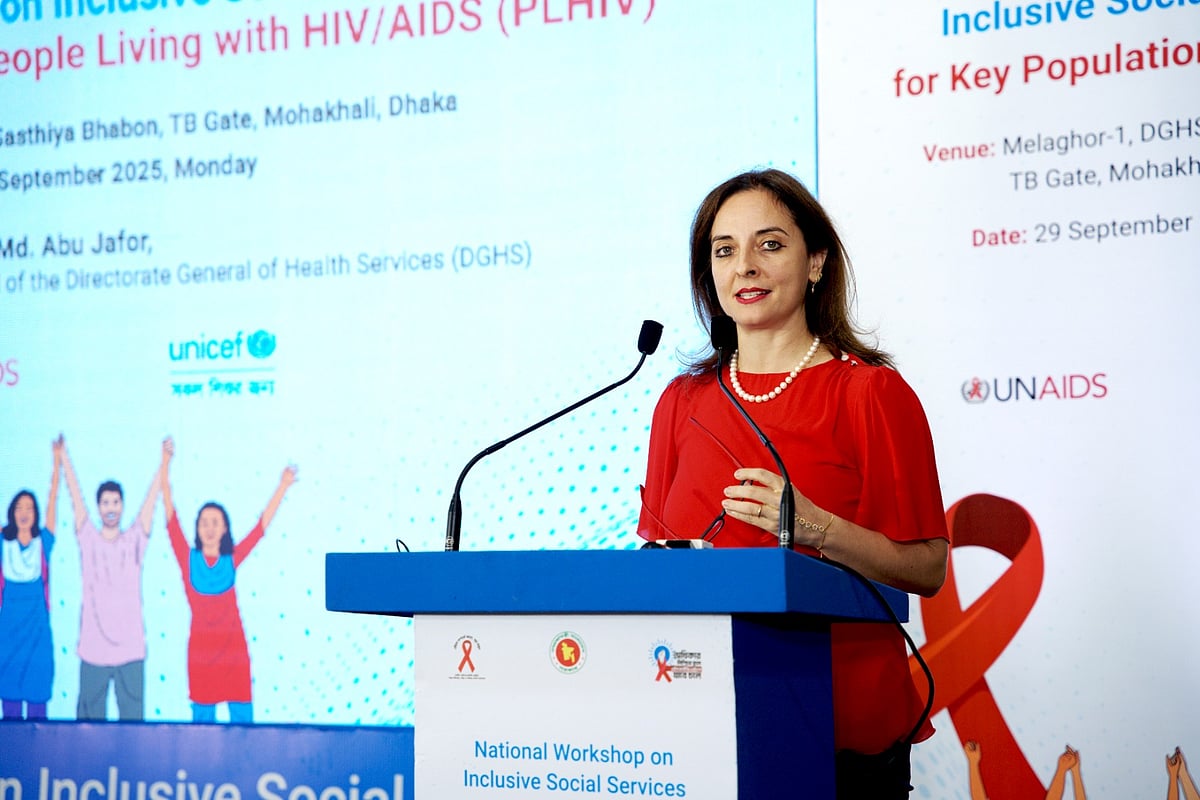
National workshop held on inclusive social services for key populations and PLHIV
A national workshop on the integration of HIV prevention and care within child protection and social service systems was held in Dhaka today, Monday. The event, led by the Directorate General of Health Services (DGHS), UNAIDS, and UNICEF Bangladesh, took place at the Melaghor 1, Auditorium of DGHS, says a press release.
Professor Dr. Sheikh Sayidul Haque, Additional Director General (Planning and Development) of DGHS inaugurated the workshop.
Dr. Saima Khan, the Country Director of UNAIDS Bangladesh, co-chaired the workshop alongside Dr. Zubaida Nasreen, Deputy Director of the National AIDS/STD Control Program at DGHS, Professor Dr. Sheikh Sayidul Haque, Additional Secretaryl, and the Director General (Planning and Development) from DGHS.
Dr. Elisa Calpona, OIC Chief of Child Protection Section from UNICEF Bangladesh Country Office suggested that to enhance HIV prevention and care through integration into social service systems, including strengthening the training of social workers and community facilitators.
Elisa Calpona spoke about incorporating and improving referral pathways through CPIMS+ and the 1098 Helpline while maintaining strong safeguards for confidentiality. There are strong needs to expand access to adolescent-friendly HIV services such as: testing, self-testing, and PrEPwith a specific focus on emerging hotspots; addressing stigma at the family, community, and at the service facility levels, she said.
We also need to to enhance accountability and safeguarding protocols across health, justice, and child protection systems; and finally, the effort should broaden social protection measures, which include cash support, nutrition, and life skills training for people living with HIV. and their families, she added.
The event announced the joint release of the UNICEF–UNAIDS guide titled "Policy and Programming Approach: Linking HIV Prevention with Harmful Practice Prevention in Bangladesh", a multi-stakeholder partnership initiative.
Dr. Saima Khan, raised the issue of rise of HIV infection in the country. She attributed the intensifying risk to a "collective neglect of the children" and a failure to support them during their vulnerability. She specifically stated that the separation of children from their families and the abuse they endure often forces them into situations like sex work or drug abuse, significantly heightening their risk of contamination of HIV. She stressed that this critical situation demands a collective efforts from all stakeholders to "stand by the key population at risk" and address the root causes driving children into these perilous circumstances.
Also speaking at the workshop were Mahbub Hossain, Monitoring Expert, “Prevention of Violence and Harmful Practices Against Children and Women in Bangladesh (PVHP) project under the Ministry of Women and Children Affairs; SIM Ferdous Alam, Assistant Director (Administration), Directorate of Sports (DoS), Ministry of Youth and Sports (MoYS); Md. Khalid Shifullah, Assistant Director, Special Education Section, Directorate of Secondary & Higher Education (DSHE), MoE ; Mohd. Sadiqul Haque, National Project Director, CSPB Project, Phase-II, Department of Social Services (DSS).
They highlighted the existing lack of capacity and conceptual clarity on HIV and discussed the scope of further collaborations among stakeholders and potential partners. UNICEF and UNAIDS teams function as strategic partners, providing a protection-oriented perspective and practical implementation tools to the intersectoral coordination efforts led by DGHS. The integrated strategy seeks to mitigate stigma, bridge service gaps, and ensure Bangladesh remains committed to ending HIV as a public health threat by the year 2030.