Trash business in Dhaka
Workers haul the waste, leaders fill their pockets
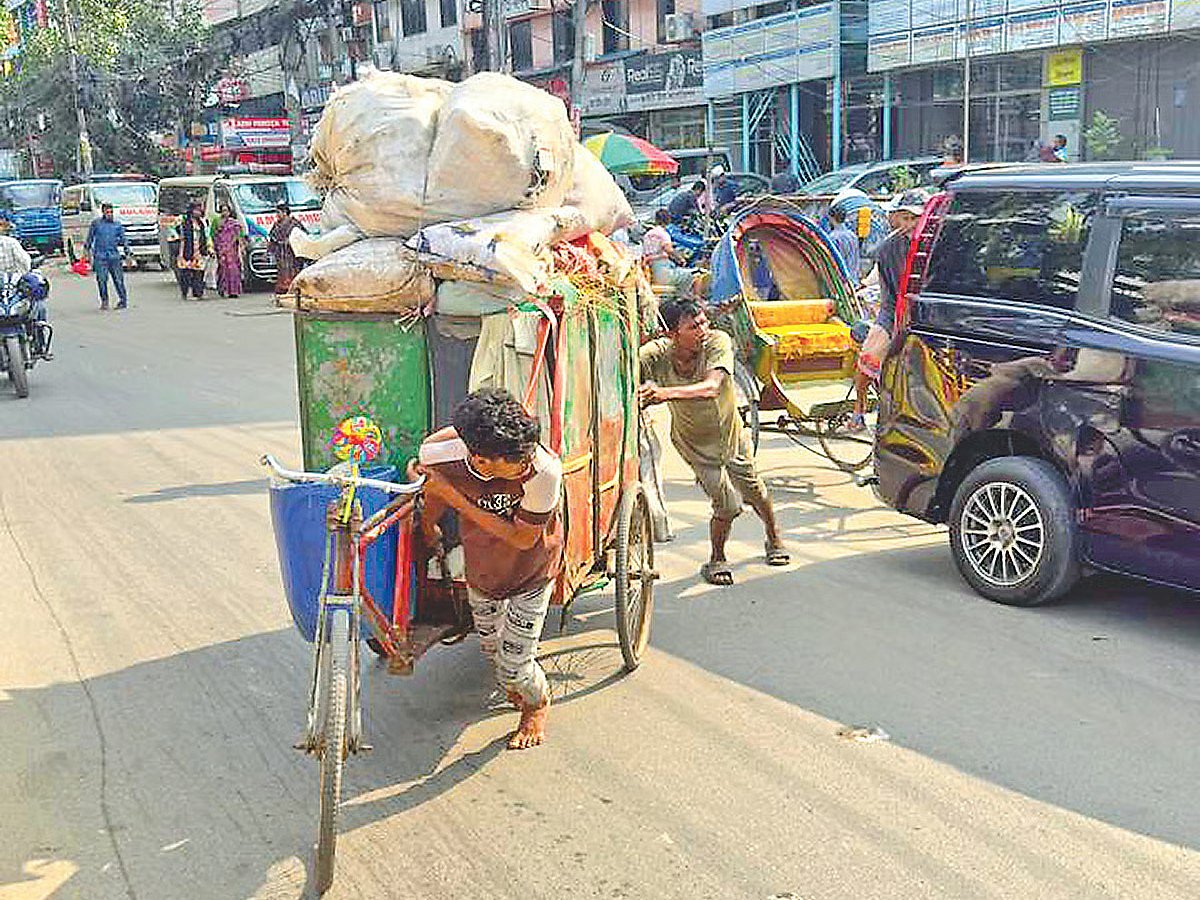
The rickshaw van was overflowing with rotten leftovers from homes and restaurants, broken plastic items, bottles, sacks and filthy polythene bags. Two persons, a young man and a teenage boy, were pushing the heavy van forward with all their strength.
Pedestrians close by hurriedly past avoiding the foul stench spreading from the cart. But the two workers cannot stop. No matter how exhausting the job is, they must deliver the waste-filled van to the designated site — a temporary waste transfer station or a secondary transfer station (STS).
At around 2:30 pm last Saturday, the two workers were found on a road beside Panthakunja Park in the capital. The van driver’s name is Rubel, while the teenage assistant with him is Saidur. Together, they collect waste from homes and restaurants on several roads in Ward No. 16 of the Dhaka South City Corporation (DSCC).
Rubel and Saidur begin working every day at around 9:00 am and usually finish between 4:00 pm and 5:00 pm. Rubel receives a monthly salary of Tk 13,000 from the waste collection company he works for, locally known as a ‘van service’. Saidur earns Tk 10,000 a month.
Rubel lives in the Kathalbagan area with his mother and brother. The rent for their one-room home is Tk 8,000 a month.
During the conversation, Rubel said they separate recyclable plastic, paper, glass and different types of metal from the collected waste and sell them. Selling these recyclable materials brings in an additional Tk 8,000 to Tk 10,000 a month, which he shares with Saidur.
“Waste collection is a really tough job,” Rubel said. “We spend nine to ten hours a day on the streets. What we earn at the end of the month is not enough. Most of it goes on rent and food. But if we don’t work, how will we survive?”
Like Rubel and Saidur, many other young men and teenagers across the capital work to collect waste from households. In most areas, the job involves pushing vans through the streets.
Waste collection is a really tough job. We spend nine to ten hours a day on the streets. What we earn at the end of the month is not enough. Most of it goes on rent and food. But if we don’t work, how will we survive?Rubel, driver of a waste collection van
These workers are known as van service workers. Their job is to collect waste from homes and transport it to the city corporation’s designated STSs. From there, the waste is taken under city corporation supervision to various landfill sites.
In other wards of DSCC as well, van service workers earn between Tk 10,000 and Tk 15,000 a month. They supplement their income by selling recyclable scrap materials collected from the waste.
Workers said they receive Tk 22 per kilogramme for recyclable scrap. A single van typically yields around 10 kilogrammes of saleable scrap materials a day.
After backbreaking labour throughout the day, waste collectors earn barely enough to survive. Yet some leaders and activists of whichever political party is in power make millions every month from the waste business built on the workers’ sweat and labour.
On the other hand, city residents are forced to pay waste collection charges far above the officially fixed fee of a maximum Tk 100 per month.
In Banani, for example, each flat is charged between Tk 300 and Tk 500 a month for waste collection. The area generates around Tk 14.4 million monthly from the waste business. Yet the people who collect waste from homes and restaurants receive meagre wages, while some survive solely on income from selling recyclable scrap.
In Banani, for example, each flat is charged between Tk 300 and Tk 500 a month for waste collection. The area generates around Tk 14.4 million monthly from the waste business. Yet the people who collect waste from homes and restaurants receive meagre wages, while some survive solely on income from selling recyclable scrap.
Prothom Alo published a three-part investigative series on the ‘waste business’ between 13 and 15 May. The first report, published on 13 May, was titled ‘Extortionists have changed, obstacles from ‘invisible forces’ too’.
The second report, published on 14 May, was headlined ‘‘Blessing’ of power runs waste business’. The third installment, published on 15 May, carried the headline ‘Banani Model introduced by Awami League still continues’.
Also there is little discussion about the health risks faced by waste collection workers. According to city corporation guidelines for van service companies, workers involved in waste collection must use masks, gloves and gumboots to reduce health risks.
The guidelines also states that child labour is prohibited in this work. And, waste-carrying vans are required to be covered with tarpaulin or lids during collection. But none of these conditions are properly followed in the areas under Dhaka’s two city corporations.
Speaking to Prothom Alo, Safiullah Siddique Bhuiyan, superintendent engineer of the waste management department at DSCC, said, “There is no point denying that van service companies collecting household waste are not properly monitored to ensure compliance with these conditions.”
“However, we will try to ensure that they are forced to follow the rules in future. Another issue is that the city corporation once provided masks and gumboots to van service workers, but they did not use them properly,” he added.
Monthly wages range from Tk 10,000 to Tk 17,000
DSCC has 75 wards. Through tenders, the city corporation has assigned one private company in each ward — locally known as a ‘van service’ — to collect waste. However, in every ward, the waste collection business is controlled by some leaders and activists of the ruling BNP (BAngladesh Nationalist Party) and its affiliated and associate organisations.
Before 5 August 2024, the work was controlled by ward councillors, along with leaders and activists of the Bangladesh Awami League — whose activities are now banned — and its affiliated bodies.
Dhaka North City Corporation (DNCC) has 54 wards. At present, none of these wards have city corporation-approved private waste collection companies. As a result, waste collection from households is being carried out informally through political influence.
Consequently, monthly wages for van service workers vary from ward to ward. In areas such as Mirpur, Mohakhali and Farmgate, some van workers earn Tk 10,000 a month, while others receive between Tk 15,000 and Tk 17,000.
However, most van service workers in Gulshan and Banani receive no monthly salary at all. They survive by selling recyclable scrap materials collected from the waste.
Nayan Mia, a worker for a van service operating on Roads 91 and 92 in Gulshan, said he and his four brothers collect waste from homes and commercial establishments. Four of the brothers drive vans, while their youngest brother, 12-year-old Farid, helps by pushing the vans and sorting recyclable scrap.
There is no point denying that van service companies collecting household waste are not properly monitored to ensure compliance with these conditions. However, we will try to ensure that they are forced to follow the rules in future.Safiullah Siddique Bhuiyan, superintendent engineer of the waste management department at DSCC
Nayan, now in his thirties, told Prothom Alo, “We don’t get any salary. We survive on whatever we earn from collecting and selling scrap.”
According to Nayan, recyclable materials collected from a single van can be sold for Tk 600 to Tk 700 a day. He said his three brothers also earn roughly the same amount daily from selling scrap.
Kawsar, working on Road 23 in Banani, Miston Mia on Road 86, and Ashraful Islam on Road 90 in Gulshan also receive no monthly salary. They too depend entirely on income from selling recyclable scrap. Each of them earns between Tk 600 and Tk 800 a day from selling such materials.
Siblings working in waste collection
Moshahid Mia and his elder sister Julekha Begum collect household waste in the Ainusbag area under Ward No. 49 of DNCC.
Moshahid said the two siblings work under a van service company and together earn Tk 25,000 a month — Tk 12,500 each. Previously, Julekha worked alongside her husband, Mohammad Shafique. But Shafique now works for another employer collecting waste in the Kawla Bazar area.
“The pay is a bit better there. Shafique earns Tk 17,000 a month. But that extra salary comes with conditions. They are not allowed to keep any recyclable scrap found in the waste. Everything has to be handed over to the owner,” Moshahid said.
When asked how much they earn from selling scrap materials, Moshahid said the area where they work is not affluent, so there is not much recyclable waste. Whatever little they find brings in no more than Tk 70 to Tk 80 a day.
Nayan, now in his thirties, told Prothom Alo, “We don’t get any salary. We survive on whatever we earn from collecting and selling scrap.” According to him, recyclable materials collected from a single van can be sold for Tk 600 to Tk 700 a day.
Moshahid added that the roads in the areas where they work are in very poor condition. Once the van is filled with waste, even the two of them struggle to push it forward.